

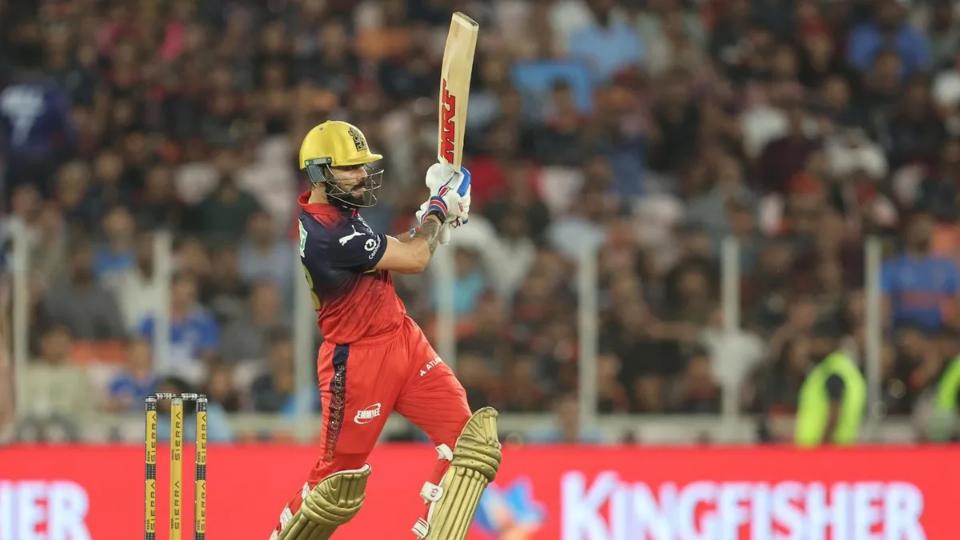
“I know my name is now attached to just promoting the game in different parts of the world when it comes to T20 cricket. I’ve still got it, I guess.”
That was Kohli, a faint smile accompanying the remark, two years ago. The comment came in response to a growing narrative that had begun to cast him more as a figurehead than a force, particularly ahead of the T20 World Cup in the USA and the West Indies. He had just struck 77 off 49 balls in a win for Royal Challengers Bengaluru against Punjab Kings, but two years later, the comment now reads less like a rebuttal and more like a marker of what was to follow.
If anything, the numbers since have only strengthened that assertion. After striking at 139.82 in the 2023 IPL, Kohli’s returns have risen to 154.69, 144.71 and 165.50 across the next three years, with the last two seasons coming after he stepped away from T20Is. It prompts a broader question: what has changed, and how has Kohli continued to refine his batting in the shortest format?
Virat Kohli – IPL strike rates
| 2023 | 2024 | 2025 | 2026 | |
| Overs 1-6 | 136.8 | 161.5 | 157.4 | 169.9 |
| Overs 7-15 | 134.0 | 136.9 | 132.0 | 163.5 |
| Overs 16-20 | 185.0 | 194.0 | 158.3 | 450.0 |
Going aerial and creating his own length
With Kohli, the change in 2026 is not confined to one phase of the innings. His Powerplay strike rate continues to climb, maintaining the upward trend of previous seasons, while his scoring rate in the middle overs, long seen as his area of control rather than acceleration, has also jumped sharply. The spike at the death comes from a limited sample size and offers less insight, but what stands out instead is a more consistent rise in scoring rate across the innings, rather than a late surge driving the numbers.
If the rise in strike rate explains where the change has come, detailed numbers also show how Kohli is getting there. According to CricViz, he is playing a lofted shot every 3.8 balls in 2026 (as of April 29), compared to every 7.3 balls across the previous three IPL seasons.
A lofted shot or an intentional attempt to hit over the infield rather than along the ground is a marker of attacking intent, even when it does not result in a six. Alongside this, his dot-ball percentage has dropped sharply from 15.3 to 8.7, while his boundary percentage has risen from 65.07 to 71.92, suggesting that the change lies not in output alone, but in how regularly he is putting bowlers under pressure.
What makes that shift more nuanced is how it is applied early in the innings. In the Powerplay, Kohli is attempting a lofted shot every four balls in 2026, compared to once every eight balls across the previous three seasons. The change, then, is about a batter looking to disrupt lengths and field settings earlier, rather than waiting to accelerate later.
Against pace, he has become markedly more fluent, with his strike rate rising from 157.6 between 2023-2025 IPL, to 175.7 in 2026. That improvement is underpinned by how he is approaching deliveries on a good length, traditionally a containing option.
The length balls have been struck at 208.5 in 2026, a notable jump from previous seasons, where he hit them at 131.8. Among batters to have faced at least 50 such deliveries this season, Kohli is the only one to strike at over 200 against length.
The approach against length is not simply a product of better timing. Kohli has been far more decisive with his footwork against pace in 2026. While his scoring off the front foot against length has seen a steady rise, from 174.8 between 2023 and 2025 to 200 this year, it is his willingness to move down the track against pace that stands out, with a strike rate of 220 when doing so this season – up from the 140.9 last year.
He is also the only batter this year to have advanced more than 30 times against pace overall, underlining how central it has become to his approach. It is a high-risk option, particularly against seam, where length can vary in bounce and movement, and is therefore rarely used by many. Kohli has been dismissed while advancing down the track thrice, also displaying the risks involved with this type of stroke play, but that makes its success here more significant.
Notably, his returns off the back foot have not seen a comparable rise, reinforcing the idea that this is not a reactive adjustment, but a deliberate move to meet the ball earlier and take control of length.
A similar pattern has been visible in ODIs in recent months. Since the South Africa series, Kohli has shown a greater willingness to take the aerial route, with his balls per lofted shot dropping sharply from 30.3 between the 2023 World Cup and the start of that series to 8.7 since. That has been accompanied by a rise in his attacking percentage and a sharper scoring rate against length, which has climbed from 79 to 101, suggesting that the change in intent is not confined to one format.
The spin worries remain
The most striking change in Kohli’s game this season has come in the middle overs, where his strike rate has risen sharply. There is, however, a caveat. Against spin, his returns have remained largely unchanged, striking at 127.1, slightly higher than the strike rate of 126.6 against the slower bowlers between 2023 and 2025, suggesting that this is one area where the improvement has been limited. In the middle overs in 2026, he is striking spin at 134.3, with just two sixes in that phase. If the surge between overs 7-15 is not being driven by spin, what explains it?
Part of the answer lies in how little of that contest he is now facing. In 2025, he faced 200 balls of spin across 12 innings; in 2026, that number has dropped to just 48 balls in six innings, down to roughly a quarter. That change has been shaped in part by Phil Salt’s approach at the other end. With Salt scoring at 231.25 against spin this season, opposition sides have been more reluctant to turn to it early, reducing its influence on Kohli’s innings.