

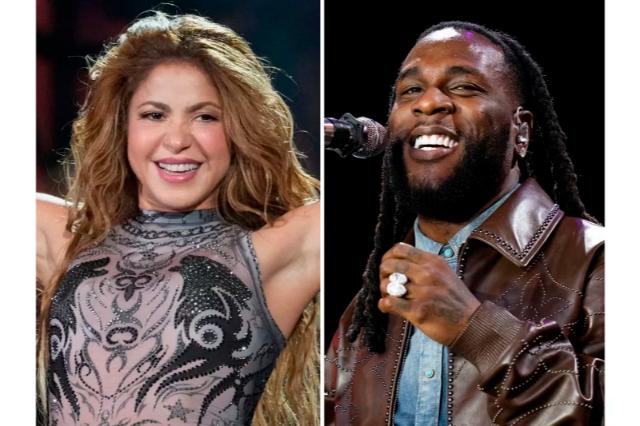
Shakira and Burna Boy, two of the biggest artists on the global stage, have joined forces for the official song of the 2026 World Cup.
“Dai Dai,” released on streaming platforms Friday, “captures the energy, passion and global spirit that will define the greatest show on earth,” FIFA said in a statement, adding that royalties from the song will support the FIFA Global Citizen Education Fund. It aims to raise $100 million for children’s education and soccer opportunities by the end of the tournament, which runs from June 11 through July 19.
The song’s title comes from the enthusiastic Italian expression meaning “come on, come on,” and its lyrics include the English, Japanese, French and Spanish equivalents.
The track blends Afrobeats with Latin Pop, sung mostly in English and a bit of Spanish. It’s sprinkled with inspirational messages, references to famous soccer players (“Pelé, Maradona, Maldini, Romário, Cristiano Ronaldo”) and the names of countries playing in this year’s tournament (“Brazil, Uruguay, Argentina, Colombia, U.S., England, Germany, France”).
“It has a lot of the typical signs of a good World Cup song,” says Eduardo Herrera, an associate professor of ethnomusicology at Indiana University whose work focuses on soccer chants and fandoms.
“But I think this is purposefully FIFA’s effort to have a successful song by bringing in artists that they know [are] going to appeal to at least two large numbers of the population, the Latin population and the sub-Saharan African population.”
Burna Boy is a Nigerian singer who is credited with bringing Afrobeats to a more mainstream audience through smash hits like “Last Last.” The so-called “African Giant” became the first solo Nigerian artist to win a Grammy Award (for best global music album) in 2021, and the first African artist to sell out a U.S. stadium (New York’s Citi Field in 2023).
And Shakira is no stranger to making World Cup music.
Her hit “Waka Waka (This Time for Africa)” helped define the 2010 tournament and eventually outlive it. It earned the Guinness World Record in January 2025 for “most streamed FIFA World Cup song on Spotify,” with over a billion listens at that point.
The Colombian singer also performed a special version of her song “Hips Don’t Lie” at the 2006 World Cup closing ceremony, and “La La La (Brazil 2014)” — which was featured on FIFA’s official album — at the closing ceremony in 2014.
“She’s … good at kind of incorporating elements or gestures towards other cultures,” Brent Keogh, a lecturer in music and sound design at the University of Technology Sydney, told NPR’s All Things Considered. “So she can kind of pull on these things and bring it into this global pop package.”
Shakira — along with Madonna and K-pop band BTS — will also headline the first-ever halftime show at this year’s World Cup final in New Jersey, which FIFA announced earlier this week. Fans are likely to hear “Dai Dai” there.
But that’s not the only place the song will pop up. And it’s also not the only song that may come to define the World Cup.