

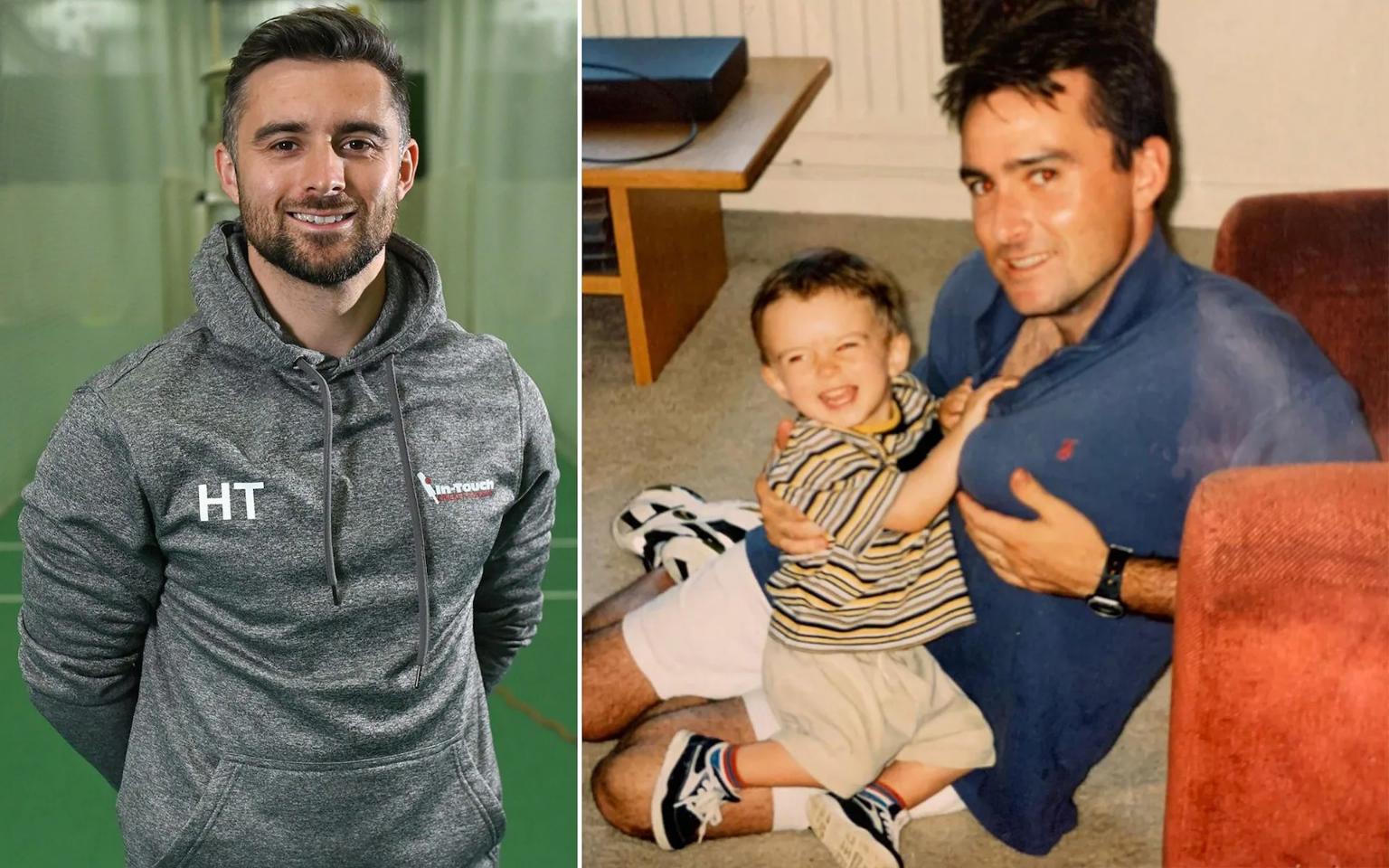
“This is the one I talked about,” says Henry Thorpe after sending a photograph he has in a frame at home, next to the St Christopher his dad gave to him as a child.
In the picture, Graham Thorpe is young, fit and smiling happily with his England career taking off. He is hiding a ball under his blue shirt, and Henry looks like he is trying to grab it, giggling like toddlers do.
Henry, the son from Thorpe’s first marriage, speaks poignantly about the photograph, which is laced with meaning many years later. He is speaking now for the first time since his father’s suicide more than 18 months ago and is candid about their, at times, “fractured” relationship, as well as his own subsequent mental-health struggles.
“I get most emotional about this because I’m 30 this year and looking back at that kid in that photo, and my dad who’s around my age now, little did we know what life was going to throw at us, and where it was going to take us, and how difficult it was going to be for each person in that photo.”
Henry’s parents divorced when he was young and the separation was bitter and public. For many years he had little contact with Graham. Both parents remarried and life moved in different directions.
They reconnected around 2019 and he says they had a “golden year” in the lead-up to the 2021-22 Ashes tour. They had coffee on Esher High Street just before Graham left for the Covid series in Australia, where the confines of pandemic life combined with the pressure of an Ashes took a huge toll on his father. It was the last time they met. Henry never saw his dad again. Graham fell ill with depression and anxiety after he lost his England job following the 4-1 Ashes defeat. He tried to take his own life soon after, and died by suicide in August 2024.
“I now genuinely get up and go to work and live my life for the kid in that photo, and the bloke in that photo who got whacked by the world. I try to do the right work for those people in that photo because I’m left here, and he’s not. That forms a lot of my decision-making with regards to what I do in life.”
It is one of two prized possessions Henry has of his father. “He gave me a little St Christopher when I was a kid and he was going on tour. He said: ‘Always keep it.’ I remember going on my first day of school years later when we moved to Qatar, and I wasn’t happy being there. I carried that St Christopher with me as comfort.
“The other thing he always said to me about being apart was that in the daytime, everything generally is fine. It’s at nighttime that your thoughts and feelings creep in. I’d always feel saddest at night when I was a kid and he’d gone away on tour.
“He said: ‘You can always look up and wherever I am in the world, I can see the moon, and wherever you are in the world, Henry, you can see the moon at night too and we can talk to the moon, we can talk to each other through it.’ So, now, even though he has gone, I talk to the moon.”
The resemblance is striking. Henry is of similar physical stature to Graham – short, stout and strong – and we meet at Fastlane cricket facility, just off the M25 in Surrey, where he has been in the nets coaching all morning, just like his father did with England.
Henry left his job at M&C Saatchi Merlin, founded and chaired by Richard Thompson, the current chairman of the ECB and former chair of Surrey, just after his father’s death.
He now juggles private cricket coaching at the In Touch Cricket Academy with working in the Surrey pathway as the under-13s batting lead alongside being a part-time cricket pro at a private school, and running his executive coaching company, Alignment Triangle Coaching, that he set up with a business partner. Henry is also involved in Thorpey’s Bat and Chat project, a 12-week wellbeing programme that involves cricket sessions at the Oval followed by chats about mental health.
“I didn’t feel like my life really went anywhere for the best part of 10 years. And then, after my dad died, it became very clear what I wanted to do. I want to throw cricket balls. I want to get in the dirt and work with players. The mindset-coaching has been an unexpected success. I love it.”
Henry has also been advised by former England football manager Gareth Southgate, after connecting on LinkedIn. The pair chatted online and Southgate shared contacts. “Gareth was at my dad’s day at the Oval last summer. I wasn’t having a great day, to be honest, it was a really tough day. I really wanted to talk to him but it just wasn’t right. I was on edge. I sent him a message on LinkedIn a couple of months later, not expecting him to ever see it. He wrote me an email of about 500 words. He was so kind in sharing his number and linking me up with other people that I’ve connected with since. From a leadership and a transformational culture perspective, he is a genuine hero of mine.”
Cricket is where he feels comfortable now, although it was not that way for a long time, and it only happened after unpacking his emotions with his dad. “There was a long period where our relationship was fractured because of the divorce. Me and my sister, Amelia, were young when Mum and Dad got divorced. Trying to get your head around, ‘Daddy’s got to go away’ was hard. We were used to him going [on tour] but he used to go away and come back. Now he wasn’t going to come back. My dad and my mum were both incredibly public in their separation. They didn’t agree and that impacted us as kids.
“We suffered as a result in terms of having a consistent relationship with him. His job didn’t help, make no mistake about it. Naturally, also, he got a new family too, with Amanda. My dad spent 2½ years in Australia, so you start to sit there and add it up and it’s like: ‘Right, OK.’ Those are what I call vacant years. I did what I could with the tools that I had available to me at the time. We had some small-scale interactions, but they were never overly purposeful or meaningful or consistent.
And who are we blaming for that? I think we blame life. There was definitely ill-feeling from what had gone on in the past, but actually the distance between everyone geographically made it really challenging.
“I drifted back to my dad when I was sort of in my gap year. We met up, went for a beer. We had a conversation. I said: ‘I’m a young man now and I need to understand different perspectives.’ I also need to be better at information gathering. And take more accountability for my own life, my own relationships. So that’s what kicked it all off positively. For a whole 12 months before he got unwell, me and Dad would walk his dog in Esher Woods and talk about batting.
“It was brilliant, and then he went on that tour to Australia. I remember him taking over from Chris Silverwood for the fourth Test in Sydney and him telling me what he was going to do, and how they should play it. And then what happened, happened.
“It was challenging because I didn’t know what was going on. No one really knew what was going on for a long period of time. For me, there was a lack of information at the time. I was told he’d had a stroke so I obviously sent as many messages of support as I could, wanted a call back but unfortunately I didn’t get to find out, actually, what happened to him until about six months later.
“That was really difficult. I spiralled off that. I lost a lot of confidence in myself. I was living on my own at the time. I was in a really dark place and people didn’t really understand or realise it at the time because it was highly functioning anxiety and genuine deep depression. I didn’t know the truth and if I had known what happened it would have been a lot clearer for me.
“But only a very small group of people knew and because my relationship was just with my dad, I didn’t have any other line of communication. No one reached out to me. It was difficult.”
Eventually Henry collapsed from mental exhaustion while playing cricket. “I hadn’t slept for days, a couple of months had been terrible. I was living with deep, deep mental-health issues and I didn’t realise at the time that my dad was suffering the same. I couldn’t understand why I hadn’t had more information and the next year and a half were absolutely horrendous. The chapter ultimately ends when my dad dies.
“Richard Thompson rang me when I was on the way to work. He said: ‘Where are you?’ He was like: ‘Henry, your dad died.’
‘How did he die?’ He didn’t know what to say. But what I will say is I’ve got so much love for Richard. His aftercare of me has been remarkable.
“No one ever prepares you for death, no one ever prepares you for your dad to die. No one ever prepares you for a suicide death. No one ever prepares you for your dad to be Graham Thorpe and to die like that. You could sit and talk about it for hours. At different phases of your life you wish you had done it all differently. All these feelings that it can create within you; anger, resentment and sadness. Also just genuine pride that my dad was who he was.”
Despite it all, there is a positive from what happened and Henry is keen for this to come across. He is adamant that what happened to Graham gave him clarity about his own life. The chats with his dad sitting on a bench in Esher Woods had a profound effect.
“During that time we got to share theories, ideas, talk about life and what’s actually important. Are you happy? Yes. Then that’s all that matters. Do you think something is right? Yes. That’s what you should do, then. You know, that calm, self-assurance that if it comes from a genuine, authentic place, whatever you feel, that’s what you should be doing. He ultimately set me on the path to freedom for myself.
“And that got me here now. It feels right doing what I do now, so I’m doing it. I quit my job and I’ve taken my life down this tangent because Dad’s ideas and thoughts were sort of ingrained within me. He gave me assurance that if something feels right, and you believe in it, you f—— do it. One of the most beautiful things was, regardless of how he was feeling at the time, he was still able to give me genuine, clear, life-changing advice.”
Last year I interviewed Jackson Warne, Shane’s son, and Henry echoes his opinion that amidst the grief, they are fortunate to be the sons of famous cricketers because of the public footprint left behind.
“I get to still live and breathe him, where some people never have a recording of their grandparent or parent speaking. I have interviews to watch back.
His mates have been incredible with me. Ali Brown, Alec Stewart, Jeff Banks, his best mate, who spoke at the funeral and is my godfather. The three of them have helped me so much. When I was a kid my dad used to take me to the Oval, and when he was batting Ali and I would play football in the changing room with Alex Tudor. I loved it. I remember just having the best days. Ali’s a great speaker, a great listener and I love talking to him.
“I found it hard to go back to Esher Woods, where my dad and I used to walk. We used to sit on the same bench and I used to sit in the same place. And on that bench we put a lot of it to bed. He was open and honest about his divorce from mum. I was open and honest about things I’d seen and, at the time, found it hard to understand because what does perspective look like aged 10? How do you have the right perspective to understand equal argument? Or balanced argument at the time? Who’s right and who’s wrong there?
“We put a lot of the world to rights on that bench and I’ve not been back. I can’t go, but Ali offered. He was like: ‘If you want to go, take a coffee, then we can just sit down, just not even speak.’ Stuff like that, people have been willing to step up for me.”
The boy in that photo has grown up. “Today, we are having this chat and then I’ll go home and I’ll talk to the moon tonight, or talk to his little picture and I’ll say to it: ‘I chatted about you today and I did four hours of coaching.’ What I will say is my dad ultimately gave me the greatest gift of all and that is my positive energy. He gave me my love for things and as a result of great suffering at his end, put me in this position now.”