

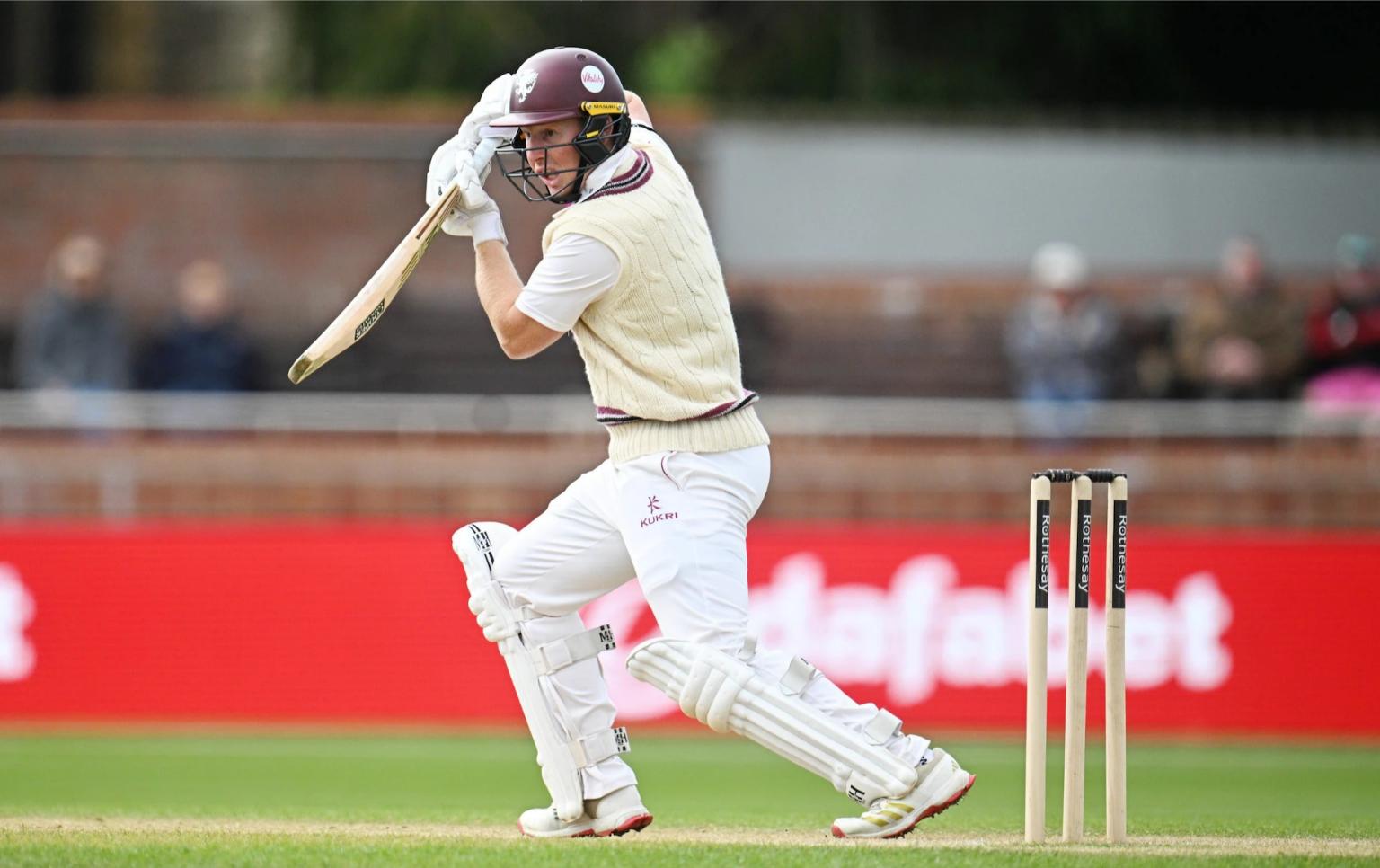
Although James Rew added no more than nine runs to his overnight 77 against Hampshire, before slicing a drive and being caught in the gully, some critics are already arguing that he has done enough to be selected for England’s Test side. But in what capacity?
Promoted to No 4 for Somerset this season, Rew has reeled off 64, 122, 48 and 86 – usually when his side are two wickets down for 20-odd – with the utmost composure that is his hallmark, even at the age of 22. Last season he was in England’s Test squad for the one-off Test against Zimbabwe.
The most vulnerable batsman in England’s Test side has to be Zak Crawley. Neither has he done anything so far for Kent this season, after failing to reach 30 in his four championship innings.
The case for dropping Crawley is strengthened by the fact that England’s first Test series of this summer is against New Zealand, whose attack is led by Matt Henry, and Henry has dismissed Crawley eight times, for fewer than 22 runs every time. Crawley’s defence has been exposed by Henry nipping the new ball back or away.
For this vacancy, however, Rew is not qualified. The time might come, even later this summer, when James opens Somerset’s batting and his younger brother Tom keeps wicket and bats in the middle order. The pair have been playing with and against each other since they attended King’s College, Taunton. But, as yet, the elder Rew keeps wicket and is therefore effectively barred from opening, as the two jobs are too much.
One of the criticisms of James Rew has been the allegation that he is vulnerable to the short ball, which would undermine his credentials to be an opener – or a specialist batsman of any kind. But there was little evidence of such a weakness when he faced the bouncers of the rapid Sonny Baker on a pitch of inconsistent bounce at Southampton and mostly ducked under them with his normal composure.
England’s pack can be shuffled without such a leap into the unknown. It is asking a lot of Jacob Bethell to return from the IPL, where he is currently bench-warming for Royal Challengers Bengaluru, and open the Test batting. Yet given the same Rew-like composure, Bethell has risen to every challenge so far. He scored 154 at No 3 in the Sydney Test, 105 off only 48 balls in the World T20 semi-final against India, and rustled up four wickets at the death of a T20 against Sri Lanka with his still-to-be-exploited left-arm spin.
Bethell’s upbringing in Barbados had him batting in the top three until he moved to England. Were Bethell promoted to open, the vacancy at three could be filled by Jamie Smith. Smith has been making a fine fist of it as a specialist batsman for Surrey, scoring two centuries in his two championship matches at No 3 this season.
Smith has always done a competent job for England as a wicketkeeper, but has never given the impression of being enamoured with the role. The first test of a keeper, traditionally, was: does he always want the ball? And Smith, quiet and demonstrative, seems happy to let someone else pick up the ball and throw it around the fielders. A noisy orchestrator, like Matt Prior or Alec Stewart, he is not.
James Rew could then come in as England’s wicketkeeper/batsman at number six or seven, depending on Ben Stokes’s preference. If England were to lose quick wickets and fall to 50 for four, Rew could bring his composure to bear. New Zealand, even if they have no great bowler, have a fine array of seamers. Five of them average below 30 runs per wicket in Test cricket.
Rew is not like his contemporaries in playing shots from ball one. He plays himself in, and quietly builds a first-class innings – 12 of which have resulted in centuries.
There is a question about Rew’s wicketkeeping: he is a left-hand dominant keeper. Keepers who have been left-hand-dominant have been as rare as hen’s teeth. George Sharp of Northamptonshire and David East of Essex have been two of the very few in county cricket.
But the game has changed since the last century. Left-handed batsmen used to be rare, but now they can form one-third of a Test team. Indeed, three of England’s top six in their last Sydney Test were left-handed. When right-handers are batting, it is helpful for a wicketkeeper to have the ball, when left alone or outside-edged, heading towards his dominant right hand. But if a large minority of batsmen are now, like Rew himself, left-handed, then there is little or no disadvantage in being a left-hand dominant keeper.
Meanwhile, James Anderson turns 44 at the end of July yet nothing about him has changed – except that he has become more parsimonious.
In what is surprisingly his first ever championship match at Bristol, Anderson began with an opening spell of six overs for seven runs. Truth be told, he was slightly wide and did not make Gloucestershire’s batsmen play enough.
But Anderson tightened up when he wrapped up the home side’s tail on the second morning. Like a masterchef given the end of a roast joint to carve, he sliced through what remained and took three wickets for all of five runs.
It is a pitch with a bit of nibble, and some batting has been loose and poor, but Anderson has barely declined from his peak. When Gloucestershire started their second innings 104 behind, Anderson squared up their captain Cameron Bancroft and dismissed him leg-before, giving him a day’s work of four wickets for 15 runs.
The figure is as trim as ever, the run-up the same gradual build-up before the unleashing, and all at the age of 43. The only difference is that, now he is Lancashire’s captain, he cannot disagree quite so openly when an umpire rejects one of his appeals.
In his first game of this season against Northamptonshire Anderson took six wickets for 80, in the second against Derbyshire eight wickets for 111. In all first-class cricket he has clocked up 1,161 wickets – and still counting – at an average of 24. The dominance of T20, and of the Hundred which he lambasted earlier this season (he “hated” every minute), and the decline in the amount of red-ball cricket, guarantee that his like will be never seen again.