

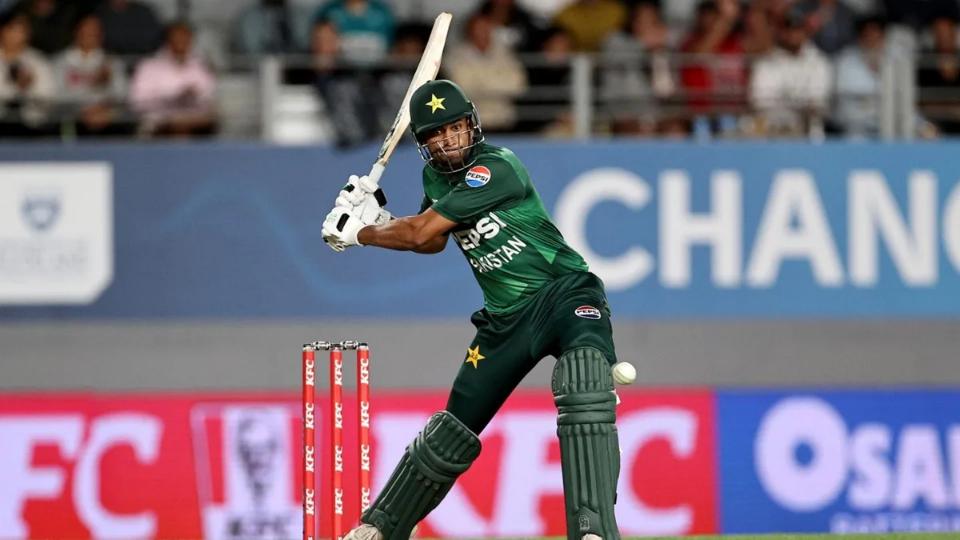
asan Nawaz was a superstar when he broke out for Pakistan last year.
It’s a strange thing to say about someone who made four single-digit scores in his first five innings, averages just about 21 in T20Is, has an international career lasting all of eight months and was eventually dropped for the T20 World Cup.
Nawaz’s 24 innings in a Pakistan shirt yielded 457 runs, scored at a rate in excess of 150. Shahid Afridi is their only other player ever to combine that volume with that scoring rate.
Clearly, it wasn’t what they wanted.
During last year’s Asia Cup, it was outlined in these pages that Nawaz had crucially been rewarded with a national call-up for his style of play in the T20 format. It appeared to be a shift away from the conservatism that has dogged Pakistan in the shortest format for the longest time. But now, it seems the selectors have reverted to type.
Two things made Nawaz unique in Pakistan’s setup; he would take on the bowling early in his innings, and he was a bonafide six-hitter. Players with these traits are what Pakistan have tended to either lack, or simply not pick.
Mike Hesson’s appointment as head coach seemed to be a step in the right direction, given his open admiration of Nawaz, and subsequent tweaks to Pakistan’s lineup to ensure Mohammad Rizwan and Babar Azam were either not playing or used only in specific scenarios that required their more old-school style of batting; take your time, get set and accelerate if you can later on.
Read more: Babar used to be Pakistan’s whole gameplan – now he has no clear role
Even dropping Nawaz may not have been the worst thing. After all, he had three wretched series back-to-back; a tri-series against Afghanistan and UAE, the Asia Cup and the home series against South Africa. He averaged 12 and struck at 114 across 11 innings.
The larger issue is Nawaz seems to think volume is his route back into the side.
Hasan Nawaz 2.0 is consistent – but is that a good thing?
Midway through the ILT20 in December, Nawaz began what has been a remarkable run of consistency. In 24 innings, he has recorded 23 double-digit scores, including 16 in a row across the ILT20, Bangladesh Premier League, Pakistan Shaheens’ series against England Lions, National T20 Cup and the ongoing PSL.
But this, naturally, comes at a cost and raises the age-old question of ‘consistency’ in T20 cricket. Is reliability an indicator of a good batter, or one who doesn’t take enough risks to ensure his team maximise the balls available to them?
Nawaz’s career split before and after he was dropped from the Pakistan side is stark. Until he was left out, his 55 career innings had seen him average 27 and strike at 147. In the 29 knocks since, the average has improved to 30, and Nawaz’s median score has gone up from 15 to 19.
The cost? A plummeting strike rate, from 147 to 127. This is no accident, either.
“When we picked hasan Nawaz as a guest player for our team, it was in my mind that only one thing was missing; the first two, three, four overs he played, he wasn’t able to survive,” Sialkot head coach Naveed Latif said during the National T20 Cup last month.
“Because of that, there was an effect on his performance. There is no doubt that he can hit easily; he is a good player and has the strokes to play all around the ground.
“So we spoke with him, worked a bit, gave him time and helped him with his mental approach. We had counselling with him to say, ‘Unless you survive those first two-three overs and get to the death overs, there is no use of your hitting.’ Hitting two or three fours or sixes in the middle overs, making 18 to 20 and coming back is no use. That 18 to 20 should be taken to 70 or 80.”
Nawaz finished top of the run-scoring charts in the National T20 Cup, no doubt a job well done as far as Latif is concerned. But he had the second-lowest strike rate in the top ten. In a sense, it lays bare the traditionalist thinking driving Nawaz’s slow march from genuine hell-raiser towards a more run-of-the-mill batter.