

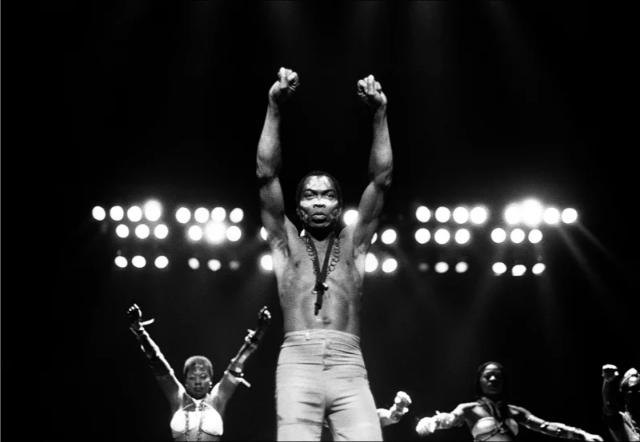
Editor’s note: This is an update of the profile published in December of the great African musician Fela Kuti. The original post was published when it was announced that Kuti would become the first African musician ever awarded a Grammy Lifetime Achievement Award. Now this week, he is on the list of Rock & Roll Hall of Fame inductees and again is a historic “first” — the first African pop star to be inducted into the hall.
Fela Kuti, the Afrobeat pioneer and activist who died in 1997, now holds two landmark honors.
On December 19, he became the first African musician ever awarded a Grammy Lifetime Achievement Award, joining an elite group of legends like The Beatles, Johnny Cash, Aretha Franklin, Bob Marley and Frank Sinatra — all recognized for making “creative contributions of outstanding artistic significance to the field of recording.”
This week it was announced that he is one of the musicians who will be inducted into the Rock & Roll Hall of Fame in 2026. He is being honored in the category of “musical influence.” The Hall of Fame paid this tribute: “Fela Kuti was a revolutionary voice who spoke out against injustice through his innovative music — provoking political change while infusing jazz, West African and soul music to pioneer the Afrobeat genre.”
(There are other inductees who were born on the African continent but moved to the United Kingdom or the United States before becoming famous. For example, Helen Folasade Adu, the lead singer and namesake of the newly inducted band Sade, was born in Nigeria. Dave Matthews, of the Dave Matthews Band, was born in South Africa. Freddie Mercury, the lead singer of Queen, was born in Zanzibar.)
Kuti has long been acclaimed by his fellow African artists. “Fela Kuti’s music was a fearless voice of Africa — its rhythms carried truth, resistance and freedom, inspiring generations of African musicians to speak boldly through sound,” says the legendary Senegalese singer Youssou N’ Dour.
Nicknamed the “Black President” for his role as a political and cultural leader, Fela is one of the rarified artists who’s recognized by a single name. He saw huge success as a pioneer of the Afrobeat genre, with its multilayered and shifting syncopation, psychedelic horns and chants. He was never nominated for a Grammy during his lifetime — although his musician sons, Femi and Seun, and grandson Made, have received eight nominations collectively.
A really big sound
Fela embraced a massive sound. His band often swelled to more than 30 members (including backup singers and dancers) and featured two bass guitars and two baritone saxophones. He himself played saxophone, keyboards, guitar, drums and trumpet (his first instrument as a child). His emphasis on complex polyrhythms and the inclusion of traditional African instruments like the talking drum were revolutionary at the time — a rebellion against the dominance of Western pop and a marked effort to forge a post-colonial African identity.
From the start of his career, Fela aimed to reach a larger and Pan-African audience by singing almost exclusively in Nigerian Pidgin English (rather than his mother tongue, Yoruba, which doesn’t translate throughout most of the continent).
He did not play by the rules of the music biz. He expressed disdain for party tunes and love songs. He’d release as many as seven albums in a single year. And he refused to perform songs live once they’d been recorded.
His music broke new ground with songs that could stretch to 45 minutes. One of his most famous albums, Confusion, was composed of a lone tune broken into two sides, Confusion Pt. I and Confusion Pt. II — the first half entirely instrumental.
BCUC (Bantu Continua Uhuru Consciousness) from Soweto, South Africa, the incendiary live band and 2023 winner of the WOMEX Artist Award, sent a statement to NPR: “Fela is our spiritual muse and if he didn’t pursue music without boundaries of song length and speaking his truth — even when it was putting his life in danger — we wouldn’t have had the guts to be ourselves without fear or favor.”