

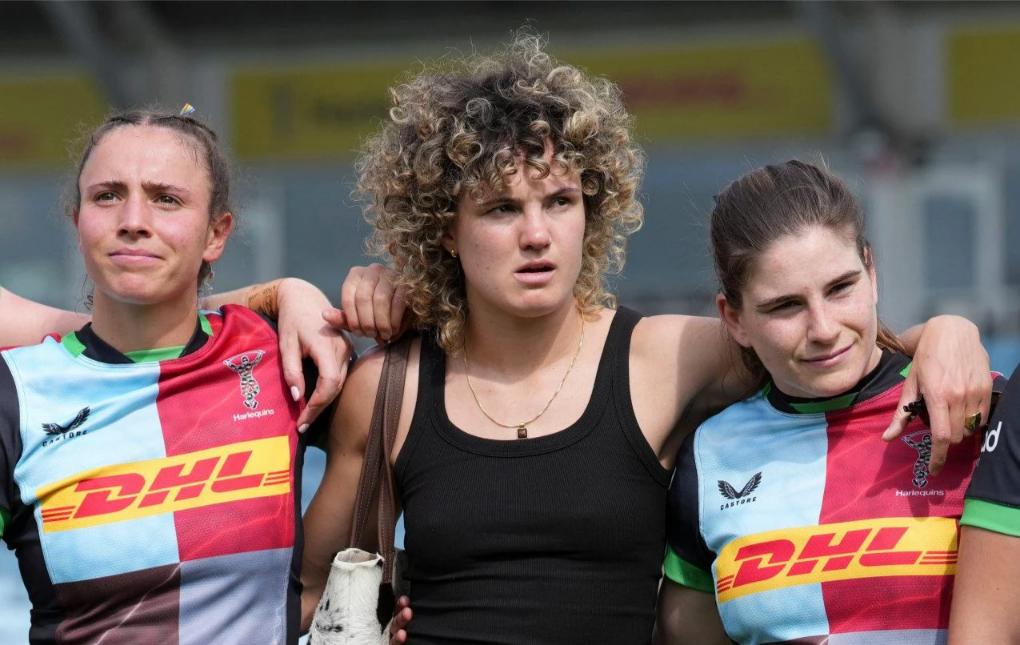
The noise around Ellie Kildunne’s departure from Harlequins is an adequate measure of how the landscape in women’s club rugby is changing.
Given how the news of her exit was disseminated, it was clear that the relationship between Kildunne and Harlequins had become fractured beyond repair.
Rather tellingly, the Red Roses full-back was not even quoted in the four-paragraph-long statement that Harlequins issued on Monday, instead publishing her own cryptic Instagram post in which she revealed she was “gutted” to be leaving the west-London club.
“After five years at Quins, it’s hard to put into words how much this place has meant to me,” she wrote. “I’ve shared so many moments here – on the field, in the changing room, and with friendships that will stay with me long after I leave. I’ve always tried to be the best player I can be, giving everything I have every time I step on to the pitch. For me, that’s always been about being in the right environment – one where I can be unapologetically myself and work with those who truly value each individual and what they bring to the team.
“I’m incredibly grateful to the supporters and my team-mates who have inspired me to play the rugby I love. Things may not always be in our control, and I’m gutted to be leaving, [but] I wish everyone at Quins the best for what’s next, see you on the pitch.”
With Harlequins having played their last game of the regular Premiership Women’s Rugby season, there will be no home send-off at the Stoop for one of the biggest names in the game.
It paints a picture of a player who ultimately became unhappy at the club where she spent five years. Kildunne was dropped from Harlequins’ starting XV before the Women’s Six Nations, missing out on the club’s marquee “Big Day Out” fixture with Bristol at the Principality Stadium in Cardiff on March 28. Against a Bristol side who have struggled for form and consistency this season – plummeting from the highs of their Ilona Maher hype last year – Harlequins lost 17-14 in what would prove a serious blow to their play-off ambitions.
Telegraph Sport understands Kildunne’s punishment was mainly because of her timekeeping. According to a well-placed source, she was repeatedly late to team meetings. Her relationship with head coach Ross Chisholm – a person who is familiar with the rigours of professional rugby, having made 128 appearances for the quartered shirts at full-back – is said to have become strained as a result.
Kildunne’s lack of punctuality is something that this paper is familiar with: she was more than an hour late to a Telegraph Sport interview earlier this year, while her tardiness is common knowledge among Red Roses team-mates. If she had one superpower, what would it be? “To be able to pause time. I would use it all the time, like when I’m running late for training,” she joked in a separate interview with Telegraph Sport last year.
The World Cup winner is also understood to have on at least one occasion prioritised a commercial opportunity over a team social. Such a decision is unlikely to court much controversy, especially given that her central contract with the Rugby Football Union is a fraction of what an England men’s player earns. You can hardly blame Kildunne – a player in her heyday in a sport hardly flush with millions – for wanting to maximise her earnings off the pitch. And yet, these sorts of choices are likely to have landed awkwardly with the rest of the playing group.
It nevertheless presents a fascinating insight into a cultural dichotomy opening up in women’s club rugby. With more than 230,000 followers on Instagram, Kildunne – last year’s BBC Sports Personality of the Year runner-up – commands a greater social media presence than most England men’s internationals (for comparison Henry Pollock – now managed by Eddie Hearn – has 290,000). Her social footprint is greater than those of Premiership Women’s Rugby and Harlequins Women combined, meaning she will be a huge marketing asset for whichever club she signs with next.
Should Harlequins have worked harder to keep the player they unapologetically plastered over match-day programmes and marketing campaigns? Perhaps. Kildunne’s exit is a significant blow to a club earning quite the reputation of letting Red Roses players go (Abbie Ward and Rosie Galligan are among big names to have left in recent years). It is becoming a source of disgruntlement among fans.
Naturally, the rumours are already swirling around where she will sign next. Sale raised eyebrows with a trio of lucrative signings last week, announcing England’s World Cup-winning captain Zoe Stratford, Tatyana Heard and Sarah Beckett, with the club promoting their northern roots.
As someone who comes from Keighley in West Yorkshire, Kildunne would certainly fit that mould, although she is understood not to have entered into talks with Sale. Ealing Trailfinders are geographically the closest club to Reading-based Kildunne and the opportunity for her to link up with her fellow “cowboy” and England room-mate Meg Jones is an enticing one.
With PWR clubs governed by a salary cap of about £255,000 – leading Red Roses are thought to command club contracts topping no more than £25,000 – money is not likely to be one of the motivating factors. One thing is certain: this England poster girl will not remain without a club for long.