

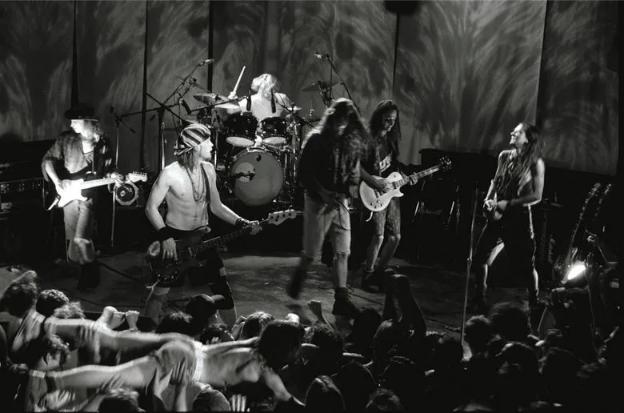
I can’t pinpoint the moment precisely, but at some point in my childhood, I came to believe that rock bands were going to be a much more important part of my adulthood than they’ve ended up being. Perhaps it was the many portrayals of garage bands I ingested via films like Freaky Friday (2003), Jennifer’s Body (2009), and Diary of a Wimpy Kid: Rodrick Rules (2011), or The Killers and Green Day soundtracking various suburban-set, coming-of-age films and CW originals throughout the 2000s. My family car rides were accompanied by a wide range of bands from Guns N’ Roses to No Doubt, along with anecdotes from my parents about the concerts they attended in the 80s. Born and raised in Seattle, I learned very early on that grunge band culture was baked into the fabric of my city. Eddie Vedder and Chris Cornell were among my mom’s top celebrity crushes.
When I was in middle school, harder rock gave way to indie, with bands like The 1975 and Arctic Monkeys being among the trendiest groups to stream. Millennials, who were then the older siblings and babysitters of my close friends, favored Passion Pit, Cage the Elephant, and Kings of Leon. I, lamely, stanned 5 Seconds of Summer, and attempted to get into bands they cited as inspiration, like Blink-182 and Good Charlotte, which is very brave of me to admit, everybody clap.
Young adulthood, according to the movies, was a montage of catching a friend’s band play at a local bar and bumping into your soulmate in the crowd, or being the dreamy girl in the front row, swaying with her eyes closed, adrift in the music. On and off screen, the more obscure-sounding your favorite band was, the more culturally attuned you were. Those who revered pop stars were ditzy, shallow, and artistically underbaked. Those who listened to bands that played real, loud music, with real, weighted instruments were emotionally in-touch cerebral tastemakers. This was at least the world as I saw it, as a girl who felt a natural draw to melodramatic pop stars, but ventured deep into the annals of indie bands’ discographies in an attempt to convey good taste and high intellect.
Today, however, rock bands, and bands in general, have dissipated in mainstream culture. They’re undoubtedly still around, and I’m sure many of you listen to them. But they don’t play as big a role in monoculture as they did decades ago.
A couple of years back, the podcast The Rest is Entertainment pointed out that in the first half of the 1980s, there were 146 weeks in which a band held a number one chart position. In the first half of the 1990s, there were 141 weeks when bands held a number one spot. But in the first half of the 2020s, there were only three weeks in which a band reached the top chart position.
For The Guardian, Dorian Lynskey ponders the many reasons why bands have fallen off. While the pop genre has always been dominant, it seems to encompass even more mainstream listenership than it did in decades past, nudging rock and even hip hop closer to the periphery. There are several reasons for this. For one, the barrier to entry for making bedroom pop on your computer is far lower than garage rock; no instruments or rehearsal space required.
Lynskey also writes that selling multiple personalities to audiences is much trickier than launching a single one. It takes much more skill to convey the idiosyncrasies and dynamics of a group, and perhaps a longer form of media and a sturdier attention span. He writes that the MTV era of televised music programs made formalized band introductions more straightforward. Today, most people are finding new music through Spotify and TikTok algorithms, both of which remove artists from their particular contexts, compiling them into a kind of monotonous sludge of clips and soundbites on a feed. Lynskey points out that even the portrait orientation of an iPhone video for a TikTok is more tailored to a solo artist than a group, as you can’t fit everyone in the frame.
The punchiest voice always wins online, and the voice of a group is naturally a bit more muffled. Unless, of course, the group is a pop boyband or girl group, in which every member is engineered to be highly singular, each person fulfilling a different, but equally potent archetype. In a rock band, the separate players, while impressive on their own, are their most extraordinary when put together.
Interestingly, just because there’s less mainstream noise surrounding bands doesn’t mean there isn’t a curiosity about them. The cross-generational enthusiasm surrounding Geese makes this abundantly clear. As does the internet’s tendency to romanticize Fleetwood Mac’s 1997 “Silver Springs” performance, in which Stevie Nicks sings the bridge directly to Lindsey Buckingham, which was later replicated in the YA novel turned Amazon Prime series Daisy Jones and the Six. There’s clearly a mild interest in the relational drama that can unfold within band dynamics.