

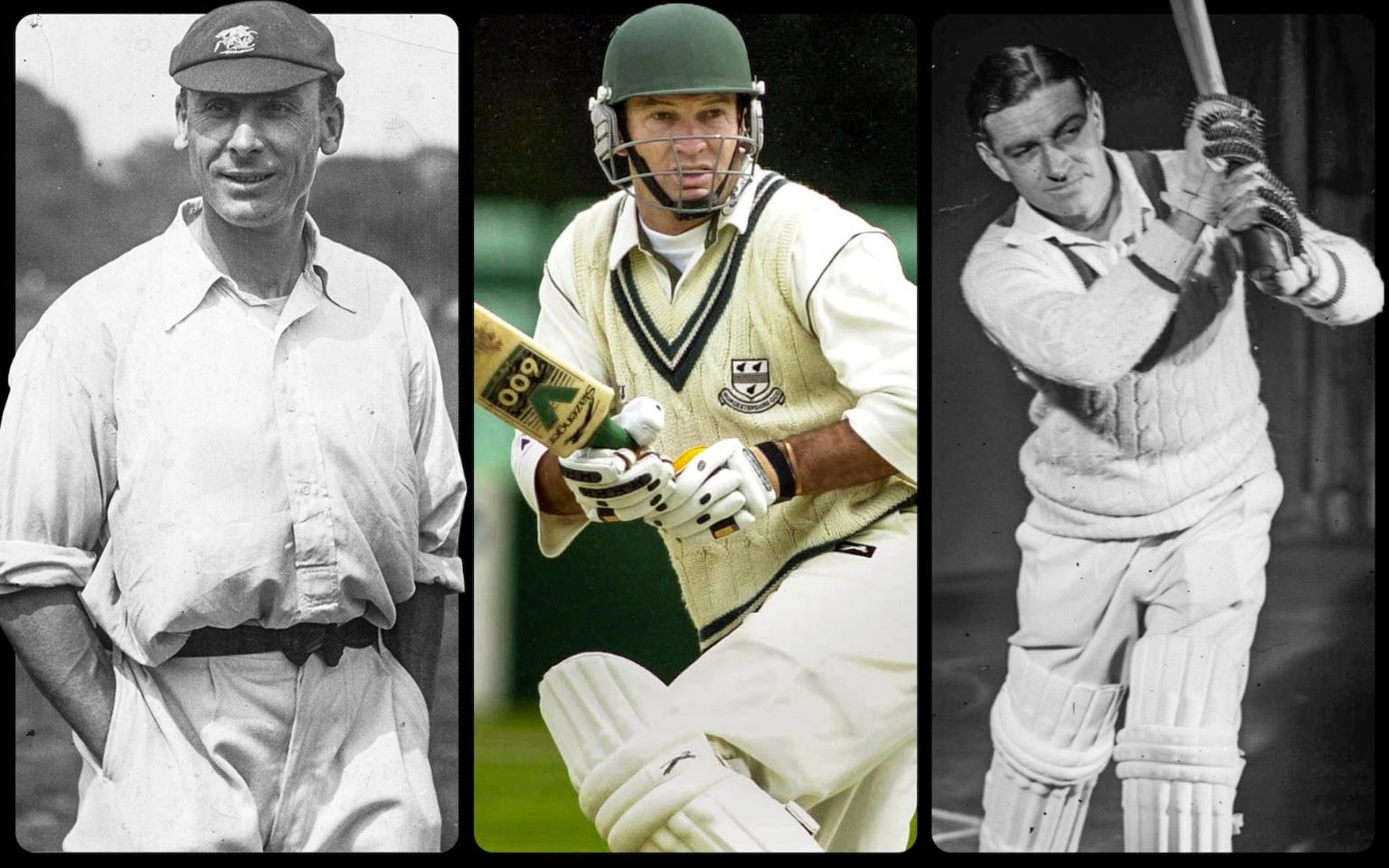
This best County Championship XI has been selected with a starting point of 1890, when the competition was officially organised and WG Grace was past his prime, and a finishing date of the year 2000 – find our greatest of this century here.
If Grace were available, he would insist on opening the bowling, and on opening the batting, which would ruffle the feathers of either Sir Jack or Sir Geoffrey.
Two overseas players are allowed, as in the period of 1968-79, when the championship was in its modern heyday.
1. Sir Jack Hobbs, Surrey, 1905-1934
He scored 38,737 runs in the championship, the third most, in spite of missing four seasons to the First World War. He could play all round the wicket, whereas his great contemporary Wally Hammond did not hook or pull. His signature was the quickness of his feet, not only when playing forward or back, but when fielding at cover point. In which case he will make the ideal partner for Sir Geoffrey Boycott when it comes to running between wickets.
2. Sir Geoffrey Boycott, Yorkshire, 1962-1986
It is astonishing that he averaged 58.27 when championship matches lasted only three days, although the second half of his career was played on covered pitches. That means Yorkshire seldom lost in his time – and he did score more quickly for Yorkshire (his captain Brian Close made sure of that) than he did for England. So he pips Herbert Sutcliffe to open with Sir Jack. And yes, some perfect strokeplay, too, especially that back-foot force through the covers.
3. Wally Hammond, Gloucestershire, 1920-1946
Style secures his place, especially his off-side driving on back foot and front, whereas in Ashes Tests the Australians learnt how to contain him on leg stump. For example, in 1934 he averaged 125 for Gloucestershire but did not reach 50 in the Ashes series. Overall he scored 31,344 championship runs at an average of 56, not to mention his being England’s best slip before the modern era, and his fast-medium bowling and his off-spin. Not a candidate for captaincy of this XI, although he often led England: too aloof.
4. Graeme Hick, Worcestershire, 1984-2008
The first batsman of modern times (i.e of big bats and power hits) to dominate the championship: his unbeaten 405 against Somerset was just one example, in 1988, when he was the last person to score 1,000 first-class runs before the end of May (but one match was not in the championship, for MCC). His happiest days were when he arrived fresh from Zimbabwe and turned Worcestershire into a championship-winning side. Still a much-loved figure at New Road, dominating the ground with the pavilion named after him.
5. Frank Woolley, Kent, 1906-1938
The statistician would argue the case for Phil Mead, who scored 46,268 runs for Hampshire, the most ever in the championship, and 2,843 of them in 1928, the most in one season – but Hampshire only finished 12th. Mead had a cautious, crabby style, so he is overtaken by the man with the second highest aggregate: Woolley, with his 43,703 runs. In the 1930s, when too many batsmen played cagily off the back foot, Woolley was the exception with his free swing of the blade. His left-arm spin also took 1,578 championship wickets, mostly in his younger years, and he made 712 catches, the most by any fielder in the championship and normally at slip.