

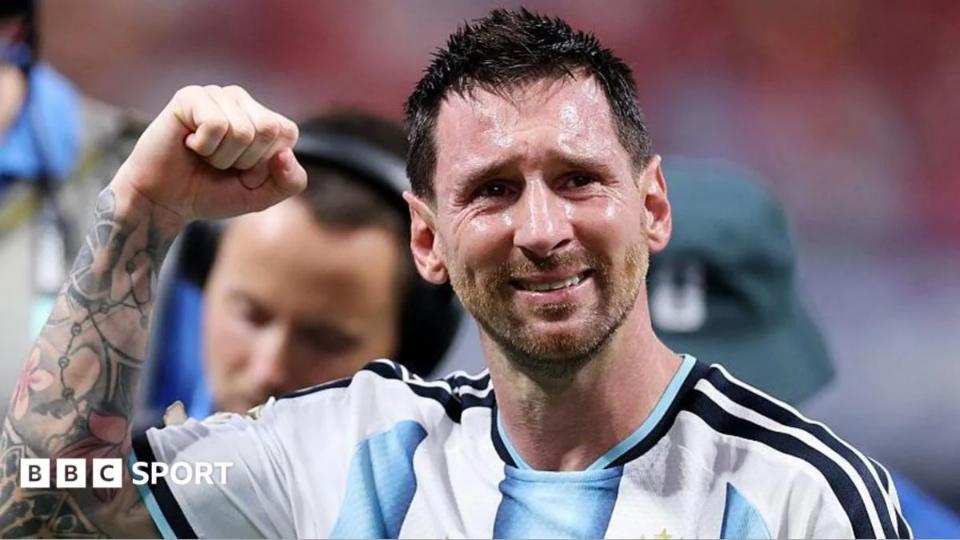
If Argentina are to become the first nation to successfully defend their World Cup crown since 1962 – and just the third ever – then Lionel Messi will have been at the centre of it.
The 39-year-old has sparkled at his sixth World Cup – a joint record with Portugal’s Cristiano Ronaldo and Mexico’s Guillermo Ochoa – scoring eight goals and providing three assists.
But while Messi leads the Golden Boot race with France striker Kylian Mbappe, the global audience has seen a very different Messi from the one who made his debut for Barcelona in 2003.
Argentina will renew a historical rivalry with England in the semi-finals on Wednesday (20:00 BST) at Atlanta Stadium, when the attention will fall on Messi once again.
Most players decline. The elite ones find ways to adapt. Ronaldo reinvented himself as a penalty-box predator when his pace went.
Messi has not adapted to decline. He has adapted so he can dominate and stay ahead of a game that has always been chasing him.
At this World Cup, he has been creating more but moving less. He has had 33 shots and created 21 chances, the most combined (54) since Diego Maradona in 1986.
He has managed this despite walking 47% of the distance he’s covered, the highest percentage of any outfield player.
Messi has averaged the shortest distance of all Argentina outfield players to have featured for 20-plus minutes at the tournament – covering just 8.2km per 90 minutes.
The stats do not stop there. He is averaging just 2.7 sprints per match, compared to 5.3 just four years ago.
England will have to do something only Poland have managed in Messi’s past 15 World Cup appearances – stop him from scoring or assisting. He has 16 goals and seven assists in those 15 games.
Since that 16-year-old made his Barca debut in a friendly against Jose Mourinho’s Porto, playing on the right, dribbling and often cutting inside, Messi has reinvented himself at least five times to evolve into the player he is now for Argentina and Inter Miami.