

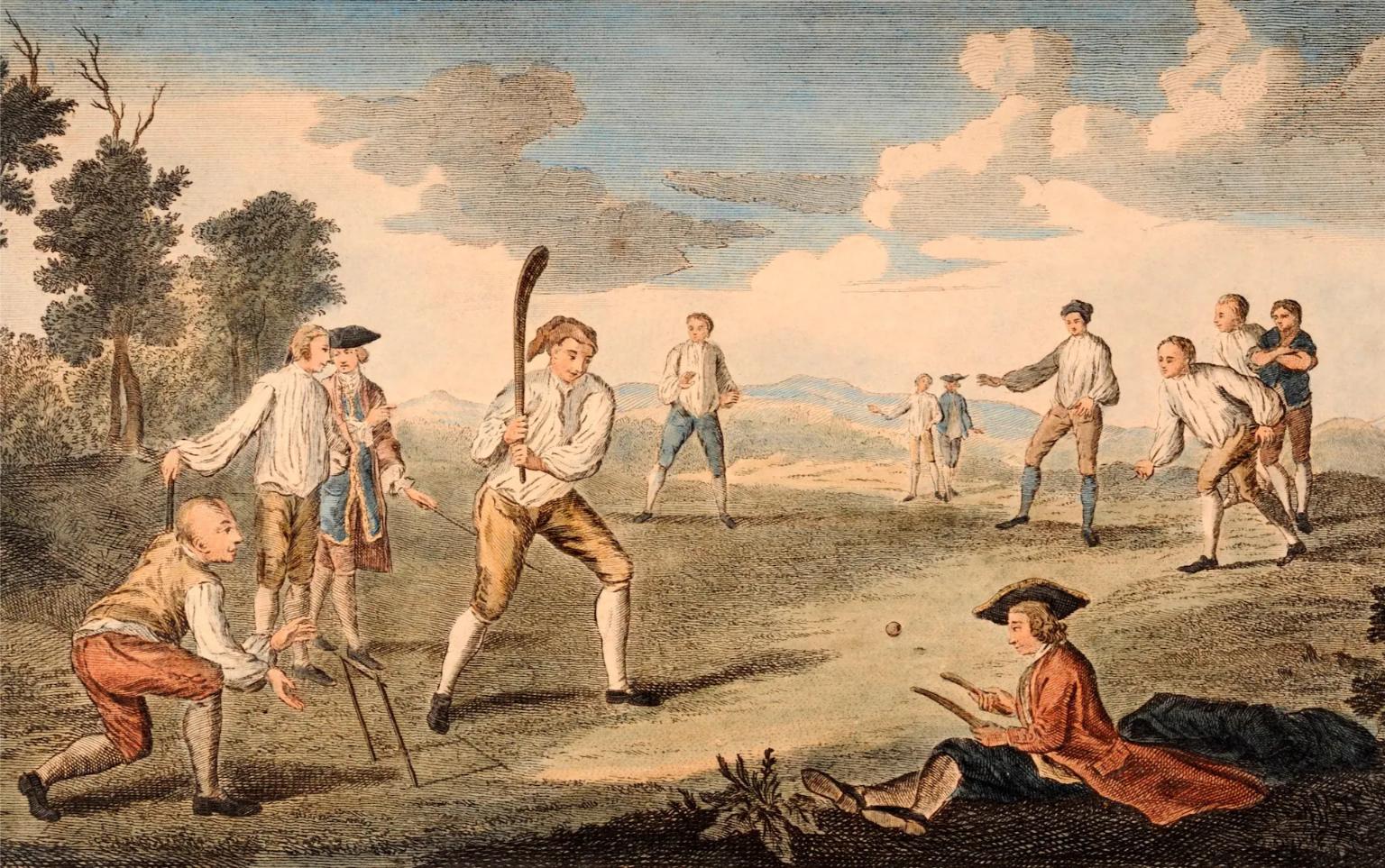
Cricket’s position in English society was established almost 300 years ago. The match played on June 18, 1744, was so exciting that ever afterwards the sport would have its place, not least because it attracted royal favour.
The match was between Kent and a team styled All England, though cricket was then confined to the south east of the country. It is the first match of which we have a report in English (there was one in Latin), and the first recorded instance of a charge for admission, for this game is nothing less than the start of the commercialisation of leisure. It is the second oldest of which we have a scorecard.
The crowd at the Artillery Ground in Finsbury, London, was numbered at 10,000, including Frederick Prince of Wales and his younger brother, “Butcher” Cumberland as he was soon to be known after the Battle of Culloden. And they attended the game partly because they liked cricket – Frederick can be considered the first captain of Surrey – but also to make a political statement.
Long before the Brexit referendum, English society was split between those who viewed Britain as part of Europe and those who did not. The king reigning in 1744, George II, led the Britain-in-Europe campaign: he was, firstly, the Elector of Hanover, and very German. He loved Handel, hunting and fighting, and was the last British monarch to lead the Army into battle, in 1743 at Dettingen. But the English taxpayer hated his costly participation in the Wars of the Austrian Succession.
When the Prince of Wales turned up at this cricket match, he was presenting himself as the pro-English and anti-European alternative to his father. Frederick had befriended the most popular politician in the land, William Pitt the Elder, who was all for getting out of European wars and cutting taxes. Frederick had also commissioned the song which caught on: Rule Britannia.
Kent bowled first. Their opening bowler was William Hodsoll, aged 25, a tanner by trade; and an over consisted of four balls. Not until 1900 was the six-ball over introduced. Some bright spark thought the five-ball over was worth a go in the 1890s, but it was discarded as unsatisfactory – until another bright spark devised the five-ball set in the Hundred.
Hodsoll bowled under-arm, as over-arm was not legalised until 1864, and he must have been quick by the standards of the day. The match report says that the ball delivered by Hodsoll “whizz’d along with unimagin’d Force”. All England collapsed to a score of three runs for five wickets. Hodsoll took at least three, maybe more: if a batsman was out, the scorer credited the fielder only, not the bowler as well.
The reporter at the game was only 23 years old, and a bit of a lad who played cricket himself, for Richmond, where he worked in the theatre. James Love (a pseudonym for James Dance) had his mistress – a French actress – as well as a wife to support. To raise money, he composed a long and witty poem about this game, had it published the following year, and sold copies for one shilling. He also wrote a fawning dedication to Lord Sandwich – he who is commemorated at many a tea-time – and who was such a blundering old fool, with at least nine illegitimate children, that the epitaph proposed for him was: “Seldom has any man held so many offices and accomplished so little” (we all know the sort).
So much has changed in cricket and yet so much has stayed the same. A cricket match is still set in motion by the toss of a coin, as then: the captain who guesses correctly wins the right to bat or bowl first. Almost three centuries later, this practice remains intact – after numerous alternatives have been proposed, for example, the visiting side should be allowed to choose, or that the right to decide whether to bat or bowl should alternate in the course of a series.
The pitch is still 22 yards long, and the ball still weighs between five and six ounces. Homo sapiens must have grown 10 per cent taller, and bowlers almost seven feet high are pounding the ball down over-arm. Yet the pitch is the same length as when Hodsoll bowled under-arm, probably without any run-up, at batsmen who wielded a bat shaped like a hockey stick, because the ball would come from a low trajectory and might bounce more than once.
The stumps back then were only two in number, spanned by a single six-inch bail. Nice to be beaten all ends up but hear no death rattle as the ball passed between the stumps (a third was added in 1775). Batsmen and wicketkeepers had no gloves or pads to wear until the early Victorian era. Leg before wicket was not a mode of dismissal then, but a stumping was recorded in this match.
The Laws of Cricket, as a formal code, were first introduced in 1744, devised by members of the Honourable Artillery Club. The main motive for writing down the laws was to solve gambling disputes. In Georgian society almost everything that moved seemed to be the subject of a bet; horse racing and boxing were all the rage; and enormous sums of money could be staked. This cricket match was being played for 1,000 guineas a side. Don’t want any disputes or fisticuffs, do we?
At this stage, when All England had scored three runs for five wickets, entered the premier batsman of his time. Richard Newland came from Slindon, the Sussex village which had been the strongest cricket team in the land thanks to the patronage of the Duke of Richmond, losing only one of 40 matches. Newland was a left-hander; and we might guess that the bowler stayed over the wicket, and bowled across him, giving him width and the chance to demonstrate that left-handed batsmen are prettier. Such was the fashion until right-arm bowlers switched to round the wicket for left-handed batsmen around a decade ago.
If we reckon that a run then was worth three or four times its current value, Newland’s 18 not out was the equivalent of 50. England totalled 40 all out (120-160?). At which point the royal party arrives and, I would guess, takes their seats in Armoury House, the fine Georgian building completed 10 years before this match, there to watch through open windows. Ordinary spectators had to buy their tickets, at twopence each, at the other end of the ground, and come through the Pyed Horse inn, whose landlord, George Smith, held a lease to stage entertainments on the ground. Smith was a cricketer himself and indeed played for the All England XI.
In reply to All England’s total of 40, Kent’s batting was opened by Lord Sackville, who had assembled the team, effectively his team. Now this Kent v All England game was one of two fixtures. A few days earlier the first leg had been staged at Coxheath, the result unknown: my guess is that Kent lost, and Sackville was then on course to lose a lot of money he could not afford. For certain, for this return game, Sackville did not captain Kent. He played, and opened the batting, but he did so under the captaincy of Val Romney, the head gardener on his estate at Knole Park. Consider what was happening around this time at Versailles, and the strict hierarchy of French society, and this appointment is astonishing. (England’s national cricket team were to be captained by an amateur until 1952.)
To win cricket matches, and bets, a small handful of nobility – another was the Duke of Richmond, a spectator at this game – were employing the best cricketers on their estates, maybe as a gardener, like Romney, or a groom. In any event, Sackville, as an opener, contributed five runs to Kent’s first innings – not so bad when three of his team-mates made ducks – and Romney, a fine athlete by Love’s description, scored 11, and Kent totalled 53, a valuable lead of 11.
From where does the concept, very fashionable at present, of the second chance come? You know: “we all deserve a second chance in life, don’t we?” It does not stem from theology: you pay the price for your sins, unless you confess and do penance. But we have decided that it is only fair for a transgressor to be given “a second chance” – and I wonder whether it stems from these cricket matches of the 18th century. Rough hand-scythed pitches, which stacked the odds in the bowler’s favour, allowed time for each side to have a second innings in one day. Six All England players scored a duck, as well as three of Kent’s. Never mind, old boy, you’ve got a second chance!
Sure enough, none of the All England players score a duck in their second innings. Hodsoll is again among the wickets, taking at least four, but every batsman offers his mite. Thomas Waymark scores nine runs; he works for the Duke of Richmond as a groom and is a capital cricketer, specialising in single-wicket and double-wicket matches. Newland weighs in again with 15, to go with his 18 not out; and Smith finds the time and concentration to contribute eight runs.
Love’s poem told us that Smith at some stage had to arm himself with a whip to keep the crowd – about 8,000 paying spectators, along with 2,000 Honourable Artillery Company members who entered for free – behind the boundary rope, because they are spilling forwards in their gambling zeal. An advertisement in a London newspaper of the early 1730s had informed readers about a match on a ground that would be “roped out”, but this is the first report of a boundary rope being definitely used to hold back spectators. Love records that a player called Bryan, a bricklayer by trade, hit a ball that went over this rope and he and Newland ran five runs before the ball came back, so the ball was in play even after it had passed the rope.
All England added 70 to their first innings of 40, which left Kent needing 58 to win. As wicketkeepers are normally overlooked, a word here for Kent’s keeper, Kips, who did not concede a single bye: quite a feat, stopping all those grubbers, without gloves we must assume. Kips was also the first wicketkeeper/batsman of note: he alone of the Kent side, along with Newland of All England, reached double figures in both innings.
Nothing like a run-chase, the fifth and final act of a play. Spectators cheer every run, even every ball. “Winning is everything” and even more so when thousands of guineas rest on it. An All England bowler surnamed Newland is among the wickets, taking at least four: it could be Richard, or it could be one of his two brothers who were also in the team. I imagine Richard bowling brisk left-arm, firing the ball in, albeit under-arm, and letting the pitch do the work. He used the money he earned through cricket to qualify as a surgeon.
Kent lose so many wickets that when their last pair come together, they still need a few more runs, perhaps as many as five (the scorecard does not record the score at the fall of each wicket). One of the last pair is Hodsoll, who has had a busy day – he has taken a minimum of eight wickets – while his partner is John Cutbush, a clockmaker from Maidstone; and time stands still when, with three runs to win, one of them sends the ball skywards. (I suspect Hodsoll, who would have had an all-rounder’s confidence in going for the big, match-winning hit.) Or in Love’s more felicitous phrase:
The mounting Ball, again obliquely driv’n,
Cuts the pure Aether, soaring up to Heav’n.
(Love composes in a mock heroic style: he is imitating Alexander Pope, the celebrity of the day for his The Rape of the Lock.)
The fielder under the ball transpires to have been one of All England’s finest:
Waymark was ready; Waymark, all must own,
As sure a Swain to catch as e’er was known.
But catching is one thing, catching at the climax of a match is quite another. Love reports that Waymark reached for the ball with “outstretch’d hand” – then dropped it. And Kent won by one wicket.