

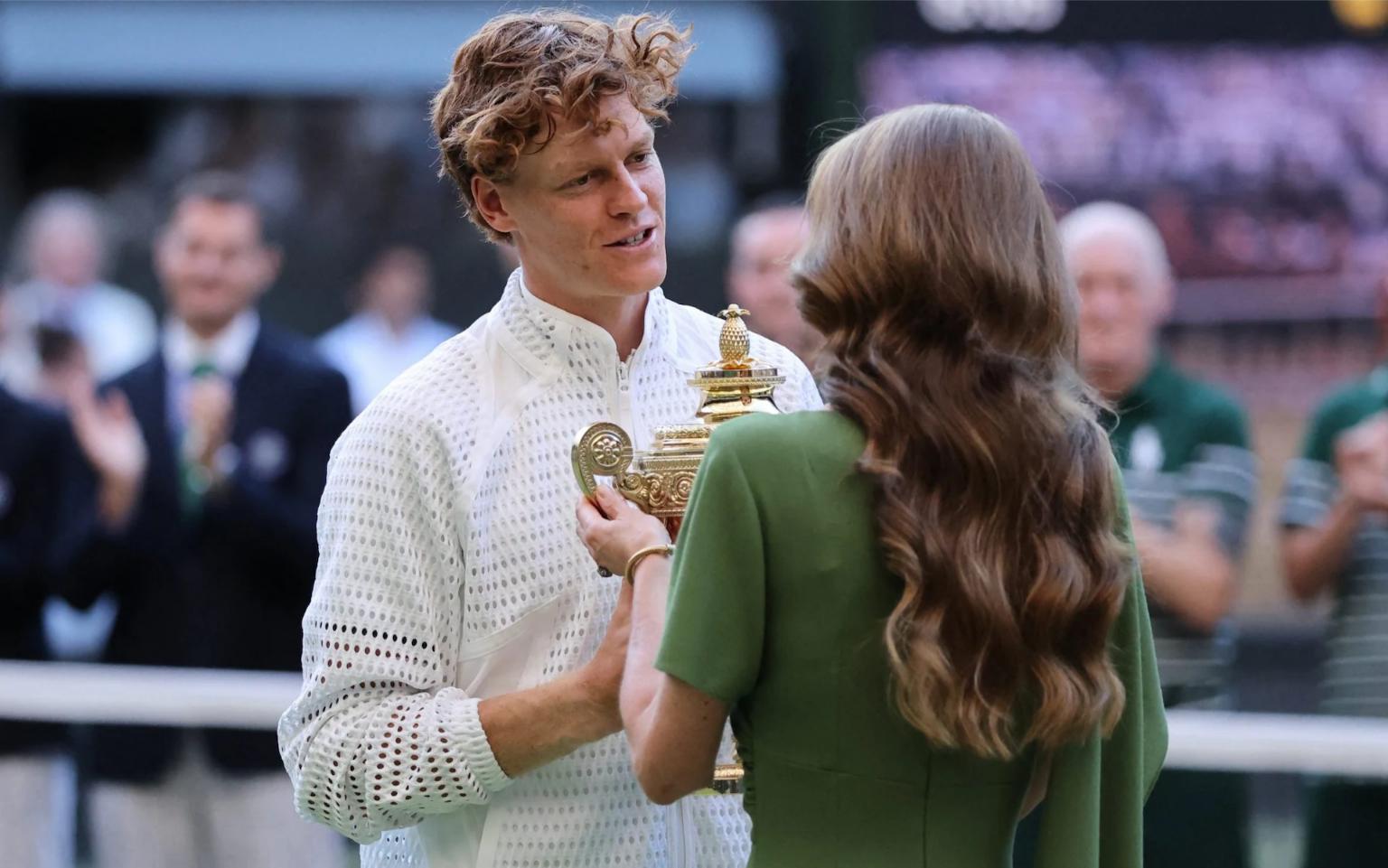
The heavy artillery rolled out at Wimbledon on Sunday as world No 1 Jannik Sinner successfully defended his men’s singles title amid a fusillade of aces.
After the deftness and artistry of Saturday’s women’s final, Sinner’s collision with Alexander Zverev was a contrasting study in power. The transition felt jarring, like going from one of Disney’s classic hand-drawn animations to a Transformers movie about two CGI robots bashing chunks out of each other.
It was a competitive match, and a highly impressive one in a technical sense, but the texture of the play was so serve-dominated that we could almost have travelled back 30 years to the era of Pete Sampras and Goran Ivanisevic.
Astonishingly, it took two hours and 54 minutes of play for the first break of serve to come up. This arrived in the 34th game of the match, with the score standing at 6-7, 7-6, 4-3 – which soon became 5-3 in the third set when Zverev pushed a forehand long and then threw his racket sideways along the baseline in frustration.
In the second year of the All England Club’s new scheduling policy on singles finals, which now start at 4pm, the organisers were fortunate that Sinner then managed another miraculous break at 3-3 in the fourth set. If this one had gone to a decider, fading light would have necessitated the closing of the roof – a bad look for a tournament that prides itself on being played outdoors wherever possible.
As the shadows lengthened, Sinner brought up match point with an astonishing 23-shot rally in which he threw up a high lob, traded a dozen backhands, rushed to the net to retrieve a deadly drop shot, and then somehow flicked a sharp-angled riposte to about the only position on the court where Zverev was unable to reach it.
Sinner was smiling now, in defiance of the convention that tennis players keep a poker face until the match is over. He had started a little slowly, by his own stratospheric standards, and allowed Zverev to dictate the forehand exchanges in a way that had rarely happened in their previous meetings – the last nine of which had gone to Sinner.
But this dynamic reversed as the match went on, and Sinner proved as much on the final point: one huge forehand howitzer cross-court, another down the line, and then the patented collapse on to his back, which Rafael Nadal has turned into the go-to celebration for his successors.