

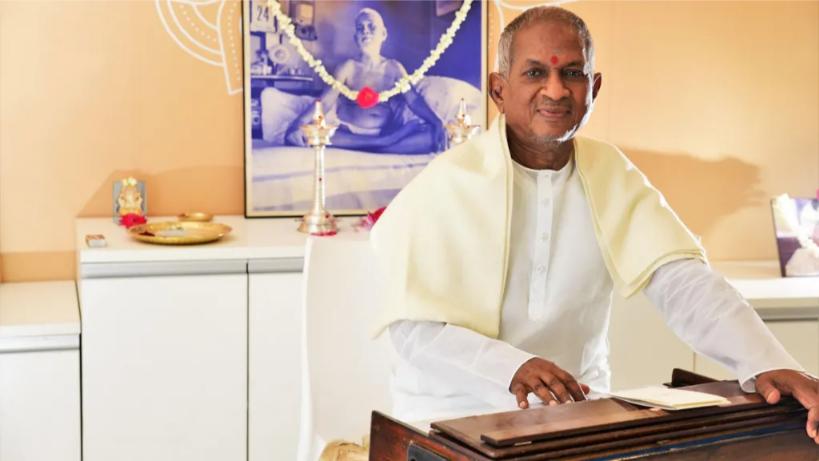
His ardent fans call him “the Maestro”. Five decades after his debut, Ilaiyaraaja’s music still echoes through homes, concert halls and cinema screens across India.
The 83-year-old composer from Tamil Nadu has scored more than 1,000 films in nine languages, a record unmatched in Indian cinema.
He transformed the sound of Tamil film music with Annakili in 1976 and has gone on to become one of India’s most influential composers.
“Ilaiyaraaja’s arrival was a watershed moment. It was an intervention by a person from an entirely different social and aesthetic background who had imbued a distinct aural soundscape,” says TM Krishna, a celebrated Carnatic musician.
In India, playback singing is central to popular cinema: singers record songs that actors lip-sync on screen, while the composers usually also create the film’s background score.
Before Ilaiyaraaja, a lot of film music was rooted in Indian classical music. Western symphonic influences were rarely woven into the mainstream soundtrack.
But Ilaiyaraaja, Krishna says, drew on a wide range of musical traditions from around the world.
“What’s unique is that he creates a cohesiveness to all the different forms he’s taken from different genres of music. That is the genius of Ilaiyaraja,” he said.
Following the success of Annakili, Ilaiyaraaja produced hits across languages, including Pathinaaru Vayathinile, Olangal, Sadma, Geetanjali, Chinna Gounder and Nayakan. He has composed more than 8,000 film songs, drawing heavily on Tamil Nadu’s folk and rural ballad traditions.
Last year, he became the first Indian to compose and perform a Western classical symphony in London with the Royal Philharmonic Orchestra, which described it as a “milestone in global music history”.
Born in June 1943 in Pannaipuram, Tamil Nadu, as R Gnanathesikan, Ilaiyaraaja was raised on the folk songs and ballads sung by his father, a cardamom estate supervisor. He was seven when his father died suddenly.
“My mother Chinnathayammal bore the entire burden of the household after that. We went through a difficult period,” Gangai Amaran, Ilaiyaraaja’s younger brother and a celebrated music director himself, told the BBC.
Born into a poor, socially marginalised family, Ilaiyaraaja had few opportunities to get ahead. But music was all around him. His eldest brother, singer-playwright Paavalar Varadharajan, performed at Communist Party events in the 1950s, when the party wielded significant influence in the region.
“We travelled from village to village with our elder brother. That’s how we learnt folk and rural musical traditions,” Amaran said.
When Varadharajan fell ill before a performance, their mother persuaded Ilaiyaraaja to take his place. It was his first public appearance.
Forced to leave school at 14, he moved to Madras (now Chennai) with his brothers in 1968 in search of a film career. He later recalled walking miles to save bus fares and often going to bed hungry.
Under Dhanraj Master, he studied Western music, mastering the guitar and piano while immersing himself in Bach, Beethoven, Mozart and Schubert.
“It’s God’s gift. Learning and mastering musical instruments came to him naturally,” Amaran said.
In 1969, he began assisting popular film composer GK Venkatesh.
“GK Venkatesh was my teacher, guru and encouraged me to write orchestra scores,” Ilaiyaraaja recalled in an interview later.
He became a guitarist and started writing his own film music compositions.
His early years in Madras followed a gruelling routine: music lessons at dawn, recording sessions through the day and home close to midnight.
He worked on more than 200 films with Venkatesh and others, honing his craft and building industry connections.
His breakthrough came when Panchu Arunachalam, the writer-lyricist of Annakili, invited him to demonstrate his talent to the film’s team.
“There was no instrument in the room. He used a wooden table as a percussion instrument and sang. But the producer was impressed,” says Amaran.
Arunachalam also renamed the young musician, who was now called Raaja, “Ilaiyaraaja” (young king).
Annakili’s success brought fame and more movies to Ilaiyaraaja.