

There are album tracks and there are hit singles. Looking at the movies of musically-obsessed Irish filmmaker John Carney, “Once” and “Sing Street” are the hit singles, the instant classics that remain stuck in people’s brains.
Carney’s new film “Power Ballad,” like “Begin Again” and “Flora and Son,” is an album track. Which I don’t mean necessarily as a criticism – an album track can sometimes be a diehard fan’s personal favorite, the one they’ll defend to the death when everybody else is humming the big hit.
But “Power Ballad,” a crowdpleaser with engaging performances from one of the most affable actors working today and from a bonafide pop star, somehow doesn’t seem destined for repeat plays.
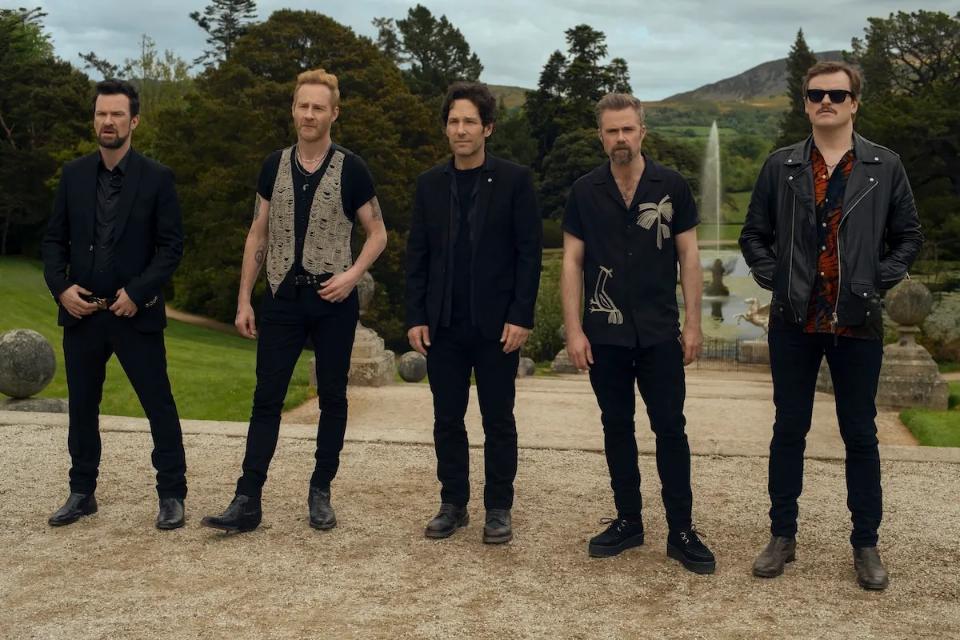
Paul Rudd draws on his decades of goodwill with an audience (and a heretofore hidden singing ability) to play Rick, the American frontman of an Irish wedding band called Bride & Grooves. The backstory is that Rick was a middling American rocker whose band was playing Dublin when he met a girl, Rachel (Marcella Plunett).
Fifteen years later, the band is gone, and Rick is still in Dublin, and he and Rachel have a teenage daughter, Aja (Beth Fallon). (It’s not said whether Rick named his daughter after a Steely Dan song, but it would be on-brand for a dad rocker.)
Rick now joyfully belts out “The Power of Love” and “Celebration” to happily boozy crowds at wedding receptions. Every once in a while, he sneaks in one of his originals into the set and allows himself to imagine that he’s playing before a stadium crowd. His own songs are good. But they’re no “Power of Love.”
At one wedding gig at an Irish castle, the best man Danny turns out to be a famous pop star (Nick Jonas). Or, at least he was years ago when he was a member of a boy band. Danny half-reluctantly takes the stage with Rick’s band to sing Stevie Wonder’s “I Wish,” and the has-been and the never-was turn out to have great chemistry on stage.
That bond leads to a weed-and-whiskey fueled all-night jam session in Danny’s palatial suite, where the two talk music and help each other with their unfinished songs. This is the best scene in the movie. Carney is so good at letting characters communicate through their music in ways they couldn’t otherwise. Danny and Rick may live worlds apart, but they’re both part of a special fraternity who understand the thrill of finding the perfect next line in a song or the right note in the chorus.
The next day, Rick leaves the castle with a vintage guitar that Danny gives him as a parting gift and a good story to tell. And then, six months later, he’s strolling through a mall when he hears a familiar song over the loudspeakers. It’s one of the unfinished songs he shared with Danny, an earworm called “How to Write a Song (Without You).” And Danny is singing it. And it’s a massive hit.
At first, Rick is thrilled that one of his songs has become a global sensation, validating his secret belief that, all along, he was good enough to play those fantasy stadiums. But as he realizes that Danny doesn’t plan to credit him for the song – won’t even return his calls – Rick turns his life upside down trying to prove he wrote the song and to get the acknowledgement he deserves.
The parts of “Power Ballad” following Rick in Dublin are very engaging – I’m enjoying this period in Rudd’s career where the seemingly ageless actor is starting to act his age a little more, playing a middle-aged guy wrestling with despair and anger at how his dreams have been deferred. Peter MacDonald (who co-wrote the screenplay with Carney) is very funny as Rick’s best mate Sandy, a sweet but dim ex-con who likely stopped head-butting people in bars because he worried he might break his readers.
It’s the scenes following Danny in Los Angeles that don’t quite work. The film never gets a bead on what motivates Danny to steal the song – is he just a jerk, or is he desperate for a hit, or is just oblivious? How does this version of Danny square with the guy who opened himself up to Rick after the wedding? Jonas never lets us inside the guy. His performance is as distancing as the security gates outside Danny’s mansion, and his scenes with his girlfriend (Havana Rose Liu, who seems even more underused after seeing “Tuner”) and ruthless manager (Jack Reynor) are flat and uninteresting.
Eventually Rick and Sandy fly to Los Angeles to confront Danny – it’s unclear what they’re really looking for, and it’s unclear what the movie wants out of this climax either.
I enjoyed a lot of “Power Ballad,” but it never quite achieves the emotional liftoff of Carney’s other films. Although, it should be said, weeks after seeing the movie I still have “How To Write a Song” stuck in my head.