

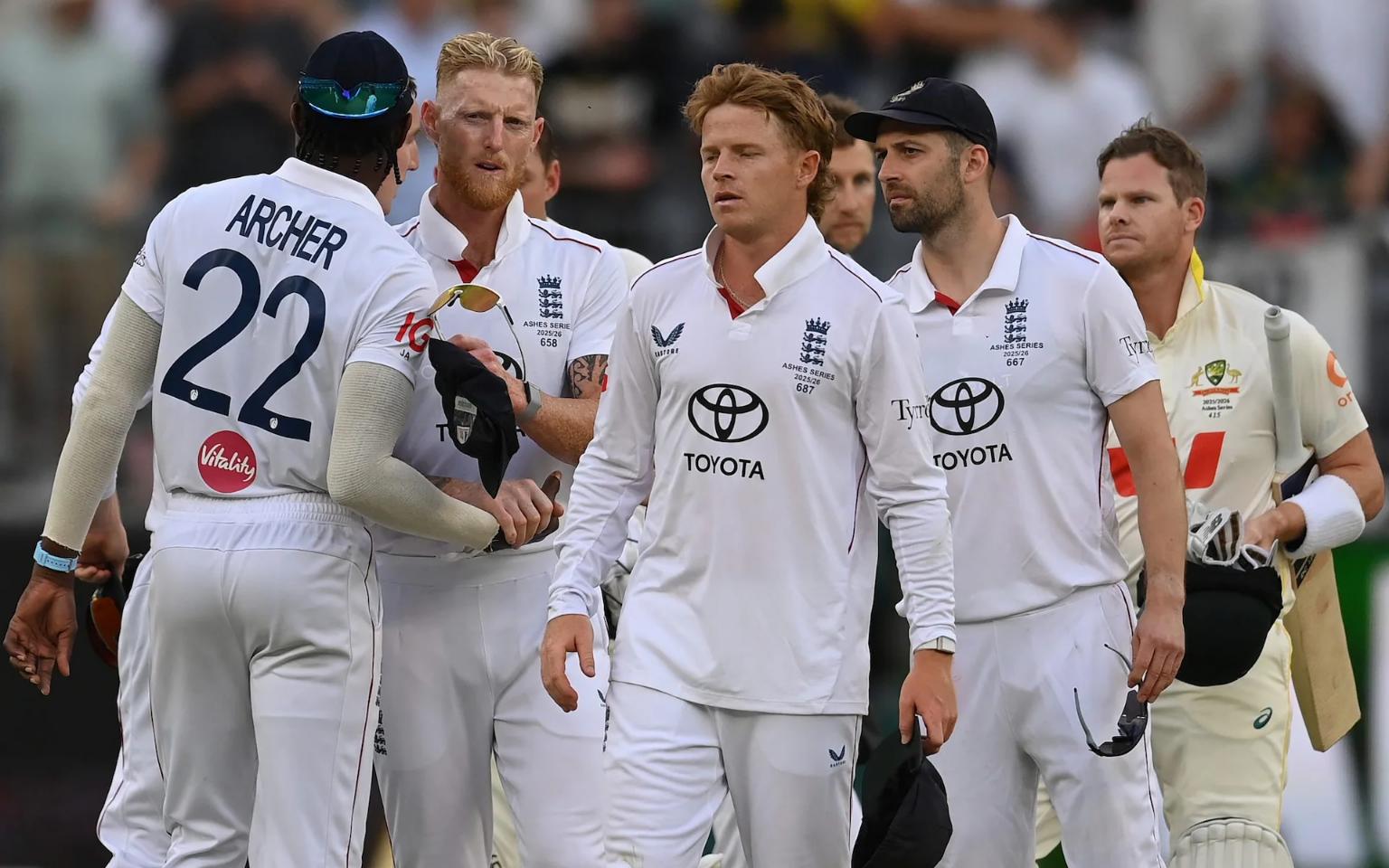
“We do have to reflect hard on what happened during the Ashes. The performances were extremely disappointing and have culminated in decisions we have made.”
That was Tom Harrison in 2022 talking in the same room as Richard Gould, his successor as chief executive of the England and Wales Cricket Board, did on Monday to present a post-Ashes review.
Four years ago it was about marked, visible change with Harrison detailing why he had sacked Ashley Giles and Chris Silverwood, the team director and coach, after a 4-0 Ashes defeat. Further churn was revealed a couple of weeks late in the same boardroom when Sir Andrew Strauss, then England managing director, dropped James Anderson and Stuart Broad for a tour of West Indies.
This time the boardroom was a safe haven for ECB employees, of which there were at least nine in the room. It was awash with words like “adapt”, used 21 times, and, on 12 occasions, “evolve”. There was also a PowerPoint presentation of two slides under the heading “Areas of Focus” that used phrases such as “performance systems”, “better individual and collective decision-making” and “planning cycles”. It broke the selection process down into an eight-level structure. It was something that Rob Key, England’s managing director, clearly wanted to put across because he consistently circled back round to the suggestion they picked Shoaib Bashir based on an Instagram reel.
This was essentially Gould’s show. He started with a 20-minute preamble, flanked by Key, a man he could have fired, and went on to present “changes” without any tangible changes taking place.
He had to be pressed twice about what head coach Brendon McCullum had really done differently in Sri Lanka and India compared to the Ashes tour and it came down to using a walkie-talkie to pass down instructions to the players on the field; something that actually started in Australia.
There were no new coaching announcements or additions to the set-up. Everyone remains in place apart from selector Luke Wright, who resigned for reasons not related to England’s winter. Troy Cooley’s role as pace-bowling lead coach was talked up, but the process to appoint him predated the Ashes.
All very general and unspecific
Gould reckoned that “30-40 per cent” of the review was new but admitted it will not be a “complete reset”. In effect it was an attempt to show how professional they are already despite evidence to the contrary. When asked at the end of an hour-long media briefing whether we will see a different McCullum this summer, Gould said: “I hope not too different.” Nobody really fancied the chaos of mass sackings, and in a franchise era it is much harder anyway to find the people you want.
Key’s hand of friendship to the counties, his laying down of a gauntlet to batsmen to score runs to be picked will be tested if a player like Dom Sibley – the anti-Bazballer – emerges as the top run-scorer demanding to be selected. Or will a couple of 80s from Zak Crawley be enough?
It was all very general and unspecific. Contrast that to the no-filter statement put out by Ben Stokes just hours later and it was a reminder of the early Bazball days when Key was telling everyone to “strap themselves in” for the ride under McCullum. “I have learnt a lot about myself but the most important thing that I want the fans to know is that…. I f—–g love cricket, I f—–g love this team, I f—–g love being England captain and I have got so much more to give to this role and I’m so happy that I get to do it with Baz and Rob.” Hard to imagine that one was run by the communications experts before being published to his 3.1 million Instagram followers, but then that is just Ben Stokes.
And so the trio survive. The word in Sydney, before the fifth Test, was that England did not want to sack anybody anyway and the past three months have been spent looking for reasons to justify the inaction and present them in a way that will mollify angry supporters, disillusioned county figures and sceptical media. In the end, everyone is lucky to still have a job and work for such a forgiving employer.
Gould accepted there was a cultural problem which culminated in Harry Brook being punched by a bouncer in Wellington the night before he was due to captain England. “Significantly unprofessional” was how Gould described it and, after running a tight ship at Surrey, and his previous career in the Army, there is no doubt he was appalled by it all. McCullum appears to have been cleared of blame because when he spoke to the media in the ECB boardroom the day he was appointed, he warned his players not to do anything that will make them front-page news. His advice that “nothing good happens after midnight” was quoted by Gould, but it did happen on McCullum’s watch, and at the worst possible time.
Gould and the ECB hope with a little tinkering and stricter oversight from Lord’s, England will improve enough to beat Australia in 2027. Australia have proved over the past decade they are much closer to winning in England than England are to winning in Australia. English cricket is putting a lot on the hope Australia will not be as good next year, that Steve Smith will be on his last legs along with the three great fast bowlers. It is a dangerous assumption for anyone to make.
“We do have to reflect hard on what happened at the Ashes, but I am not saying I am clinging on for grim death, that is not what I am doing. I am doing this because I think it is the right thing for English cricket right now and as soon as that is not the case, you will not have to push me. We have a lot of work to do and we need to get the Test team back on track. We are building a plan to get the Test team back into a good place.”
That was Harrison, again in 2022. Sounds familiar.