

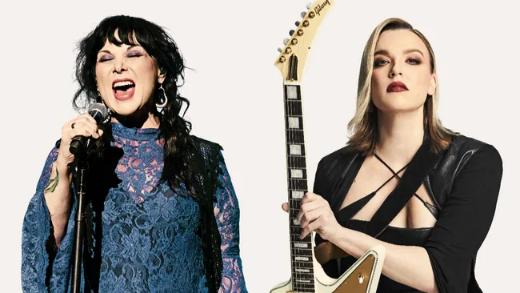
Heart’s Ann Wilson and Halestorm’s Lzzy Hale are two of the most iconic musicians of their respective generations. In 2022. as part of Classic Rock’s 300th issue celebrations, we got the pair together for an exclusive interview to talk about siblings, sobriety and covering Stairway To Heaven in front of Led Zeppelin themselves.
Lzzy Hale is smiling from ear to ear, looking like she’s 15 again. It’s understandable; the Halestorm singer-guitarist has just met her idol, Heart vocalist Ann Wilson, for the first time.
We’re in The Smoakstack, one of the many studios that has transformed Nashville neighborhood Berryhill into the next Music Row. Wilson is here recording a new solo album, and from the control room you can hear snippets of a playback with her unmistakable powerhouse voice.
For Classic Rock’s interview, the studio has set up what looks like a little staging set – a 1950s red formica table and chairs, with candles and flowers. As the two women settle into conversation, there are many knowing nods and bursts of shared laughter. By the end of the allotted hour it feels like a new friendship has been forged. And although age-wise they’re separated by a few decades, they’re part of a continuum of remarkable artists who have continued to overturn outdated notions about rock music. More than that, to use Wilson’s phrase, they’ve both answered “a calling”
You’re both in bands with your siblings. What’s the best and worst thing about that?
Ann: For me the best part was and is always that we have a shorthand. We know what each other is feeling without having to say it. I can look across the stage and if she’s [sister Nancy]freaking out I can go over and give her some vibe. Or vice versa
Being women coming up through a business through the decades in a male-dominated industry – not so much any more – that was a real strong means of support. The dark side would be that you were kids together and you know how to push each other’s buttons [laughs]. And so things can get real icy. That’s hard when you’re trying to do a tour.
Lzzy: My little brother [Arejay Hale] is my drummer. We’ve been doing this since 1997, when we were teenagers. And everything we’ve been through together since then, it was always him and me against the world. We had been having trouble finding other members, and it was just a rotating door of kids in and out. I remember saying: “Bro, are we crazy for even doing this?”
Ann: [Laughing] We said the same. But you’re driven. It’s a calling.
Lzzy: He said: “Yeah, we’re crazy, but… what else are we going to do?”
Ann: It’s an interesting dichotomy. Sometimes it’s the best thing in the world, and sometimes you’re just like, I’m a grown up, I don’t want to be in this family.
Ann, you came into 1998 not with Heart but with The Lovemongers. Then, while Nancy took a break, the Ann Wilson Band. How did that shape the next chapters of your musical life?
Ann: We had come through the eighties and early nineties, which was Heart’s most commercially successful time. It was the MTV era, where you’d spend half a million bucks to make a video that would sell the record. It was an incredibly traumatic, stressful time. So by 1998 I’d gone back to Seattle, I had two kids, ages seven and newborn, and I felt like: “God, I’m just going to do whatever I want. I don’t have to play Magic Man any more” [laughs]. It was a reaction time. I totally shed the skin of Ann Wilson in Heart, and just went: “Fuck this, this is so not me.” Also, I was offended by the way Nancy was being presented. Sure, she agreed to it, but it was offensive to me that she was always trotted out front as this little cheesecake thing. I just felt really alienated. So I stepped out of it.
For you, Lzzy, around 1998 you had discovered Heart through their live album The Road Home. You’ve said it “set the tone” for what you do.
Lzzy: [To Ann] First and foremost, I would not be the singer that I am without you and without what you’ve done. There’s an otherworldly thing inside you. There’s a way that you flip yourself inside out and reveal your soul to someone. You’re queen of that.
Back then, I was just digging for anything that I could grasp on to where I could see myself. My dad introduced me to Deep Purple, Ronnie James Dio and Van Halen. My mom, God bless her, said: “Well, if you’re going to be into all of that stuff, you’ve got to know that women can do this too!” So she got me a bunch of CDs and one of them was The Road Home. I wore it out. In the Pennsylvania scene, everybody wanted to be Jewel; everything was all very soft and there was no passion and anger. [To Ann] So when I heard you sing on that live album, it made that bridge to what I wanted to sound like and who I wanted to be just a little bit shorter. It really helped me figure out my stage presence as well. Really, you put me through rock’n’roll school [laughs].