

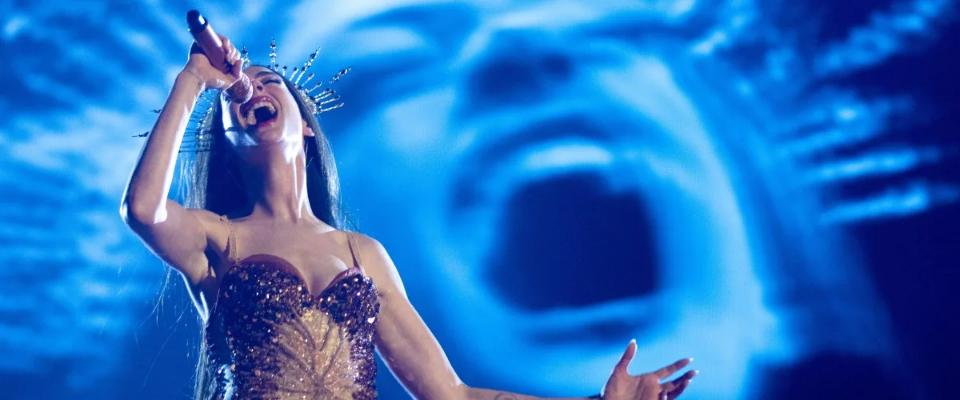
Winking at the audience in a way that most David Lowery films do at least once, Anne Hathaway’s title character in “Mother Mary” says, “These metaphors are exhausting.” Lowery has played with exhausting metaphors before in surreal dramas like “A Ghost Story” and “The Green Knight,” and he’s once again working in a dramatic register that could be called dreamlike, valuing sound and image over traditional narrative. “Mother Mary” is about two people connected by something greater than words, an almost supernatural bond that ties a pop star beloved by the world and the estranged friend she left behind. It is another story about the intersection of fame and art, but it’s not like one you’ve seen before, a two-hander that owes as much to “The Exorcist” as it does to Lady Gaga.
Hathaway plays the title character, a pop musician who has transcended mere fame to that spiritual plane that’s occasionally occupied by celebrities who reach something almost primal in their listeners. Have you ever felt a connection with an artist that’s deeper than mere admiration? Lowery was inspired by the almost religious followings that sprout up around artists like Taylor Swift, Beyoncé, or, back in the day, Madonna. These people became more than singers or dancers; they became Mother.
In preparation for a comeback performance after a tragic accident, Mother Mary finds herself almost spiritually drawn to a fashion designer who helped form the on-stage persona that made her an icon: Sam Anselm (Michaela Coel). To give you a sense of what you’re in for, “Mother Mary” opens with Sam narrating how she could “feel” Mother Mary coming to Sam’s house/studio before she did. This is a script about emotion more than action, and how the two can shape one another in the mystical world of true artistry, in both fashion and pop music.
Mother Mary comes to Sam, insisting that her old friend make her the ultimate dress for her comeback show. What follows is a lengthy two-hander in a massive barn-like studio space where Sam does her work. Lowery has said that he initially wanted to make a conversation piece between two performers, a simple drama of dialogue and ideas. The foundation of that remains in “Mother Mary,” but there’s nothing simple here.
Sam pushes at her old friend, revealing how betrayed she felt when she was given no credit for the pop-star persona she helped create, one that features religious iconography, such as ornate halos around Mary’s head in photo shoots and on stage. Mary left Sam behind, and the designer knows that they need to push through the wounds of that estrangement before they can create together again. Sam sees her work not as mere fashion worn by a celebrity but as a shared artistic expression, almost as if she’s turning Mary’s inner monologue into something visible.
The first hour of “Mother Mary” is an extended conversation piece between two characters who don’t always say what they mean. Lowery and his longtime collaborator D.P. Andrew Droz Palermo stay tight on Hathaway and Coel’s faces, especially enraptured by the expressiveness of the latter. Coel can shift so mesmerizingly from a warm smile to an embittered frown, and Lowery understands that her face often says as much as a monologue. Coel really understands this material and was reportedly involved in the process from a screenwriting phase, before being cast. As great as she is right now in “The Christophers,” this performance is even better.
Hathaway isn’t quite so successful. She often seems to be relying on crutches like pregnant pauses and a strained, almost whispered cadence to convey how seriously we need to take what she’s saying. However, the physicality of her performance saves it. It’s not only that she’s fully believable as a pop princess belting out new tunes by Jack Antonoff, Charli xcx, and FKA Twigs (also in the film’s most terrifying scene), but she gets to shine in what is arguably the most memorable sequence in the film as Mother Mary does the dance routine she’s going to do in her new dress, but with no music. Hathaway hurls herself across the wood floors as what starts as a pretty standard dance number becomes something closer to how demonic possession is captured on film. The sounds of her grunts and limbs hitting the floor amplify the idea that pop star’s hide pain behind the thumping beats, flashing lights, and other elements that disguise the raw physical and emotional exertion it takes to be an artist.
“Mother Mary” pivots into something truly supernatural in a way that doesn’t always work. Sam and Mary share what could be called a ghost story, represented by a flowing red piece of fabric, and Lowery’s film really goes off the deep end in storytelling terms, sometimes losing its way as it crashes through its ideas. It becomes a swirling nightmare, as if one had pulled the curtain back on a Lady Gaga show to reveal actual monsters in the wings. While it’s undeniably dense with unpackable themes, Lowery, the writer, loses his way a bit here, making a film that he and Coel might fully understand, but often can’t convey exactly what they mean to the audience.
Still, one can’t deny the big swings that A24 and David Lowery are taking with this film. The previews make it look like another riff on “Black Swan,” a story of obsession and the cost of being a celebrity. It is about both of those things, but in a way that we haven’t really seen before. It’s a hard film to capture in words, one that swirls in and out of its themes like a songwriter willing to let the listener interpret the lyrics rather than tell you what to think and feel.
If all of the dots don’t connect, that feels almost intentional, a way to create a personal connection with the viewer that may be different than anyone else’s. Some will struggle with the lack of cohesion; for others, it will be the best thing about “Mother Mary.” Both are right. And so is Mother Mary when she says these metaphors are exhausting. More movies should be exhausting.