

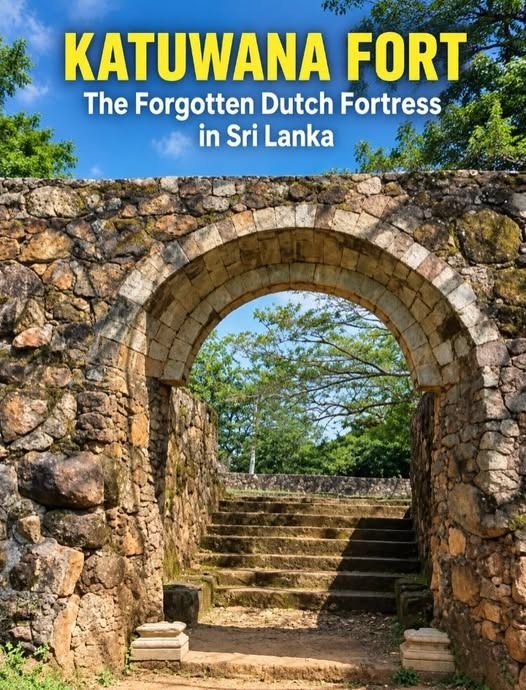
Hidden away from Sri Lanka’s famous coastal forts is an unusual reminder of the island’s colonial past. In the hills of Katuwana, in the Hambantota District, stands Katuwana Fort, also known by the old names Fort Catuna and Fort Catoene.
Unlike most Dutch forts in Sri Lanka, Katuwana Fort was built inland rather than beside the sea. Its location reveals an important part of the military history of the Dutch period, when the Dutch East India Company was not only concerned with protecting harbours and coastal settlements, but also with defending the lowlands from attacks coming from the Kandyan Kingdom.
The fort was constructed by the Dutch in 1646, approximately 40 kilometres from Matara, close to the foothills leading towards the Kandyan territories. At the time, this was an important frontier zone between the Dutch controlled coastal lowlands and the territories of the Kingdom of Kandy.
The Portuguese had previously established a strong presence in many parts of Sri Lanka, and after the Dutch gradually defeated the Portuguese in the seventeenth century, the Dutch became the dominant European colonial power in the maritime regions of the island.
However, controlling the coast was not enough.
The Dutch were aware that the powerful Kandyan Kingdom remained independent in the interior. The hills provided a natural defensive barrier, but they also created a potential route for attacks into Dutch controlled territory.
Katuwana Fort was therefore constructed as part of the Dutch defensive network.
The fort itself was relatively small compared with famous coastal fortifications such as Galle Fort. It was built on the slope of a hill and had ramparts approximately 5 metres high. A single gateway provided access to the interior, while a walkway about 4 metres wide ran along the top of the defensive walls.
Its unusual diagonal shape and two bastions gave the structure an important military purpose. Each bastion could accommodate six cannons, allowing soldiers to defend the approaches to the fort.
Because of its relatively small size and design, Katuwana was sometimes described as a redoubt rather than a conventional large fort.
For many years, the fort stood as a Dutch military outpost facing the Kandyan frontier.
But the balance of power eventually changed.
In 1761, the fort became involved in the Matara Rebellion, when forces loyal to the Kandyan king Kirti Sri Rajasinha moved against Dutch positions in the southern region.
Katuwana Fort was captured by the Kandyan forces and partly destroyed.
This event demonstrates that the fort was not simply an isolated colonial building. It was directly connected to the struggles between the Dutch controlled maritime provinces and the independent Kandyan Kingdom.
The Dutch continued to control their territories until the end of the eighteenth century. In 1796, British forces took control of the former Dutch possessions in Sri Lanka.
The Kandyan Kingdom itself remained independent for several more years, until the British annexed the kingdom in 1815.
After the British gained control of the Kandyan territories, Katuwana Fort lost much of its original strategic importance. The frontier it had been designed to defend was no longer the same, and the fort was eventually abandoned.
Today, only the remains of the old defensive structure remind visitors of its military past.
What makes Katuwana Fort particularly fascinating is not its size, but its location and purpose. When people think about Dutch forts in Sri Lanka, they usually imagine enormous coastal fortifications overlooking the ocean.
Katuwana tells a different story.
It represents the Dutch attempt to defend the inland edge of their territory and protect the southern lowlands from the power of the Kandyan Kingdom. Its walls once stood as a warning on the frontier, while its cannons were prepared to defend an important route through the hills.
Today, Katuwana Fort is one of the lesser known colonial heritage sites of Sri Lanka. It does not attract the same crowds as Galle Fort or other famous colonial monuments, but its ruins preserve an important chapter of the island’s complicated history.
The story of Katuwana is also a reminder that Sri Lanka’s colonial heritage extends far beyond the famous forts found along the coast.
Sometimes, the most interesting pieces of history are hidden away in places that receive very little attention.
Have you ever visited Katuwana Fort, or did you know that the Dutch built a military fort so far inland to defend their territory from the Kandyan Kingdom.