

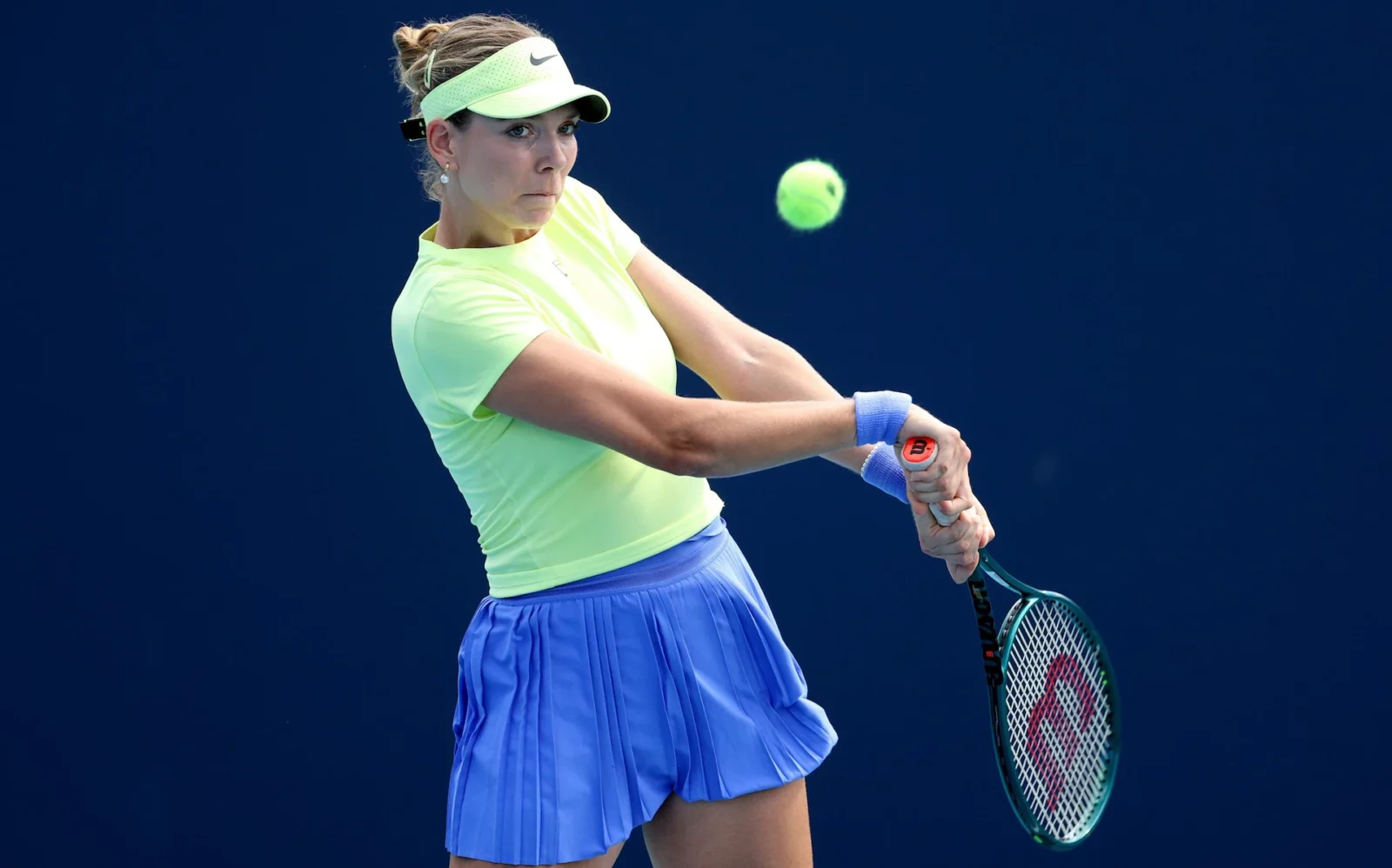
Katie Boulter believes the women’s tour could get “ugly” in terms of injuries if they are asked to play five sets.
Craig Tiley, former Australian Open chief and current CEO of the United States Tennis Association, is pushing for change to make women’s matches best of five sets from the quarter-finals onwards.
For Boulter, Tiley’s proposals, which could be implemented Down Under, would not be welcome. She said: “I think you would see a lot more injuries. I don’t think I want to see that on tour.
“We’re already seeing so many [injuries] and I feel like it’s increasing by the month. I see so many girls in general playing with injuries. One, partly because of the mandatory tournaments and two, because there’s a lot on the line.”
Boulter struggled with a stress fracture in her foot during a turbulent 2025 that saw her start the year inside the world’s top 25 and finish it ranked 100th. She said: “If we were to extend [the matches] to best of five, I don’t want to see it. It could get pretty ugly. I’m a supporter of Craig but I’m not sure that’s the way forward for women’s tennis.”
Boulter was speaking after reaching the Miami Open third round when her opponent Clara Tausen retired in the third set. Boulter said she did not want to win in that manner as Tausen was forced to leave the court with the score 6-7, 6-4, 1-0 in her favour.
It is unfair and impossible and should be canned
The debate over whether women should play best-of-five sets is not new. Between 1984 and 1998, the final of the season-ending championship at the WTA finals was best-of-five, with the first one featuring Martina Navratilova and Chris Evert.
There are pros and cons. The women’s Wimbledon final last year saw Iga Swiatek create history when she hammered Amanda Anisimova 6-0, 6-0 in a match that lasted 57 minutes. Had that game been five sets, Anisimova could have taken a set to grow into the match in her first major final, rather than be on the brink of defeat before she had time to breathe.
However, throwing something into the women’s game without considering all the variables is unfair on the players.
Given the schedule, it would be impossible to introduce five-set matches for women at all rounds of a major tournament, while still keeping the event to two weeks, which is presumably why Tiley said it would apply from the quarter-finals onwards.
It would be interesting, although who wants to watch a tennis match that comes down solely to who is fittest? Some of the men struggle to sustain their levels in hot conditions once matches go past four hours, but they have been conditioned to do so for their whole careers. To ask women to do the same without that preparation would be unfair.
Then there is Boulter’s argument. The players do not want it, and increasingly they are holding more power.
Aryna Sabalenka has spoken out against introducing best-of-five and it should ring alarm bells that so many players are raising concerns about the schedule.
There is also a desire from tournaments for tennis to be shorter and snappier and more “clippable” for social media, which goes against the idea of a five-hour epic contest. In this world, the men’s game would be shorter rather than the women’s game longer.
The desire for longer matches later in tournaments is understandable the desire for longer matches later in tournaments but forcing them to do something they are not conditioned for – to fill television slots – is an uncomfortable situation.