

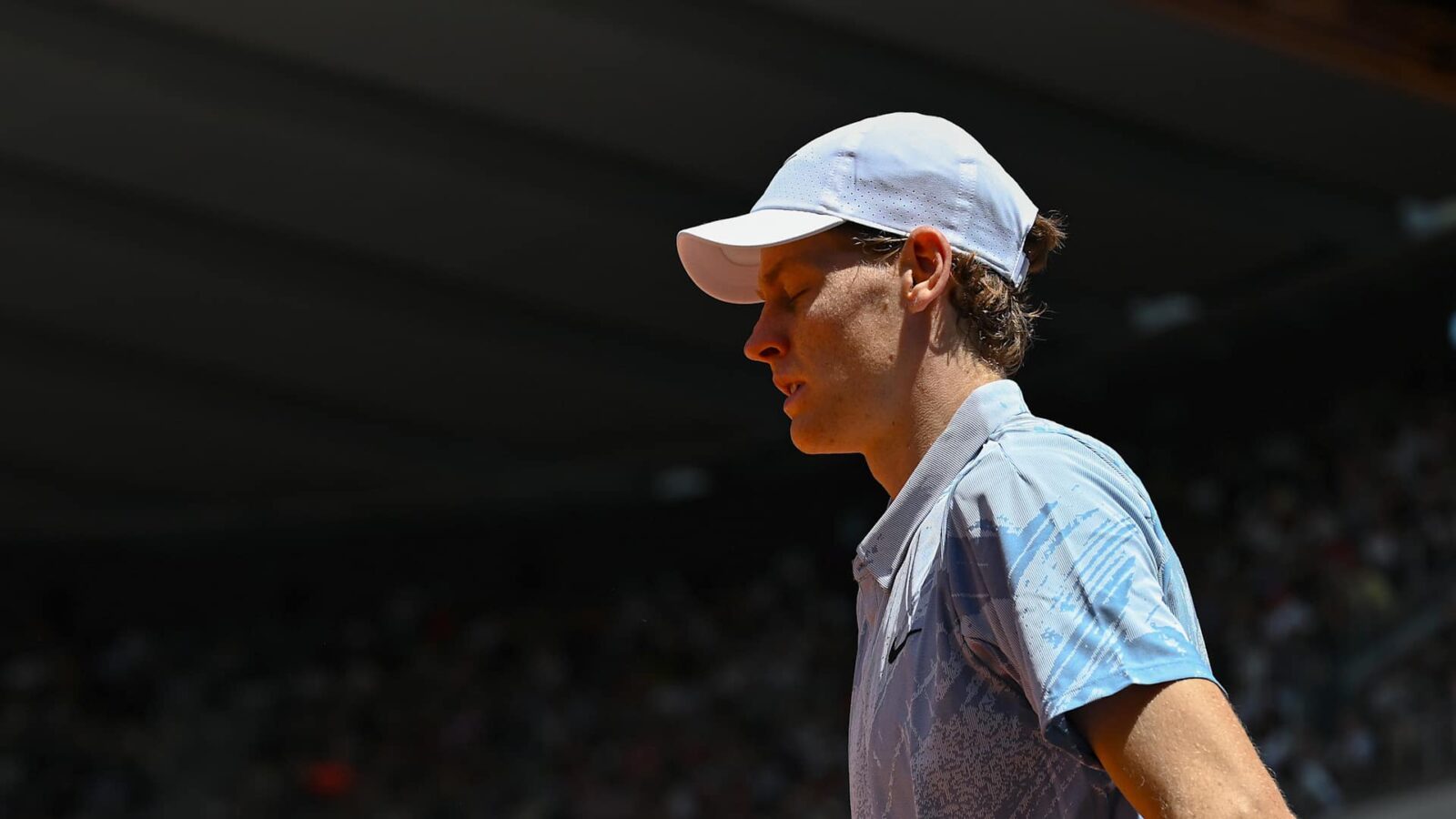
“He knows the end is near,” Brian Anderson said on TNT’s Roland Garros broadcast.
“He’s managing the pain; he’s in tennis’s version of hospice,” Anderson’s booth-mate, Jim Courier, agreed. “He’s just kinda riding this thing to the end.”
At the time, those comments about Juan Manuel Cerundolo seemed entirely appropriate. The 56th-ranked Argentine trailed top seed Jannik Sinner 6-3, 6-2, 4-1. There was an air of quiet inevitability in Court Philippe Chatrier. Cerundolo looked at his player box and threw his hands in the air, pleading for help. Sinner missed a shot and casually flipped his racquet around in his hand, as if he didn’t have a care in the world. The worries about playing on a hot day seemed to be well behind him.
Then something happened. Something tiny, but terrible.
Sinner stopped and pulled his lower right leg up. Then he started talking to his team. “I just need a moment,” he said, according to Mary Jo Fernandez on the sideline.
Unfortunately for Sinner, his moment—and his window to win his first title at Roland Garros—had already passed.
The 180-degree turnaround came with dizzying speed. Serving for the match at 5-2 and rapidly losing energy, Sinner was broken at love on a double fault that landed three feet wide. Serving for the match again at 5-4, he started with a double fault, framed a forehand into the bottom of the net, and was again broken at love. He would lose 15 straight points.
“I struggled, starting to feel very dizzy,” Sinner said. “Very low of energy. Tried to serve it out, but didn’t have a lot of energy.”
According to him, it wasn’t just the heat.
“Woke up this morning, didn’t feel very well and tried to keep the points very short,” he said. “It was warm, but not crazy warm. I feel like it was quite OK to play.”
Sinner did what he could to stay alive. He served and volleyed. He went to the drop shot. He hammered his forehand at triple-digit speeds. And he had chances to break and take leads. But Cerundolo was the wrong guy to face in his condition. Unlike many people who face a hampered opponent, he got better, and essentially stopped missing. He saved one break point with a perfect defensive lob, and another with a running forehand pass. He never let Sinner have any hope, and ended up with one of the most unlikely Grand Slam victories anyone has ever seen, 3-6, 2-6, 7-5, 6-1, 6-1.
In short, Sinner lived his nightmare on Thursday.
The Italian had won his last 31 matches. He had won five straight Masters 1000s in 2026, and pulled off the Nadal-level feat of sweeping all three on clay in Monte Carlo, Madrid, and Rome. Carlos Alcaraz, the man who beat him in Paris last year, wasn’t here. The only thing standing in his way, seemingly, was his tendency to cramp in heat and humidity. His team requested a noon start on Thursday, to avoid the peak 90-degree temperatures of the late afternoon. For two hours it worked perfectly. Then, a foot from the finish line, he stumbled.
“I felt this morning I didn’t sleep very well,” said Sinner, who played the night match on Tuesday. “This morning when I woke up, I was struggling a bit, but you know, this can happen. Usually in Grand Slams you have a couple of days where you don’t feel perfect. This was today.”
“I was hitting very clean, very good, and then I just kind of hit the wall, and that’s it.”
The punishment for winning is that you get less time off, and Sinner has had virtually none since February. He was asked whether, looking back, he should have skipped an event.
“You don’t know,” he said. “I mean, if I don’t play Madrid or if I don’t play Rome, maybe I come here and I still have a day like this where you feel sick.”
As usual, this even-keel competitor tried to focus on the positive.
“If you watch the whole clay swing…played really, really, really good, winning three tournaments in a row on clay,” he said. “Today was just not meant to be.”