

Doubles pioneer Jamie Murray has announced his retirement, thus closing a a famous chapter in British tennis history. Recent challengers such as Jack Draper have far to go if they want to compete with the extraordinary legacy of the Murray brothers.
At 40, the elder Murray had already moved towards the fringes of the sport. He played his final competitive match at the US Open in August, and recently popped up in the commentary box for Sky Sports’s live coverage of Monte Carlo.
But this still feels like a significant moment, because Murray stood at the forefront of a doubles revolution which transformed Great Britain from makeweights to arguably the dominant power in the world game.
When Murray became world No 1 for the first time, on 27 March, 2016, he was the first Briton ever to stand atop the ATP ladder in either singles or doubles. As it happened, his brother Andy finally cracked No 1 in singles just seven months later, so they became the first siblings to achieve these complementary honours in the same year.
In a message on Instagram, Jamie posted: “I feel very fortunate and privileged for all the amazing experiences this great sport has given me. Thanks Mum, Dad, Andy, Ale, Alan, Louis and Thomas for all your incredible support, efforts and sacrifices throughout my career that allowed me to achieve everything I could in the game. For everybody else that’s helped/supported me – I appreciate all of you! Excited to enter the real world!”
Paying his own tribute on the same platform, Andy posted: “Jamie, I’m not sure what I loved more when we were kids, being on court with you or winding you up. But I know the way we pushed each other helped us both go as far as we did. Looking back, so many of the moments that mean the most to me on court, we were out there together, from our first Olympics in Beijing to winning the Davis Cup. I’ll always owe you for that final match on Centre Court, it meant everything to share that with you. And now it’s your turn to call it a day. I just hope you know how proud we all are of you.”
Since Murray became the ATP’s first British world No 1, it has become almost commonplace, in the doubles world at least. He has been followed by four more Britons – Joe Salisbury, Neal Skupski, Lloyd Glasspool and Julian Cash – while Henry Patten has stood as high as No 3.
Part of this doubles supremacy comes down to the genius of Louis Cayer, the innovative Canadian coach whom Jamie’s mother Judy recruited 20 years ago after seeing him run a training session at Monte Carlo. Cayer has since become the doubles guru of the whole British game.
But Murray was also significant as a trailblazer. As Cayer told Telegraph Sport in 2020, “When I started with Jamie, he was 180 in the world. I told him he can be No 1. He wasn’t like anyone else. He had nothing big in his game – and I don’t know how well you play, but you can match his forehand for sure. But he is different, with his lobs, his chip. The opposition won’t have peace of mind.”
e grand-slam doubles winner marks end of a glorious era for British game
Simon Briggs
Tennis Correspondent and Senior Feature Writer Simon Briggs
Simon Briggs writes about tennis, cricket and a variety of other sports. See more
Published 15 April 2026 5:59pm BST
Related Topics
Wimbledon Tennis, Jamie Murray, Andy Murray, ATP
31
Add us as preferred source
Jamie Andy Murray
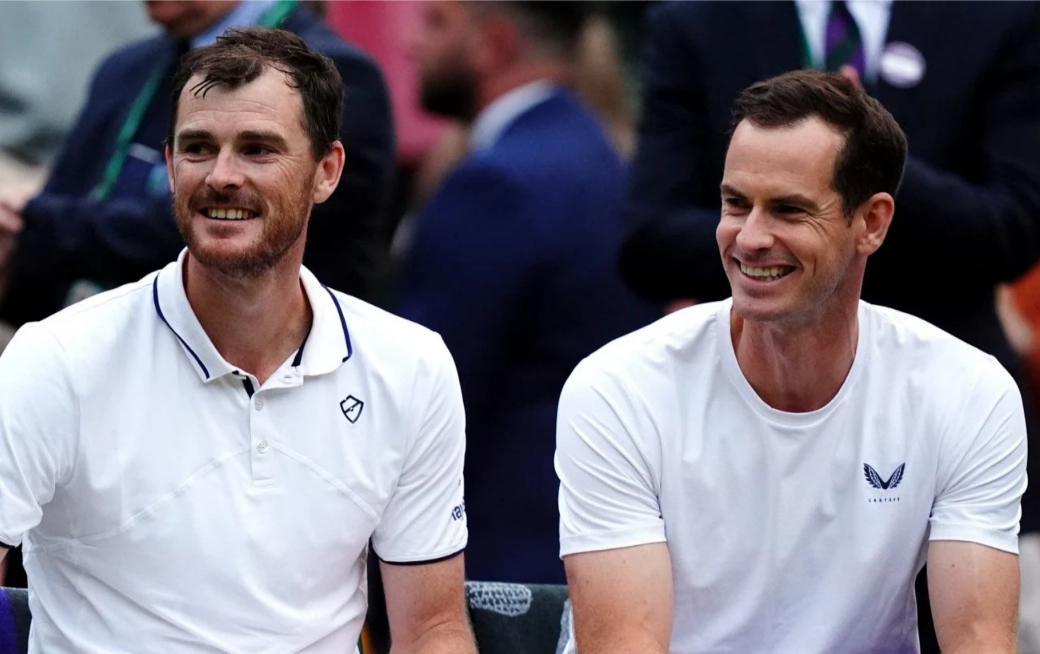
Jamie Murray (left) teamed up with brother Andy for the latter’s farewell match at Wimbledon in 2024 Credit: Mike Egerton/PA
Doubles pioneer Jamie Murray has announced his retirement, thus closing a a famous chapter in British tennis history. Recent challengers such as Jack Draper have far to go if they want to compete with the extraordinary legacy of the Murray brothers.
At 40, the elder Murray had already moved towards the fringes of the sport. He played his final competitive match at the US Open in August, and recently popped up in the commentary box for Sky Sports’s live coverage of Monte Carlo.
But this still feels like a significant moment, because Murray stood at the forefront of a doubles revolution which transformed Great Britain from makeweights to arguably the dominant power in the world game.
When Murray became world No 1 for the first time, on 27 March, 2016, he was the first Briton ever to stand atop the ATP ladder in either singles or doubles. As it happened, his brother Andy finally cracked No 1 in singles just seven months later, so they became the first siblings to achieve these complementary honours in the same year.
In a message on Instagram, Jamie posted: “I feel very fortunate and privileged for all the amazing experiences this great sport has given me. Thanks Mum, Dad, Andy, Ale, Alan, Louis and Thomas for all your incredible support, efforts and sacrifices throughout my career that allowed me to achieve everything I could in the game. For everybody else that’s helped/supported me – I appreciate all of you! Excited to enter the real world!”
Paying his own tribute on the same platform, Andy posted: “Jamie, I’m not sure what I loved more when we were kids, being on court with you or winding you up. But I know the way we pushed each other helped us both go as far as we did. Looking back, so many of the moments that mean the most to me on court, we were out there together, from our first Olympics in Beijing to winning the Davis Cup. I’ll always owe you for that final match on Centre Court, it meant everything to share that with you. And now it’s your turn to call it a day. I just hope you know how proud we all are of you.”
Since Murray became the ATP’s first British world No 1, it has become almost commonplace, in the doubles world at least. He has been followed by four more Britons – Joe Salisbury, Neal Skupski, Lloyd Glasspool and Julian Cash – while Henry Patten has stood as high as No 3.
Part of this doubles supremacy comes down to the genius of Louis Cayer, the innovative Canadian coach whom Jamie’s mother Judy recruited 20 years ago after seeing him run a training session at Monte Carlo. Cayer has since become the doubles guru of the whole British game.
But Murray was also significant as a trailblazer. As Cayer told Telegraph Sport in 2020, “When I started with Jamie, he was 180 in the world. I told him he can be No 1. He wasn’t like anyone else. He had nothing big in his game – and I don’t know how well you play, but you can match his forehand for sure. But he is different, with his lobs, his chip. The opposition won’t have peace of mind.”
Above all, Murray was the finest volleyer in any form of the game. American coach and commentator Brad Gilbert dubbed him “Stretch” because of the way his long, snakelike arms would reach out to intercept apparently impossible balls.
As a child, Murray had been even more precocious than his younger brother, ranking No 1 in Europe at the age of 13. But a move to a Lawn Tennis Association-run school in Cambridge proved disastrous. As Judy wrote in her autobiography, “The coach… made some changes to Jamie’s forehand in the first couple of weeks which were completely destabilising.”
The extraordinary thing about Murray, then, was that he reached the top of the world game without a top-spin forehand – which is a little like being a professor of mathematics who cannot do arithmetic. For 99 per cent of players, the top-spin forehand is the most basic building block in the game. But the very fact that he did not play it made him unpredictable and baffling to most opponents.
Fortunately, Cayer understood exactly what was going on in Murray’s head. “There is too much emotional baggage, a mental block,” Cayer told Telegraph Sport in 2020. “I can teach him a very good loose forehand, he will have 19 in a row, but if he misses the 20th the racket goes into the fence. But why worry? As a doubles player, Jamie doesn’t need to rally with forehands. Watch him volley, watch him poach, and for me he is still the No 1.”
Aged 21, Murray had made an early impact on the game when he won Wimbledon’s 2007 mixed-doubles event with Serbia’s Jelena Jankovic, prompting rumours of a love match through their on-court chemistry.
But by 2013, his career was apparently in the dumps. During a mournful press conference in Australia, Murray admitted that he could not see a future in pro tennis after a previous season which had involved 14 different on-court partners and – at the lowest ebb – a sequence of five successive defeats.
At this point, Cayer returned to his side for a second time, whereupon a partnership with Australia’s John Peers gelled so well that they spent the best part of three seasons together. “Louis and I had been apart for good couple of years and I was drifting along a bit,” Murray recalled in 2016, “but I had started working with John and I really wanted to make it work.”
After a frustrating semi-final loss at the 2015 ATP Finals, in which a nervous Peers was largely responsible for wasting five match points against the Bryan brothers, Murray then switched to playing with Bruno Soares, the Brazilian who featured in his most successful results. Soares’s superb returns and accurate serving dovetailed so well with Murray’s finely honed volleys that they won both the hard-court slams in 2016 – the Australian Open and the US Open.
Just before this, Murray had also teamed up with his brother Andy to help land a first Davis Cup title in 79 years. In 2015, the Murrays won three doubles rubbers in a in a brilliant campaign in which Great Britain overcame the other three grand-slam nations – the US, France and then Australia – before toppling the Belgians in a memorable final in Ghent.
We have not even mentioned Murray’s other four mixed-doubles majors between 2017 and 2019 – two of which he won with “Swiss Miss” Martina Hingis, and the others with versatile American Bethanie Mattek-Sands.
During those years at the end of the 2010s, the elder Murray was surely the pre-eminent doubles player in the world, as well as a laconic and dryly humorous presence in the locker room. For a man whose tennis career appeared to have foundered twice – firstly at the Leys School in Cambridge and then at the end of 2012 – it has been quite a run.