

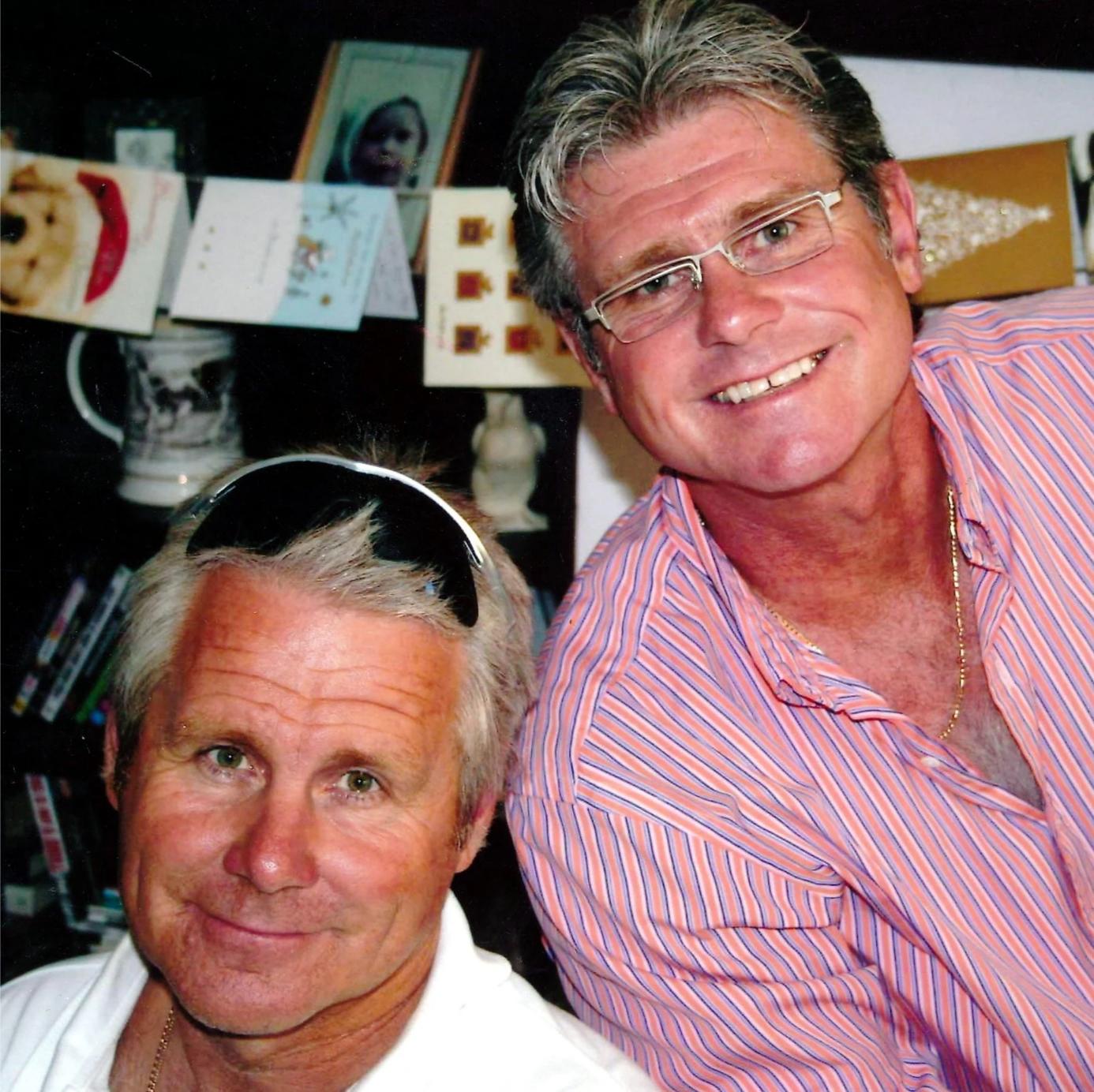
Chris Smith talks about Robin with the candour only a loving brother can. There is affection without varnish. He is honest about Robin’s flaws, and naturally saddened about how his brother’s life unravelled and led to his premature death last year.
Robin Smith died in December, during the Ashes series, at just 62, only days after sitting down with the England Lions and chatting cricket in the place he was happiest: the dressing room. It was the last flicker of the old Robin Smith, the one the public and fellow cricketers knew and loved. His body gave up a week later as years of alcohol abuse – that he admitted included drinking a bottle of vodka a day for 12 years – caught up with him.
“You know what, he was paid a huge accolade in Australia when he died,” Chris says. “Here [in Australia] they don’t have a minute’s silence for foreign players. I have not seen that ever, so for him to have one in the Brisbane Ashes Test was massive. I was in the house on my own and I cried throughout that. I thought f—, why has it come to this?”
Chris, 67, is the older brother, known in the game as Kippy, who by his own admission, had a “fraction” of Robin’s talent. He says he overachieved by carving out a successful first-class career, averaging 46 in 11 years at Hampshire, with eight Test caps for England.
Robin was the fearless aggressor with the best square cut in the game who revelled against fast bowling and averaged 44 in 19 Tests against the great West Indies team of the era; cricket seemingly came easy to him.
Chris was able to compartmentalise life, retiring contentedly at 33 and soon becoming chief executive at the Western Australian Cricket Association in Perth before setting up two very successful businesses in the garments industry.
Robin could never fill the void once his playing days were over and the man known as the “Judge” – because his frizzy hair resembled a judge’s wig – was a sensitive, vulnerable man away from the dressing room.
He never came to terms with the abrupt end of his Test career in 1996, aged just 32, and alcohol replaced the high of performance. He struggled to adapt to civvy street despite Chris setting him up in business and lining up customers and work when he moved to Perth in 2008, the start of many years of financial and moral support.
“For the last period of 17 years I tried to straighten him out. In my office there is a photo of him raising his bat having scored a century at Old Trafford with Ian Healy standing behind him in the 1989 Ashes Test [Robin scored 143, the next highest England score was 39 by Neil Foster]. He often asked me: ‘Why do you have that photo in your office and it is the only one?’
“I said: ‘I have it on my wall because I want the photo to remind me every day of what you were like at the height of your career and I will try every day to get you back there.’
“The biggest disappointment for me when he passed is that I thought I could get him through that bad period and out the other side, but despite all my efforts, I couldn’t. There was nothing anyone could do for him. He just had his finger on the self-destruct button.
“He had a financial safety blanket in the form of me. He had a lot of sensible people around him. There was nothing more any of us could do that might have turned him around.”
Chris started the interview by warning he is a “straight shooter” who has not spoken to the media in 25 years. He is true to his word: articulate and honest, this is a frank interview and not the regular sepia-tinted tribute to someone who has recently died.
They were close, no doubt, right to the end. Chris’s wife Julie spoke to Robin on the telephone three hours before he collapsed and died at home. The brothers last saw each other six days earlier, meeting up for coffee in South Perth along with Hampshire team-mates Barry Richards, Paul Terry and Mark Nicholas.
Robin was drinking alcohol again, despite a close shave with death a year before when his liver failed. The family are still awaiting the results of the autopsy, but Chris suspects he died of multiple organ failure, his body unable to take any more.
“I was frustrated because he was drinking again and he was living just inside the line. Had he not drunk again and stuck rigidly to what he had been told he would have been OK. But our father died three months earlier, he felt sorry for himself and hit the turps [went on a drinking binge]. When you are travelling just inside the line, it is not going to take much.
“Having said all that, I saw him on the Saturday afternoon of the England Ashes Test and we had a lovely chat. On the Tuesday, I was going to work, and the phone went and I had a nice 10-minute chat with him and that was the last time I spoke to him. The only saving grace was he went quickly. He wouldn’t have known much about it.”
‘I told him you don’t have a chip on one shoulder, you have it on both’
Chris splits his life with his brother into two halves: the happy years playing together at Hampshire followed by the despair as Robin fell apart, arriving in Australia a lost soul.
“It was difficult. I used to say ‘just tell me everything and I will help you get out of your hole’. I had an incredibly close relationship with my brother. It was really difficult for me and the family. The only thing that made him partially comfortable was drinking.
“I was never told the real truth by Robin about anything ever. It was very frustrating. His wonderful performances on the field made people think he was legendary and he was. He was an amazing sportsperson and I didn’t see any of these frailties during the 1980s when I was playing with him at Hampshire.
“But he developed a massive chip on his shoulder about being dropped from the England side. For 20 years he would tell me that he was the leading scorer in the last series he played. I reminded him you had new masters in Ray Illingworth and Keith Fletcher, and they had certain expectations. You were warned about how you were living your life because they didn’t like it and you didn’t change. Life is a package. Yes, on-field performances are hugely important, but if they did not feel you were a wonderful influence off it, then you needed to change because they had a new set of youngsters. Robin was never able to come to terms with that.
“I wasn’t there. I had moved to Perth by then so don’t really know why, but things started going downhill. I can’t understand why he didn’t read the tea leaves and change his ways, or why he didn’t go back to county cricket and score the runs needed to force his way back into the England team. My record in first-class is significantly better and it shouldn’t be. I didn’t have a fraction of his talent. He could have averaged 55 and 60 for the next couple of years and Illy would have had no option but to pick him, but he didn’t. He came over here in 2008 and was still harping on about this and I told him you don’t have a chip on one shoulder, you have it on both. Please move on.”
‘People can get extraordinary gifts in one part of life, but are useless in other parts’
Robin opened up in his 2019 autobiography about his drinking and anger at the end of his Test career. He contemplated suicide by throwing himself out of a hotel window and, at his lowest, would take a bottle of vodka to the beach in Perth and empty it.
“The only time he felt partially happy was when he was having a few,” Chris says. “Sometimes people get these extraordinary gifts in one part of life, but are useless in other parts. He never had to think about what he was doing on the sports field because it all came so naturally, but when he had more time to think about things off the sports field it was a lot more difficult.”
There are happy memories, lots of them, and they centre around sport, particularly Robin’s outstanding natural talent. “In life you hear this description of a flawed genius. He was arguably the greatest sportsperson who left a South African school, which is a massive accolade.
“He had an extraordinary cricket record, an unbelievable rugby record and they were grooming him to be a Springbok. He still holds a whole pile of athletics records at the school (Northlands High School in Durban) and this is 50 years after he left. He was a genius on the sports field and he worked hard because we had a tyrant as a father. In his final year at school, in no shoes he ran 100 metres in 11 seconds and he weighed 93 kilos. He ended up scoring 400 points for the first XV and the next highest score was 30 points, and that guy became a revered Springbok [Hugh Reece-Edwards].”
Chris’s cricket memories start with recalling the 12-year-old Robin playing A-grade cricket in Durban and taking on adult bowlers. Then how Robin secured his Hampshire contract in 1981 as a teenage prodigy.
“He came to England to watch Hampshire’s pre-season training and he was due to go back and work in my dad’s business. The chairman knew he could play so asked him if he wanted a bat. The first-team bowlers started off on two-three paces because he was 17. But within five minutes they were bowling off full run-ups and he played them incredibly well. Within half an hour the chairman came to me wanting to offer him a contract. It was interesting phoning my father to say Robin was not coming back to South Africa because he has been offered a contract.”
Then there is Robin’s championship debut at Bournemouth in 1983. “We played Lancs at Bournemouth and I had laboured to a hundred and got out the last ball before tea. He came in first ball after tea and by the beginning of the last over of the day bowled by Jack Simmons he had 90. With one ball to go he needed a six and smashed it out the ground and ran off with his arms in the air.”
The last time they batted together was in a Natwest Trophy quarter-final against Nottinghamshire in 1991. Chris scored a hundred to win the game, Robin made 67 and they added 114 for the second wicket. “In the gym at my house I have a picture of Robin raising his bat next to me and Eddie Hemmings is in the pic with hands on his head as if saying ‘what can I do now?’ Robin was proud of that being our last innings together. He would look at that photo in my gym a lot.”
This was part of the problem though. “He would always attach himself to events of the past, which is typical of someone who loved that period so much and is never able to find themselves once that door closes.”