

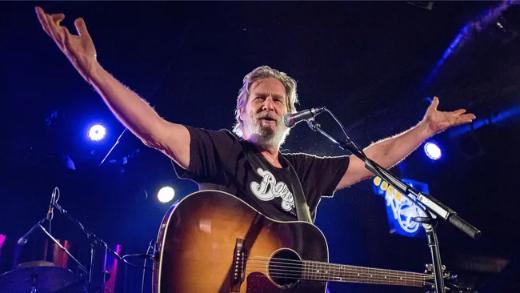
Though he’s regarded as one of his generation’s most versatile and accomplished actors, Jeff Bridges has always been in touch with his musical side. In the late 1950s and early ’60s, after his older brother, Beau Bridges, exposed him to Little Richard, Chuck Berry and Buddy Holly, the two began fooling around on a Goya classical guitar owned by their father, the late film and TV star Lloyd Bridges.
But it wasn’t until Beau purchased a Danelectro (“one of those ‘lipstick pickup’ jobs you got from the Sears, Roebuck and Company catalog”) and let Jeff have a go at it that “things started to change in a big way,” Bridges says. The early ’60s surf-rock hit “Pipeline” was the first song he learned to play from beginning to end. When the British Invasion arrived in 1964, it seemed to him that music, not acting, was his life’s driving force.
Bridges remembers going to see A Hard Day’s Night with his father and being thrilled at how “he totally got it. The humor, the songs — my dad loved the Beatles. Maybe it was because he was a singer, too.” (The elder Bridges had famously replaced Richard Kiley in Man of La Mancha on Broadway.) “He appreciated their creativity,” he says. “I was fortunate: when other kids’ parents were throwing out their Beatles records, mine were cool with it.”
As he recalls, the first “really good” guitar he owned was a Gibson J-45 that “practically played itself.” Both he and Beau were encouraged to take piano lessons by their mother, Dorothy (“I did for a while,” he says, “and then I quit. She said, ‘You’ll be sorry’ And I am”), but Jeff chose to teach himself guitar. Unlike so many budding axe men of the time, he viewed the six-string as a vehicle for songwriting, not instrumental virtuosity.
“I respected Eric Clapton and Jimmy Page and Jimi Hendrix and those guys,” he says, “but I never felt like I wanted to compete with them. Slowing down their records to study their licks? That wasn’t for me. Maybe I was just being lazy, but to me playing the guitar was about having fun.”
That sensibility extended to weekly jam sessions that the teenaged Bridges held at the family house, a tradition that continued for 15 years, “well into the time that we were all men,” he says.
“Our jams were crazy. I played electric, acoustic — it was all very free-form, kind of like Captain Beefheart meets the Talking Heads, if that makes any sense. Singing was encouraged, as was poetry, but we had one hard-and-fast edict: no songs, just jamming. I didn’t like the idea of structure.”
Literally tossed into the acting waters by his father (“the old man put me and Beau in his TV show Sea Hunt. He thought we’d like it better than school”), Bridges extended his “just jamming” ethos to his earliest film roles, which included Oscar-nominated turns in The Last Picture Show and Thunderbolt and Lightfoot.
Because he hadn’t bogged himself down with the “rules” of acting, Bridges went one better and simply was, displaying a naturalism and lack of pretension that led the late film critic Pauline Kael to call him “the least self-conscious screen actor who ever lived.”
Even so, Bridges didn’t know if he was cut out for the life of a movie star. He says that the real decision to throw himself into acting didn’t come until after he’d made “a dozen or so pictures. I dug what an actor did, but it took me a while to feel it, to truly appreciate the craft and the preparation. Plus, I was still playing music a lot, and I guess I had a hard time choosing: Was I an actor or a musician, or could I be both?”