

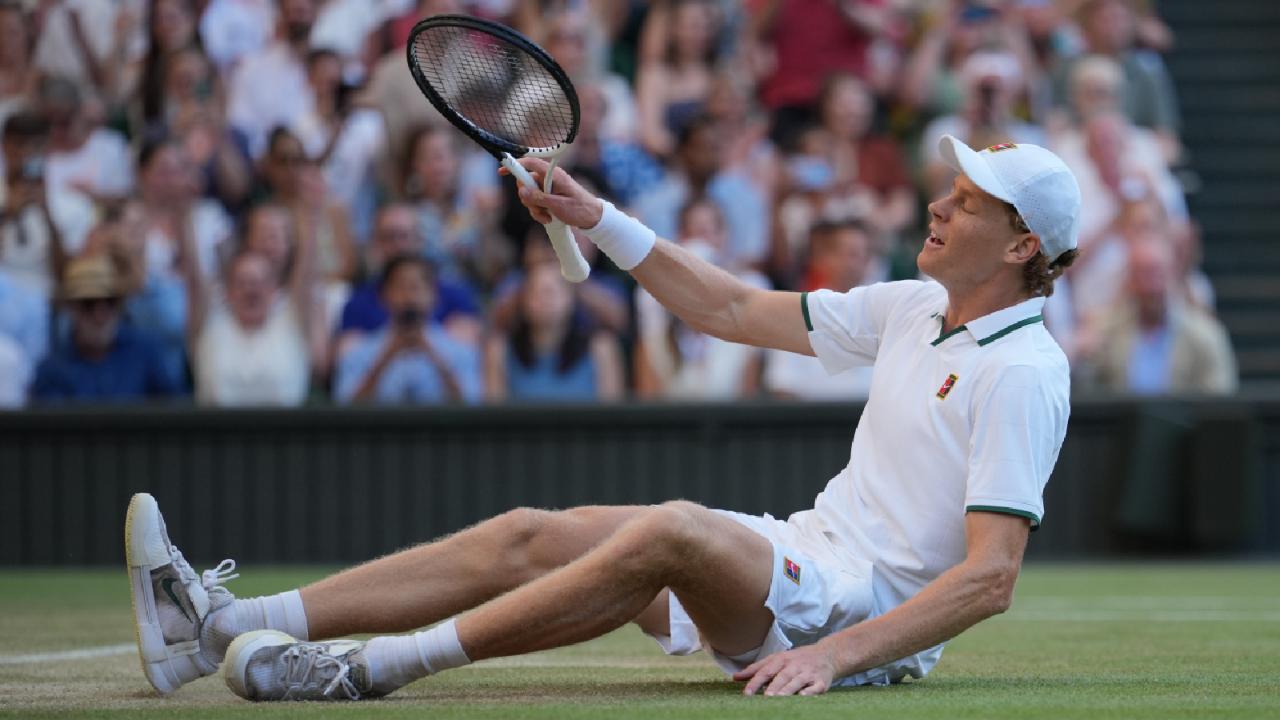
In theory, Alexander Zverev should have been the happier man walking off Centre Court on Sunday. He out-aced Sinner 17 to 15 and landed 80 per cent of his first serves to Sinner’s 66. He lost anyway, 6-7(7), 7-6(2), 6-3, 6-4.
The difference wasn’t power, it was what each man did with the points that followed. Sinner won 80 per cent of points on his first serve to Zverev’s 71, and 65 per cent on his second to Zverev’s 61. He also out-returned Zverev, 43 return points to 34. Whenever the match needed deciding, Sinner had more ways to decide it.
That efficiency has been rebuilt from close to nothing. Two years ago this would have sounded absurd. At the 2025 US Open final, also against Carlos Alcaraz, Sinner’s first serve landed just 48 per cent of the time. He lost. Days later, leaked practice footage showed him back on court working on the shot that had failed him under exactly that pressure. He won his next tournament.
The rebuild started in 2022, under Riccardo Piatti, with a platform serve, feet planted wide, the racket arm arriving from well behind the body. First-serve percentage sat below 60. When Piatti gave way to Simone Vagnozzi, the serve was the first thing he wanted to fix. Jim Courier remembers cornering him at the 2022 Miami Open to ask the plan. “The serve, it’s got a hitch in it,” Vagnozzi told him. “We’ve got to get rid of the hitch and smooth it out. I want the toss more in front so he can be more offensive.”
By mid-2023, Vagnozzi and Darren Cahill had switched Sinner to a pinpoint stance, back foot drawn up to meet the front at contact, modelled on John Isner, a six-foot-ten American who serves nothing like Sinner otherwise plays. It made no obvious sense on paper. It took years to show in the numbers: gains in 2023, more in 2024, and by 2026, a first-serve percentage above 65 with roughly 80 per cent of those points won.