

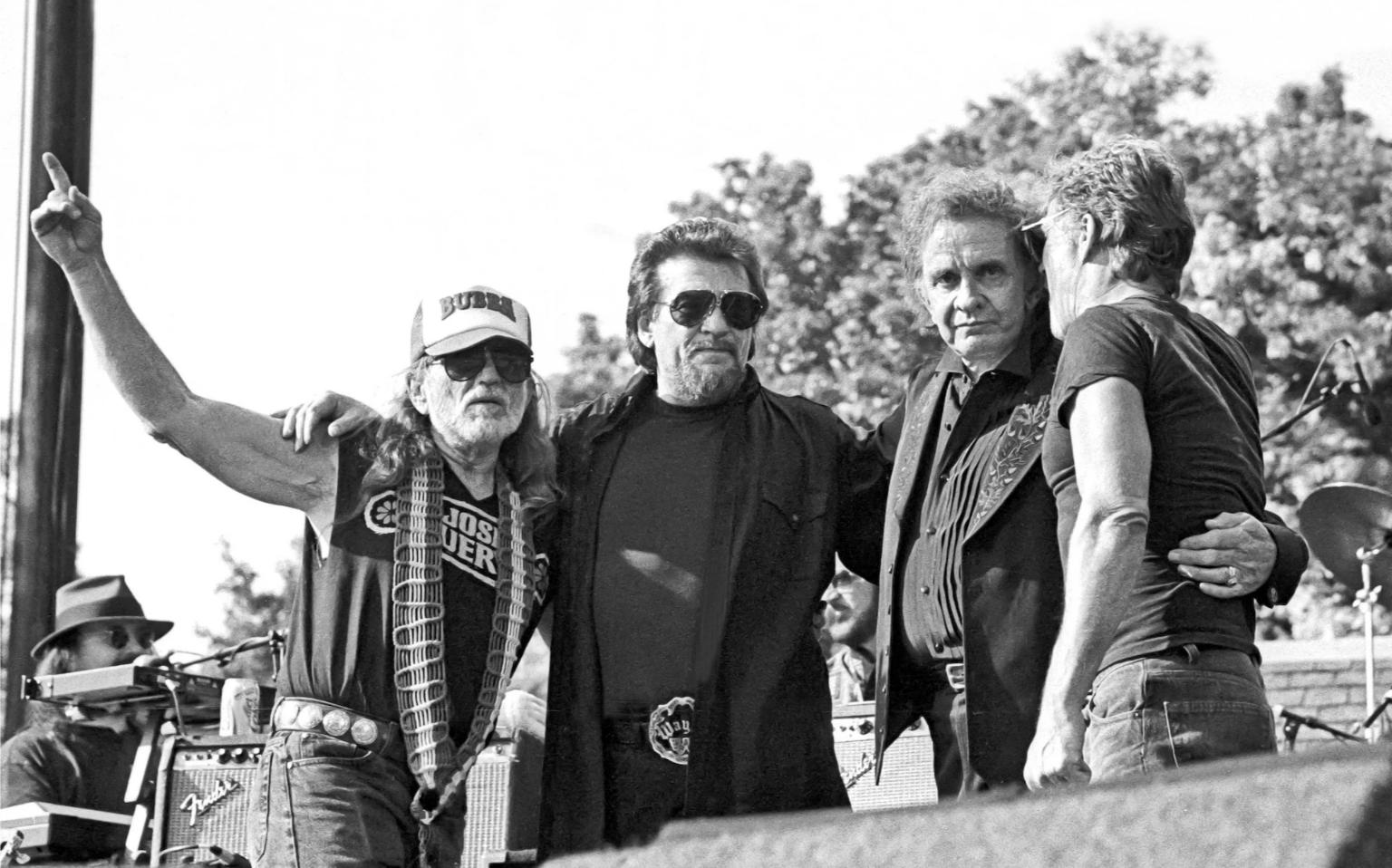
The 1986 remake of Stagecoach is not high on anyone’s list of favourite films. Mauled by the critics who described it as “laughable”, Ted Post’s version of the John Wayne classic didn’t even make it to the cinemas and instead went straight to television where it aired on CBS, 40 years ago this month. Yet the film hasn’t quite been consigned to the dustbin of history, as it features Johnny Cash, Waylon Jennings, Willie Nelson and Kris Kristofferson: four giants of country music, whose work together as the Highwaymen made them “the Mount Rushmore of country music”.
The film stars Nelson, armed with only a snarl and a dream, in the lead role of dentist-turned-gunslinger Doc Holliday; Cash plays lawman Marshal Curly Wilcox, and Jennings a gambler called Hatfield. Only Kristofferson, already an established Hollywood actor thanks to A Star is Born, convinces as the outlaw Ringo Kid who seeks vengeance for his murdered relatives.
One of the main problems with the film was the unrealistic sets. To save money, it was filmed at Arizona’s active-film ranch “Old Tucson”, essentially Western-Disneyland and was derided by the New York Times for “looking about as realistic as an average episode of Sesame Street”. The dialogue, meanwhile, is hilariously awful, containing such gems as: “My dear friend, you can’t compare Kentucky bourbon with the kind of spirits old ladies hide in their knickers.” Stagecoach was meant to capitalise on the Highwaymen’s combined fame and outlaw cool, persuading even more Americans to buy their records. And while it didn’t work out like that, it failed to dent their legacy.
The term “supergroup” can often raise suspicions of wizened, greedy old record label executives pulling together a group of big names devoid of chemistry. But the Highwaymen were nothing of the sort. Nashville’s outlaw quartet had been friends for years before they decided to get in the studio together, with their genuine bond reflected in the strength of their songs: Highwayman, The Last Cowboy Song, Desperados Waiting for a Train.
Nelson and Jennings met in Phoenix, Arizona in 1965, two Texans with a shared dislike of the stuffy Nashville music establishment. Long before the Highwaymen even existed in the realm of possibility, Nelson and Jennings were gigging and singing together, resulting in the hit joint albums Waylon & Willie (1978) and WWII (1982). Jennings and Cash were also close, having lived together when Jennings first moved to Music City in 1965.
Kristofferson always seemed like the outsider of the group, the all-American, college-educated pretty boy with the glowing military record and budding film career who happened to stumble into the highest echelons of country music. His fellow three singers were his musical heroes – watch clips of any live Highwaymen performances, and the sheer joy and disbelief emanating from Kristofferson, like a little boy meeting his favourite footballer after a game, is palpable.
Cash was a particular mentor and during Kristofferson’s early years in Nashville, when he was writing songs for more established artists, he had desperately tried to grab Cash’s attention by sending his wife, June, various demos. But Cash didn’t pay any attention, until Kristofferson – still at that time working on the weekends for the Tennessee national guard – hopped in a military helicopter and landed it in Cash’s garden. Bingo! Cash invited Kristofferson to sing with him at the 1969 Newport Folk Festival.
In fact, it was Cash who sparked the fire that created the Highwaymen. In 1984, he asked Kristofferson, Nelson and Jennings to travel to Montreux for a Christmas television special, titled Johnny Cash: Christmas on the Road, which also featured his wife, June, and Jennings’s wife, Jessi Colter. The show included the quartet’s famous cover of Nelson’s perennial classic On the Road Again. It quickly became apparent that they needed to get in the studio once they were back in America to capture some of that magic in a bottle.
Thus came the song Highwayman, originally written and released by Jimmy Webb in 1977. Webb had been working in London with Beatles producer George Martin when, after one too many drinks with his friend Harry Nilsson, he fell asleep and dreamt up a song. “I had an old brace of pistols in my belt and I was riding, hell-bent for leather, down these country roads, with sweat pouring off of my body,” he later told an interviewer, about the dream’s contents. “I was terrified because I was being pursued by police, who were on the verge of shooting me. It was very real. I sat up in bed, sweating through my pyjamas. Without even thinking about it, I stumbled out of bed to the piano and started playing Highwayman.”
Produced by Chips Moman, who was credited with revitalising Elvis Presley’s career in the late 1960s, the rendition of Highwayman sung by Cash, Jennings, Nelson and Kristofferson in 1985 would give them their collective name. A story-song about a man coming back to life in four different lifetimes, as four different beings – a highwayman, a sailor, a builder on the Hoover Dam and captain of a starship – it has become one of country music’s most enduring works. It spent 20 weeks atop the Billboard Hot Country Songs chart and won Webb the Grammy Award for Best Country Song in 1986. Webb was a fan of the quartet’s rendition, saying the song’s verses were “predestination. I don’t know how they decided who would take which verse, but having Johnny last was like having God singing your song.”
Despite a strong friendship between the four men, there was sometimes animosity. Addiction was a problem, as each man tried his hardest to stay sober on the road. Kristofferson had given up alcohol in 1976 while filming A Star is Born, after preparation for his role as the alcoholic musician John Norman Howard (who dies in a drink-driving accident) hit too close to home.
“I remember feeling that that could very easily be my wife and kids crying over me,” he told People in 1998. “I quit drinking over that. I didn’t want to die before my daughter grew up.” Jennings, meanwhile, was more into cocaine and amphetamines before he found himself in $2.5m of drug-related debt and was forced to get sober; and Nelson, possibly the world’s most famous living stoner, had largely swapped drinking for marijuana.
Meanwhile Cash, who had been sober for nine years by the time the group set off on tour (though he would occasionally relapse), had a notoriously strict rider. “Not a drop of alcohol” was to appear in the communal fridges, with only glass bottles of Coca-Cola (and 7-Up for Nelson), coffee (iced for Kristofferson, hot for the rest) and juice permitted. The Man in Black, keen to find a treat to fill the void left by alcohol, was regularly seen scoffing vanilla ice-cream backstage at gigs.
Then there was the politics. Three opinionated Texans versus one opinionated Arkansas native (Cash) resulted in more than one heated moment, especially between Kristofferson and Jennings. Despite being roughly the same age (born in 1936 and 1937, respectively), they were worlds apart when it came to views on mouthing-off about political affairs. Kristofferson was liberal, Left-leaning and critical of American foreign policy, and relished making impassioned political statements on stage; Jennings believed entertainers should keep their mouths shut. Fights between Jennings and Cash would last for hours then turn into stubborn battles of silence.
Speaking on a talk-show in 1991, the four men were asked about their opinions on the George H W Bush administration. Jennings stayed silent. Nelson admitted there were “a lot of things wrong” with America, while Cash lamented the amount spent on the military. But it was Kristofferson who got most riled up, ranting that the presidency “reminds me a lot of the flag-waving and choreographed patriotism that we had back in Nazi Germany”.
It says a lot about the strength of their friendship that they managed to get along despite these differences and in spite of their individual fame. It’s impossible to imagine a 21st-century country supergroup, made up of modern stars like Morgan Wallen and Tyler Childers, who hold opposing political views (Right versus Left) even existing, let alone being as successful.
The Highwaymen’s last live performance was on Wednesday, June 28, 1995, at the Friendship Festival in Fort Erie, Canada. Seven years later, Jennings would be dead; Cash would follow 12 months after. Kristofferson died in 2024, and now only Nelson, 93, remains – the sole Desperado still waiting for a train, ready to meet back up with his friends in the next life.