

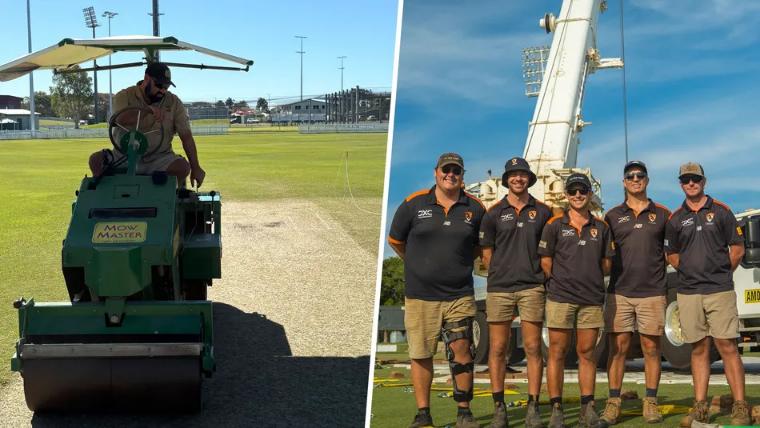
The men in charge of the Darwin and Mackay pitches have faced challenges rarely encountered by their southern counterparts
Given Jake Pavlich and Peter Kazakoff call home to a region where vicious weather and man-eating reptiles are daily considerations, it is little surprise neither of these northern curators are particularly anxious about their roles in making Test cricket’s return to Australia’s rugged tropics a success.
For the first time since the mid-2000s, Australia will play host to the country’s favoured format outside of its traditional summer window when Pat Cummins’ men face Bangladesh in Darwin and Mackay in a two-Test series.
For the Northern Territory capital, it marks an incursion into an Australian rules football-mad town that will nonetheless display its cricket pedigree when Darwin’s first homegrown Test cricketer, Jake Weatherald, likely wears the Baggy Green at Marrara Oval.
In Mackay, there will be a sense of a mission accomplished after the transformation of the Harrup Park precinct achieved an ambition to make it a hub for elite cricket. It will become just the 12th Australian ground to host a men’s Test.
And in making these off-the-beaten-track venues Test-ready, Pavlich and Kazakoff have faced challenges rarely encountered by their southern counterparts.
Cricket on the rise in Darwin
The duties of Pavlich – who laughs that he was “too short, fat and slow” to follow the career path of his cousin, the former Fremantle AFL star Matthew Pavlich – are surely among the most varied in world sport.
As Northern Territory Cricket’s head of facilities, the turf expert is also responsible for the wickets at Traeger Park in the arid desert town of Alice Springs, around 1,500 kilometres south of Darwin.
Compared to the relatively sedate climate of Adelaide, where Pavlich cut his teeth working for the South Australian Cricket Association at Karen Rolton Oval, Darwin’s distinct ‘wet’ (from November-April) and ‘dry’ (May-October) seasons necessitate a vastly different approach.
“One thing is that it just never stops growing,” Pavlich says of the grass at the flagship 12,000-capacity Marrara venue set to welcome back Test cricket for the first time since Sri Lanka’s 2004 visit.
“And then dealing with enormous amounts of rain. You’re always planning and always trying to control the growth.
“You’ve got weeds, and you don’t really want to spray too many herbicides because it obviously affects the grass that you want to grow on cricket wickets. So it is very different (to Adelaide). Same principles, obviously but just different challenges.”
On average, Darwin receives double the rain in its three wettest months – January, February and March – than Adelaide does in an entire year, forcing cricket to be played into the drier ‘winter’ while football codes sweat through the steamy summer.
The extreme weather patterns might be enough to send even the most expert of turf stewards into an early bout of Mango Madness, an affliction associated with the intense humidity that precedes the rainy months.
Pavlich is not so easily unsettled.
One of his major challenges since arriving in the remote NT outpost in 2024 has been successfully migrating and embedding a drop-in wicket into place in the middle of the main stadium in two separate pieces.
Darwin had in fact been the first venue in Australia to pull off the ‘split pitch’ method when it hosted Test cricket for the first time in 2003 for a match against Bangladesh. It is a cost-effective solution that’s been used on the Gold Coast, in Launceston and at Docklands in Melbourne.