

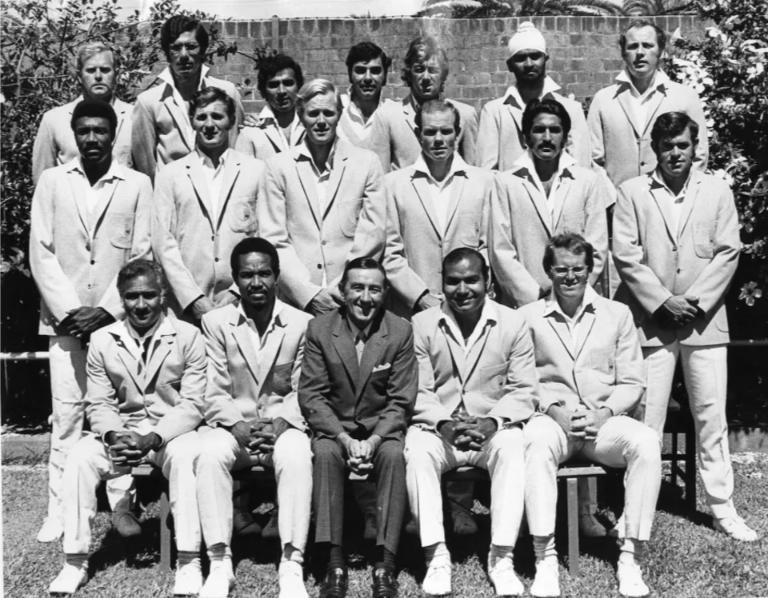
Sir Garfield Sobers is the best batter I’ve ever seen and that’s not taking into account all the other amazing skills he possessed on the cricket field.
He could take the new ball as a genuine swing bowler at a lively pace and then send down either wrist or fingerspin. He was a terrific fielder, catching in the close cordon either side of the wicket, and he was just as likely to produce a direct hit with a throw on the rare occasions he occupied an in-field position.
Playing for South Australia in the Shield competition, he once moved in from his leg-slip position to put the bails back on the stumps before the square-leg umpire could do it. “Ah,” said the wicketkeeper, Barry Jarman, “you’ve done everything else in this game, now you want to umpire.”
As an 18-year-old I had the wonderful experience of watching and learning from Garry. It always amazed me how the best cricketer in the world could treat an unknown young player from Glenelg as an equal.
“Go and grab a bottle of beer son,” he said, “and we’ll talk about a few things.” This was his response when I asked him for advice after I’d been bowled behind my legs by Australian fast bowler Ian Meckiff.
Garry gave me two or three tips on that occasion, and I adhered to them for the rest of my career. He could not only play the game but he also knew how things worked.
In the last game of the 1963-64 Sheffield Shield season the team that won the game clinched the trophy. As the final over before lunch began on the first day, South Australia had Victoria in deep trouble at 95 for 6.
Left-hand batter Ian Huntington decided it was time to put the shutters up as he faced legspinner Rex Sellers. Huntington played the first couple of deliveries with a dead bat and Sobers, fielding at leg slip, took note.
As Huntington prepared to play the third delivery in the same manner, Sobers took a couple of paces forward and placed his right hand on the ground. The forward-defensive shot landed right in his perfectly placed hand. The Vics went to lunch at 95 for 7.
It was pure genius, resulting from an alert cricket brain.
And he wasn’t above a bit of gamesmanship.
The English opener Geoff Boycott once sought Garry’s advice during a game.
“Garry,” he said, “you seem to get me lbw a lot. Why is that?”
Garry immediately went for the jugular. “Unlike a lot of people, I don’t think your technique is so good,” he said. “You play with your front foot a long way towards off stump, so I just bowl an inswinger and you can’t get the bat past your front pad.”
Boycott wandered off, shaking his head. The next morning when he came out to bat, Garry took the new ball. He ran up and bowled and Boycott edged to the slips.
As he headed for the pavilion, Garry quietly wandered up to him. “Geoffrey, you didn’t ask me about the one that goes the other way.”
That was Sobers. He loved a challenge and regularly produced his best in the biggest matches.
Big games weren’t the only thing that motivated him. Earlier in that 1963-64 season South Australia played the touring South African side at Adelaide Oval. It was the dark days of apartheid, and the only teams South Africa played against were Australia, England and New Zealand.
When South Australia captain Les Favell won the toss, he decided to bat first. Garry used to bat at four for SA, and when Les entered the dressing room after the toss, Garry asked, “Okay if I bat in the West Indies cap today skip?”
Now Les was a stickler for players wearing the SA cap. He’d once sighted allrounder Neil Hawke coming onto the field proudly wearing his Australian cap just after he’d been selected in the national side; “Piss off ‘Awkey,” yelled Les, “and put your South Australian cap on.”
Given this history, I was interested in Favell’s response to Garry’s request.
After a few moments’ thought Les said; “That’s fine by me Sobie.”
Garry smashed the South African attack all over the park, making 155. He was involved in a 253-run partnership with Ian McLachlan, who also made a century, and went on to be a minister in the John Howard government.
Through his magnificent knock Garry wore the West Indies cap proudly, perched on his head with the peak pointing skywards like a jockey’s headgear.
I always wondered about that episode because Garry was a man without prejudice.
In 1991, Channel Nine was in the Caribbean, covering the series between Australia and West Indies. I caught up with Garry in Barbados and we went to a beach bar to talk about old times over a few drinks.