

To understand how far women’s cricket in this country has come, the England team sheet for next month’s Women’s Twenty20 (T20) World Cup is a good starting point.
Take England coach Charlotte Edwards. She was the country’s most prolific batter for the best part of 20 years, serving as captain for 200 fixtures, yet she made her 1996 debut when the women’s team still played in skirts and had to pay to take part.
The squad for this tournament, hosted by England and Wales, features three members of the 2017 World Cup-winning team: then-captain Heather Knight, current captain Nat Sciver-Brunt and Danni Wyatt-Hodge. Twelve years ago, they were all part of the first intake of players to receive England central contracts, when only 18 women in the whole country were fully professional cricketers. Now there are more than 150 across the UK.
Left-arm spinner Tilly Corteen-Coleman is one of them. She may only be 18, but such is her promise that she received a huge £105,000 deal in The Hundred auction and was selected for this World Cup squad before earning a single England cap.
While previous generations spent their early years in the sport juggling part-time jobs to scrape by, this young player grew up in a world where “professional cricketer” was a viable career path. “I remember doing career day at school in year 7 and I went as an international cricketer,” Corteen-Coleman says. “I must have got some funny looks, but that’s all I’ve wanted to do my whole life really.”
Though Corteen-Coleman admits that she doesn’t remember watching her teammates in their 2017 Lord’s triumph, fast bowler Lauren Filer does. She was 16, glued to the television in her parents’ living room. “I think before that, it wasn’t necessarily an avenue where you were like, ‘I can do this for a job,’” she says. “But after the 2017 World Cup, it kind of kick-started that thinking with young players like me. The fact that it was a home World Cup I think just really solidified that impact on the women’s game.”
Sciver-Brunt’s memories from that day have an added personal meaning, as it was during the celebrations on the balcony at Lord’s that her former England teammate and now-wife, Katherine, first declared her romantic feelings. Last year, they welcomed a son, Theo, just a couple of months before Sciver-Brunt was unveiled as the new England captain.
Would she recommend reaching those two milestones at the same time? She laughs. “Not really, no. But looking after Theo then was way easier than it is now.”
He will be in the stands watching Sciver-Brunt, 33, lead out the team this summer, and she says that motherhood has given her a new sense of perspective. “When cricket’s finished, you go home and don’t have a choice but to go into Mum mode. It’s a great distraction and leveller, so that cricket isn’t all-encompassing, which it can be at times. You can often get into your little bubble of playing and training and [cricket] meaning the absolute world to you – which it still does, but I suppose I get a chance to switch off from it as well.”
The hope is that she and the team can replicate that success from nine years ago – not only by reaching another World Cup final at Lord’s in July, but also by boosting the women’s game across the UK.
Sciver-Brunt cuts a relaxed figure when meeting The Telegraph at Northampton’s County Ground midway through her prawn salad lunch. Teammate Filer describes her as a calming presence, an “under the radar” captain who is “almost there without you knowing that she’s there”. That much is clear after spending a few minutes with her. She is softly spoken, operating with the same quiet confidence that she does on the field as England’s influential all-rounder.
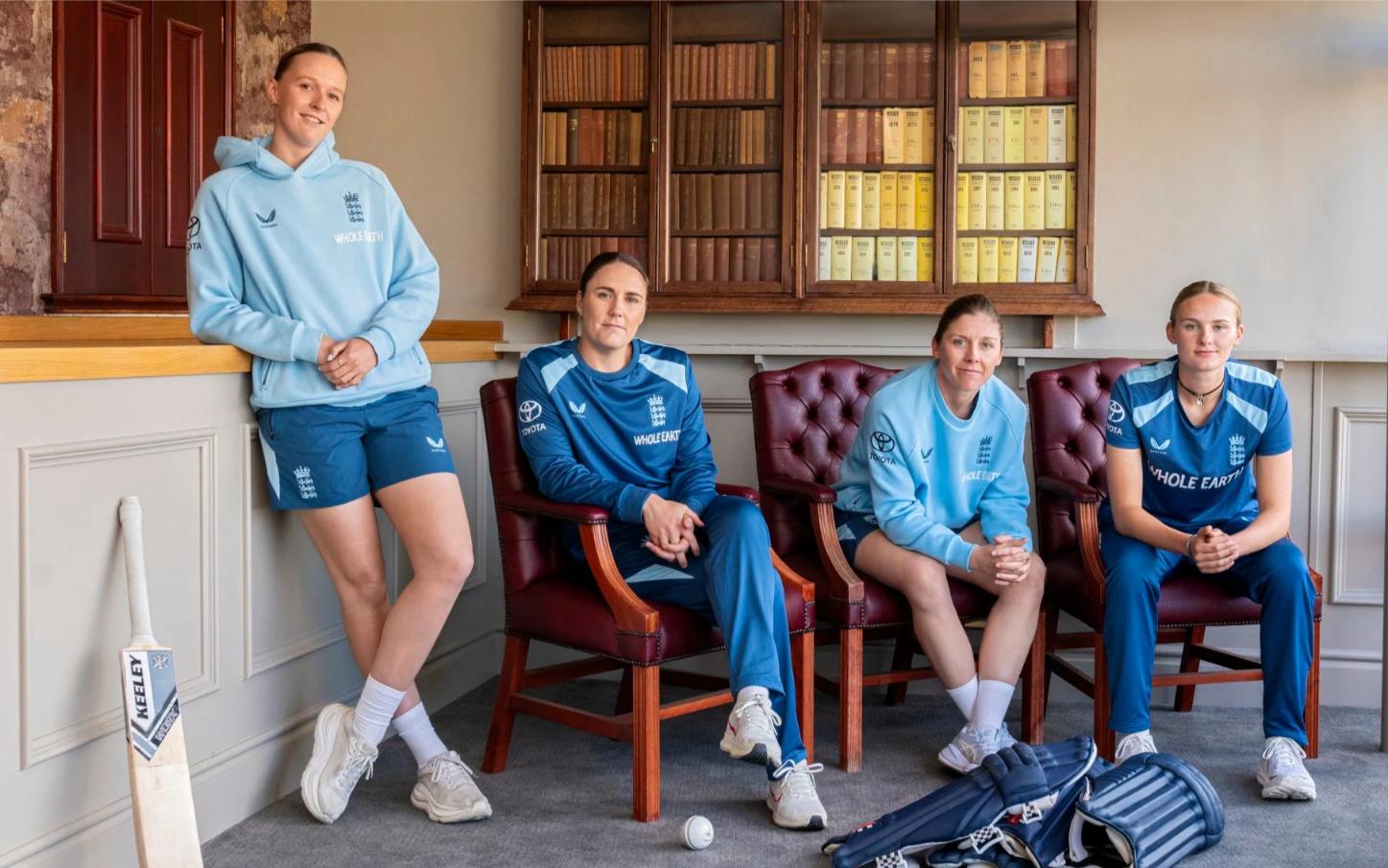
Her job is not an easy one. Apart from on-field performance, she is also managing an intergenerational squad, ranging in age from 18 to 35. Corteen-Coleman may be a rookie and Filer barely three years into her England career, but they already appear to be a tight-knit unit alongside the old guard of Sciver-Brunt and Knight during our photo shoot.
Off the pitch, things are shaping up for this to be a seismic World Cup. Though England do not play their opener against Sri Lanka at Edgbaston until June 12, this tournament is already the highest selling in history, with ticket sales closing in on 150,000. Wider viewership numbers will also benefit from Sky Sports showing all England group matches as well as the semi-finals and final free of charge.
Knight believes that the game is in a far better position than ahead of the last home World Cup in 2017. “It feels like this tournament is going to start off with a big bang,” she says.
“In 2017, it was a bit of a slow build and then it suddenly took off in the semi-finals and final. I think it flipped the mindset of a lot of people in decision-making roles. When they actually marketed the final properly and put money into it and then had this amazing crowd, they were like, ‘Oh, OK, women’s cricket could be really amazing if we did it properly.’ That got everyone to take women’s cricket seriously and invest.”
Nine years ago, a then-record crowd of 27,000 packed out the home of cricket to watch the dramatic final, where England beat India thanks to a bowling masterclass from Anya Shrubsole. Later that year, Knight’s squad was crowned Team of the Year at the BBC’s Sports Personality of the Year Awards.
Still, it took a while for that impact to translate to real, tangible change across the game. Slowly but surely, more investment trickled down. The first domestic contracts were introduced by the England and Wales Cricket Board (ECB) in 2020, before The Hundred’s launch the following year put women’s cricket on the same platform as the men’s game. Since then, salaries in the competition have increased more than tenfold to six figures, while England Women gained equal match fees to their male counterparts in 2023 (though the men’s central contracts still dwarf the women’s). Press coverage has also grown, though not always positive. Most recently, players have had to deal with questions over fitness (more of which later).
Add to that the international picture, in particular the launch of the big-budget Indian Women’s Premier League, which attracts millions of television viewers, and top women cricketers from England can now earn a substantial living and have huge global platforms. England star Lauren Bell is a prime example, with 2.2 million Instagram followers, while Sciver-Brunt is considered the highest-paid team sportswoman in the UK, earning £320,000 through her Women’s Premier League contract alone, along with a £140,000 deal in The Hundred. England’s World Cup squad announcement video posted last month, featuring a cast of fans including golfer Justin Rose, F1 driver Lando Norris and Lioness Alessia Russo, was further evidence of women’s cricket’s rise. Sciver-Brunt says the picture now is “chalk and cheese” to a decade ago.
For the ECB, as well as the squad itself, the aim is to spark another standout summer of women’s sport, taking inspiration from the Lionesses and the Red Roses. Football fan Knight, 35, was in Switzerland last year to watch England’s Euros success, and they all saw the rise in women’s rugby after a home World Cup win last autumn.
“We can join that group,” Sciver-Brunt says. “We get another opportunity – and who knows how many home World Cups you get to play in – to show the country for a third [tournament] in a row how awesome women’s sport is, how it can galvanise the country, how it can inspire different people to get into the sport or come and watch a game for the first time. It’s such a massive opportunity that if you take it too seriously, it can add a lot of pressure.”
The youngest of the squad, Corteen-Coleman, is thriving under the pressure so far, and is still coming to terms with the reality of receiving the call-up for the World Cup. “No I’m not, really?!” was her tearfully incredulous reply when Edwards called to share the good news. She recalls that at that moment she was standing outside her family home with her four miniature dogs – a chihuahua, pug and two sausage dogs crossed with chihuahuas – but soon enough her name was across national media.
She is an enthusiastic interviewee and seems at ease with the attention so far, but knows it is likely to ramp up. “It’s bizarre,” she admits. “I’ve got a family group chat and everything that comes up about me is sent there – so I can’t really miss it. I keep being told not to read the comments, but I can’t help myself. I just have to have a read. You have to be able to laugh at yourself. I think the majority of people are so supportive, and the ones that are a bit harsh, I just laugh and move on with my day.”
Her teammates are slightly more world-weary when it comes to public attention, especially as Sciver-Brunt’s side are looking to overturn a trophy drought stretching back to 2017. Since that World Cup, England have not won any of the four T20 World Cups or the two 50-over editions in which they have played, losing excruciatingly in the final twice. In 2024, they failed even to make it out of the T20 World Cup group stage and the January 2025 Ashes whitewash in Australia sparked a huge overhaul.