

When Edin Dzeko decides the time is right to retire, the highlights reel of his career will be extensive.
Two Premier League titles headline an impressive collection of honours won with the likes of Manchester City, Inter Milan and Wolfsburg.
Yet the enduring image of the 40-year-old’s career may prove to be an altogether more vulnerable one.
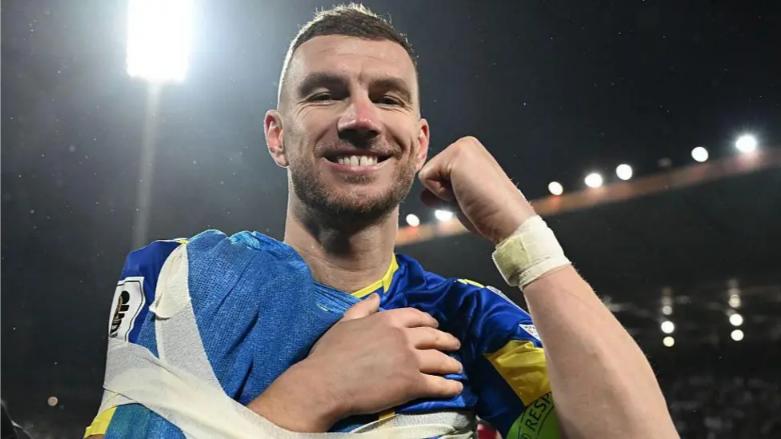
Moments after Bosnia-Herzegovina had beaten Italy on penalties to qualify for only their second World Cup, Dzeko celebrated cautiously while nursing his arm in a sling.
It’s the kind of wear and tear you might expect for a man who for almost 20 years has carried the hopes of a nation still deeply affected by past horrors.
“His career is connected to the country’s own image – resilience, persistence and proving people wrong,” Bosnian journalist Sasa Ibrulj says of Dzeko.
Placed in a relatively even group with Canada, Switzerland and Qatar, the final chapter of Dzeko’s story as a player could be the beginning of a new one for his country.
His team’s campaign begins against co-hosts Canada (Friday, 20:00 BST).
The Bosnian Diamond – as Dzeko is known – was forged against a backdrop of war and suffering.
Dzeko was six years old when the Bosnian War began in 1992, a conflict that cost the lives of around 80,000 fellow Bosnian Muslims. The Srebrenica Genocide perpetrated by Bosnian Serb forces was the largest massacre in Europe since the Holocaust.
His family remained in Sarajevo during the near four-year siege of the city, as Serbian snipers targeted civilians including children. He moved to live with his grandparents after his parents’ house was destroyed.
“It was terrible,” Dzeko told the Guardian. “The whole family was there, maybe 15 people all staying in an apartment about 35 metres square. It was very hard. We were stressed every day in case somebody we knew died.”
A young Dzeko often played on a local football pitch, but one day his mother made him stay at home; that day a shell hit the field and killed several children.
After the war, Dzeko began his football journey with local club Zeljeznicar, but in his early career went largely misunderstood.
He was nicknamed Kloc – local slang for lamp-post – because of his lanky appearance, and Zeljeznicar directors could not believe their luck when Czech side Teplice offered to buy him for 25,000 euros.
Years later, Dzeko became the first player to score at least 50 goals in the Premier League, Bundesliga and Serie A, but he did not forget his roots amid superstardom.
He has made several donations to aid renovations at Zeljeznicar, and in 2009 became Bosnia’s first Unicef ambassador.
“People remember that he did not come from privilege or from a powerful football system,” says Ibrulj.
“What makes him different is that people in Bosnia have never experienced him as distant or untouchable.”
Dzeko’s friend, Mirza Trbonja, told AFP: “When he comes, you need a lasso to catch 10 minutes with him. When someone asks him for a photo or autograph, he never refuses.”