

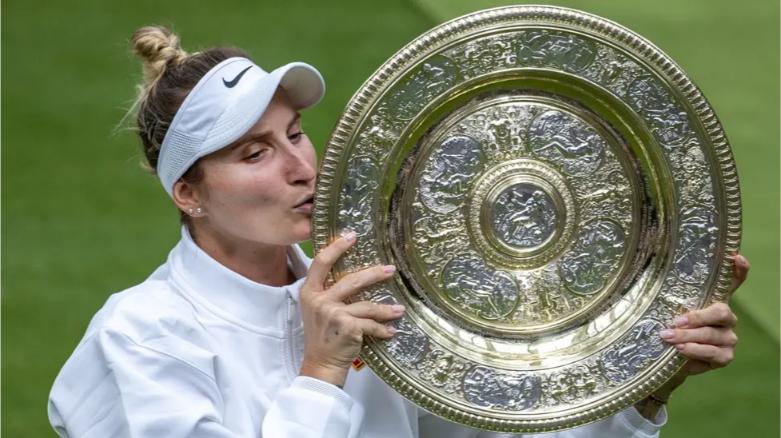
Recent Wimbledon champion Marketa Vondrousova receiving a four-year ban for refusing to take a doping test was a punishment which sent shockwaves through tennis.
The Czech, who became the first unseeded player to win the Wimbledon women’s singles title in 2023, would not let a doping control officer into her Prague home to conduct the test in December 2025.
In June, it was announced the 27-year-old would be suspended for four years – the starting point for any player who refuses or evades a test.
On Friday, the independent tribunal which imposed the punishment released its full written report about the case – which it described as a “very unfortunate matter” but which offered “no compelling justification” for a shorter ban.
From how walking her dog undermined her case, to the lack of understanding players seem to have about doping rules, BBC Sport analyses some of the key findings.
An 8pm visit and panicked texts – what happened?
Vondrousova, who also reached the French Open final in 2019 and won the Tokyo 2020 Olympics silver medal, claimed she feared for her safety when the doping officer arrived at her flat at 8pm on 3 December.
She was alone in her apartment and told the officer via the intercom that she would not open the door.
The tribunal’s report said Vondrousova called her agent to ask about doping protocol, and sent a text message to her boyfriend which said someone from doping control had arrived – using an expletive to describe them.
There is some dispute about what happened next, with the doping officer saying the pair had two exchanges over the intercom, but Vondrousova saying there was only one.
Both sides agree they met face-to-face about 10 minutes later when Vondrousova went outside to walk her Italian Greyhound dog.
That is when Vondrousova reiterated she would not take the test and signed a form which acknowledged her stance.
The International Tennis Integrity Agency (ITIA) – the body tasked with overseeing a clean and fair sport – said it had little option other than to seek a four-year suspension.
The tribunal agreed with the ITIA. It ruled she had provided “no compelling justification” for refusing a test.
On Friday, the tribunal said: “This is a very unfortunate manner in which the player made a decision in the heat of the moment to refuse doping control, in a state of stress and anxiety, with significant consequences.”