

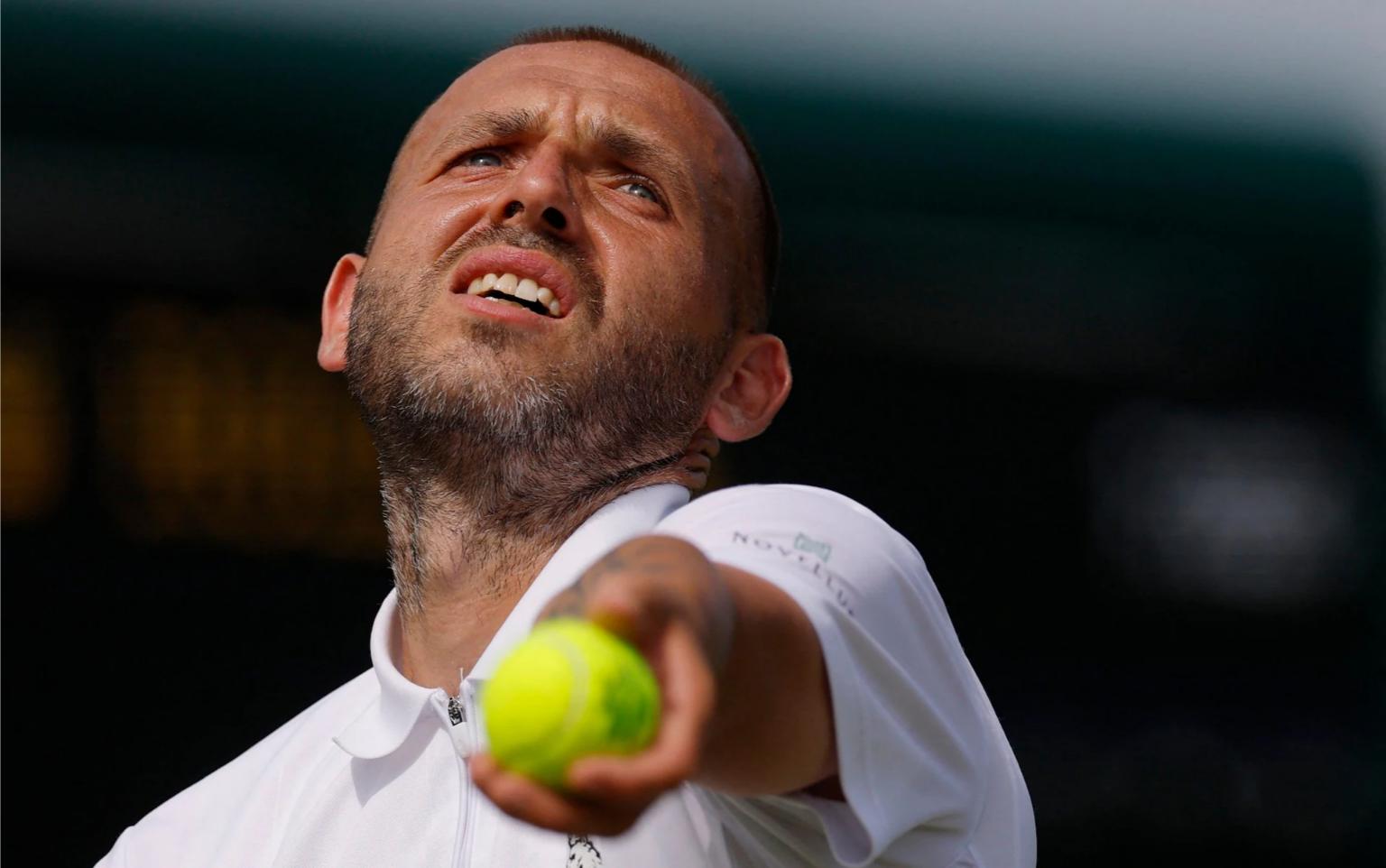
Dan Evans, the former British No 1, has criticised the Lawn Tennis Association (LTA) for refusing to support his case for a wild card into the main draw at Wimbledon.
While Evans has been a controversial figure at times, he is also a Davis Cup stalwart who always represented his country with pride. His 42 matches for Great Britain place him seventh in the Open-era list, behind such reliable performers as Tim Henman, Greg Rusedski and John Lloyd.
Yet the LTA declined to recommend Evans – who recently announced that he will retire after Wimbledon – for a wild card into the tournament’s main draw, preferring such household names as Harry Wendelken (the world No 203) and Felix Gill (No 220).
Evans delivered a vintage performance on Monday to storm through his first round at Wimbledon qualifying, and afterwards, when asked whether he had been surprised when his name failed to show up on the list, shook his head.
“I had a fair idea when I wasn’t getting wild cards into Queen’s,” he told Telegraph Sport. “I think that’s my anger. And Ilkley. I mean, I think I deserve a wild card into a Challenger.
“Listen, I just feel the LTA poured fire on my chance to get a wild card,” added Evans, who is 36 years old and has been kept off the court by calf trouble for much of this season. “Because why would the All England Club give me a wild card if the LTA are not giving me ones into their events? It’s not personal against anybody, but I just think I deserve a wild card into those events in my last year.
“I know tennis people who know a lot more than the people in Britain. I wouldn’t say we’re the most knowledgeable country in the world, and I’ve had messages from people you wouldn’t believe, who are a lot more qualified than the people in that building.”
Evans nodded towards the LTA’s headquarters, which backs onto the qualifying courts at Roehampton, as he finished this comment. We both knew who he was alluding to, when he referred to “messages from people you wouldn’t believe”. Although he would not be drawn into confirming the name, it is worth remembering that Evans used to receive regular invitations from Roger Federer to join him in training blocks in the bijou Swiss village of Valbella.
Why, then, did the LTA overlook Evans for one of their eight wild-card recommendations? “There’s all sorts of reasons, isn’t there?” said Evans. “They want to go with youth, that’s fine, but, let’s not forget, there’s been plenty of youth out there who didn’t step up when we needed them to at Davis Cup. Plenty of people who didn’t hang around for the last matches at Davis Cup.
“I don’t know who makes the full decisions, but I said to my friends and my family, ‘Listen, it’s best that it happened at the end of my career rather than at the start, when I really needed the wild card.’”
Evans was speaking shortly after his entertaining 7-6, 6-3 victory over Bolivia’s Juan Carlos Prado Angelo, the world No 156. A sun-washed crowd of some 800 people relished the opportunity to watch him rush the net and stroke away his picture-perfect volleys: a style of play that now feels like a throwback to the golden age of tennis.
Despite never having played a professional match on grass before, Prado Angelo acquitted himself well in the early exchanges, and served for the first set at 6-5. At that moment, though, Evans managed to find a burst of adrenalin, breaking straight back and playing a wonderful tie-break that reminded everyone present of how he had reached a high point of No 21 in the world.
In among the flourishing shot-making, we saw some classic Evans moments – as when he told 20-year-old Henry Searle, the former Wimbledon boys’ champion whom he has been coaching this season, to stop watching him and get out of the heat, because Searle was due to play his own first-round match later in the day.
In his on-court interview with Annabel Croft, Evans accentuated the positives. “I haven’t played a bunch of tennis, and obviously I’m stopping, so this felt more like my first win than my last,” he said. “I was very nervous at the start, and especially at the end. So, I’m really happy and proud of how I came through that. It’s been a difficult season, but I’ve built a career through fighting in my matches.
“When I played qualifying the last time [in 2018, after he came back from a year-long ban for the recreational use of cocaine], it wasn’t such a big arena,” added Evans, who will play Australia’s Tristan Schoolkate in the second round of qualifying on Wednesday.
“It was actually really nice [to play here]. I don’t want to say surprising, but it was full, which is a little different to other tournaments in Britain.”