

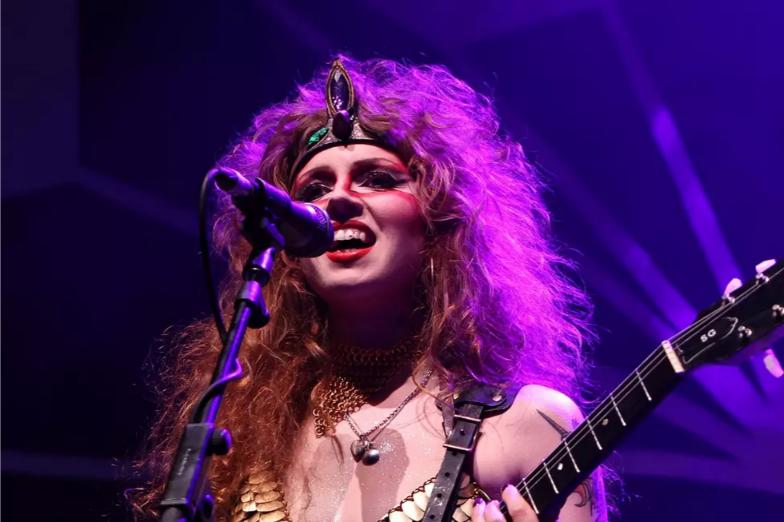
Castle Rat’s “rat queen” Riley Pinkerton has seen some interesting responses as the band’s profile continues to rise, but she got a good laugh out of the suggestion that their very much DIY group were “industry plants.”
While speaking with Full Metal Jackie about their latest album The Bestiary, Pinkerton was asked about the surprisingly quick response when the band turned to Kickstarter to work on the album. They met their financial goal in 37 minutes, leaving a full month with additional funds coming in.
While that response was “mind-blowing,” it just adds an extra element of pressure and let’s you know how invested the fans are. But it also led to some interesting responses.
“I don’t go on Reddit or anything, but my bandmates do. And so I hear reports back of people being like, “They’re industry plants,” which is hilarious and a compliment,” says Pinkerton. “I’m like, damn, we’re doing all this super DIY and you think that we’re industry plants. That’s the funniest comeback, because other people will chime in and they’ll be like, ‘Who would plant a medieval rodent-themed doom metal band in the industry and be like, ‘You know what’s really gonna make us money? This rodent-themed medieval doom metal band.'”
Within the chat, Pinkerton speaks with Full Metal Jackie about the themes running through The Bestiary album, having a trajectory for displaying their musical influences and offering a hint of where they might go next and sacrificing some of the control in her band to make it a more collaborative process for the group.
Pinkerton also talks about creating the lore for their theatrical stage show, learning to sword fight and what she’s picked up from touring with Amon Amarth and Dethklok.
Check out more of the chat below.
It’s Full Metal Jackie, and I’m so excited to welcome to the show for the very first time, the one and only Rat Queen. That’s right, we’ve got Riley Pinkerton from Castle Rat with us. Things are going well for Castle Rat right now. We’re here to talk about their excellent album, The Bestiary, and what has to be a dream tour with our friends in Dethklok and Amon Amarth. Riley, there’s been viral attention to what is a very theatrical live show. How much would you say that the visual presentation played into what you wanted musically on The Bestiary?
The music always comes first. That’s first and foremost within Castle Rat. When I set out to start the band, there were no plans for costumes or theatrics. We were just gonna be a doom metal band. And then we played a Halloween show, and then we were in costumes, and I was like, “Wait, this is very fun and very liberating.” So I was like, “Let’s just do it every time,” ’cause when something is fun, I like to do it as much as possible.
The Bestiary, I had a loose concept of a book of beasts and had sort of a checklist of mystical creatures that I wanted to write songs for. And then we did a lot of retrofitting in Castle Rat, where I’m like, “All right, I wanna do this thing,” and then later I will make up a reason why.
Afterwards I will make the lore and it will somehow all make sense. I’ll just make it up as I go. Which is good when your lore contains interdimensional time travel. You can pretty much get away with anything.
Castle Rat is still very much a work in progress. The first album was primarily you, but The Bestiary is a more collaborative effort. And in listening to it, it feels so rooted in and ’80s-era metal. Can you speak to opening it up to a more collaborative experience and share both a moment on this record that is very much your influence and one that you love that comes from one of the other members?
It was a learning curve for me. We set a really ambitious timeline to write and record an album, ’cause we wanted to follow up the first record really quickly. And there were tears on my end. No one else cried. It was just me. But I was learning to put my ego aside and allow myself the great honor of working with such talented musicians that I am blessed to be in a band with.
I think part of me being a woman in music and in metal, it takes a lot of pride and feels like it’s very necessary to prove that I can do anything and everything. So that’s always been my hesitation in collaborating because I’ve gotten offstage and someone will be like, “Oh, those guys,” meaning the men in my band, “write really great riffs.” And I’m like, “What the heck? I wrote all of that.” And I’m playing guitar on stage. But they would just be like, “Yeah, your guitar player writes great riffs.” And I’m like, “Hang on a second.”
I think that’s a unique experience of feeling like I have to prove myself on this other level that is just unique to being a woman in music.
But I’m gaining confidence in, like, “Okay, I’ve, I started this thing. I’ve created something that’s bigger than myself and I have such talented people around me. I should learn to ease up.” This whole process is me learning to let go of control in certain areas in order to make it a more sustainable thing because now it’s bigger than myself and people want albums and music videos and I wanna deliver on it.
Riley, we were talking about how this one came together more collaboratively. So which songs really reflect that?
One of the most collaborative songs was “Serpent,” where I’d written a much doomier version of the song. And we all were throwing different parts in it and we all hated it. And we all hated different parts of it. I was like, “This isn’t good.”
So kinda last minute, I was like, “We’re scrapping the song. I’ll keep the lyrics.” And we wrote it in the room together, which was the only time that we started from scratch together, where I had a melody. And then Josh, the all-seeing druid on drums, brought in the rhythm. Franco had this great walk-down thing that was proposed for another song and we were able to pull it into “Serpent.” And the chorus, the boys played it and I sang over it and I sang in a way that I never would have if I were at home writing it by myself. And it blossomed into a really beautiful thing and it’s one of my favorite songs on the album.
And “Siren” is another collaborative one that Franco, the count of Castle Rat, brought forward the idea of ending with a thrashier riff. And then the other part of the question was…
One that you love that comes more from one of the other members.
Franco wrote “Path of Moss,” which is just this little guitar interlude that is so moving where I kind of gave them the leeway. I think it’s the last track on “Melissa” by Mercyful Fate, but they have a very melodic kind of finger-picky kind of little sappy metal moment.
I was like, “Franco, give us, give us one of those.” And he sent me that recording and I remember I was at home in my apartment, and it was, like, 6 in the morning, and I listened to it and I just cried. And I was like, “I didn’t know Franco had such deep feelings within him.” And yeah, it’s just such a beautiful moment on the record.
Riley, we were just talking about some of the influences. Like I said earlier, there’s a very ’70s and early ’80s vibe to what we’re hearing. But you’ve said in other interviews that you’re not looking to get pigeonholed by a particular sound. First, what music led you down the path we’re hearing now on The Bestiary and are there places you’d like to take it in the future?
Definitely. I think it’s pretty clear that Black Sabbath is a pretty major influence. It’s inescapable. With this album, we pulled references from Judas Priest and Iron Maiden, and intentionally pushed it to later ’70s, early ’80s, where I feel like our first album is more like late ’60s, early ’70s.
And seeing as we have time travel as an option in the lore, my goal is to maybe push it into the ’90s for the next album. I’m a huge Type O Negative fan.
My favorite band of all time, Riley.
Yeah. Same. We currently have a little playlist that we’re all dumping ’90s inspo into. So it’s fun. I’m excited to [get to it]. I want to push the boundaries a bit and see how much we can change our sound while still remaining Castle Rat.
I’ve been joking and being like, “We’re gonna write an industrial metal album,” and I feel like sometimes Franco is like, “Oh no, that might be too much of a departure.” And I’m like, “I don’t mean it. I don’t mean what I say.” It’ll be through the Castle Rat filter and it will have our influence and flavors, but it’s always gonna be our own thing.
But yeah, we’re headed for ’90s goth.
I dig it.
Maybe. I want, like, October Rust sense and feel.
Yes, now you’re speaking my language.
Riley, there is a love and passion for a fantastical world in the music that you write. It’s something you used to see a lot more of in metal. I’m assuming there’s a love for that type of storytelling and I was curious if there’s a particular book, series, movie that kind of sparked your love for exploring the fantasy elements. And is there anything more recent that’s piqued your interest?
Yeah. I grew up going to renaissance festivals. There’s a really good one in Michigan that I grew up going to. I loved dressing up and that immersive world thing, the escapism of fantasy. When I was really little, I reread all of the books in The Chronicles of Narnia multiple times because to me, you couldn’t beat talking animals. My ideal world is talking to a bunch of animals more so than people. And hence The Bestiary,
Then later on, I got really into Frank Frazetta’s artwork which is a huge aesthetic inspiration for Castle Rat. The way he depicts women as strong and sultry and he gives them exaggerated figures. But he grounds the fantasy in very realistic details of stretch marks or dimples on thighs or backs of arms that hang when their arms are outstretched. And they look powerful and real. And I don’t know, that’s something that I really try to capture with Castle Rat on an aesthetic and performance level is we’re presenting a fantasy, but it’s a warts and all thing.
Costumes that are threadbare or I forgo nylons onstage, and there’s plenty of photos where I have the initial knee-jerk reaction of, like, “Oh, no, I’m not perfect,” and then I think again and I think about Frazetta, and then I’m like, “Cool, that’s gonna go on the Instagram,” and hopefully that helps someone else feel comfortable in their body the way that looking at his art helped me kind of feel more empowered by being a natural person.