

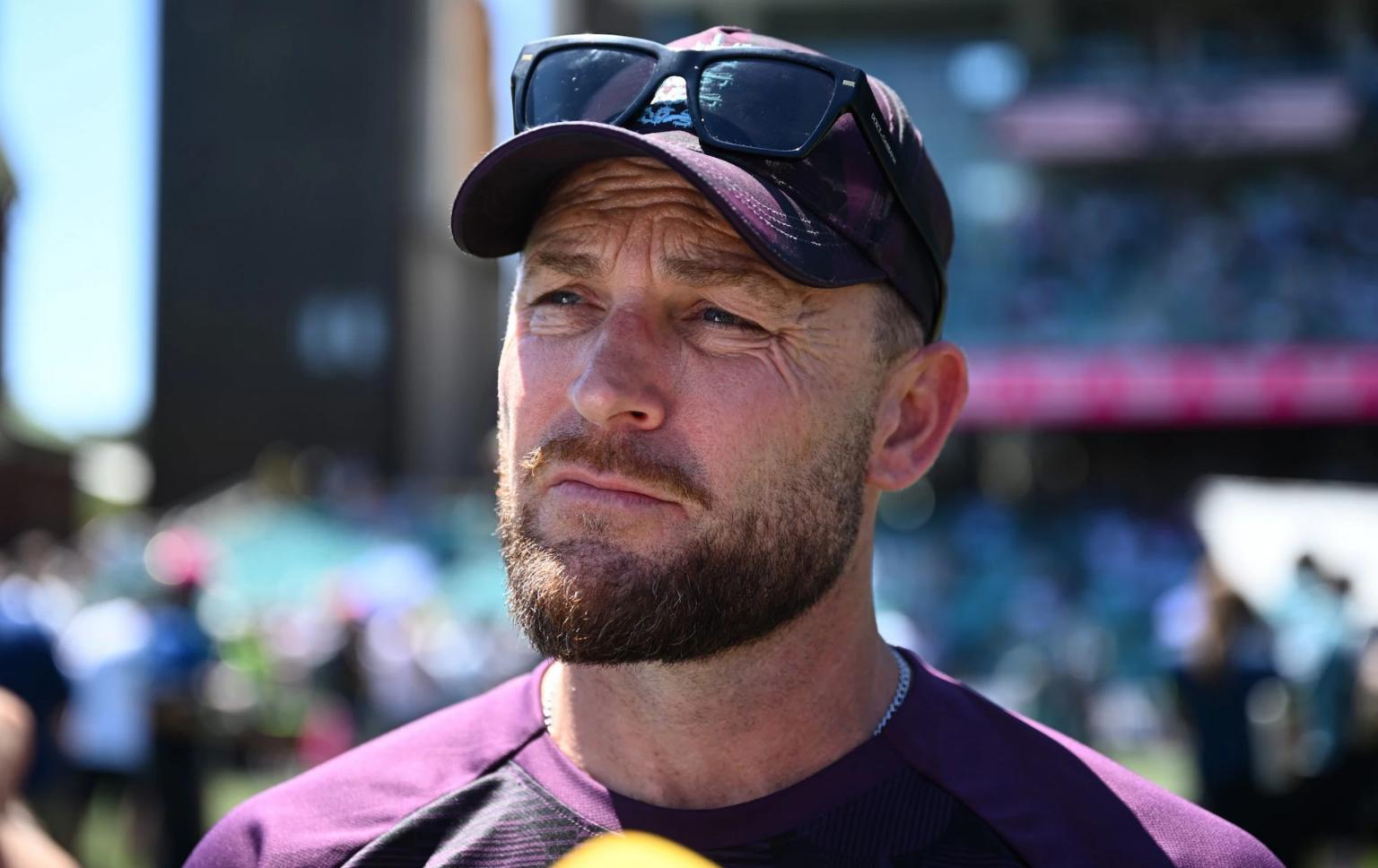
Brendon McCullum is back and faces a test of character and skill as head coach. He must prove a seriousness beneath the carefree exterior to win back a sceptical public.
McCullum landed in the UK over the weekend and went straight to Loughborough where England will reacquaint themselves at a training camp this week after almost six months apart since the end of the Ashes in Sydney in January.
It has been a long break for the Test side. McCullum was due a holiday after the Twenty20 World Cup where he saved his job by convincing the England and Wales Cricket Board (ECB) that he is willing to listen and change.
Now, essentially reappointed to the role, he has 17 Tests in 14 months to the end of the next Ashes (it could be 18 if England add an extra one as a warm up before next summer’s home Australia series) and his contract.
What has changed? McCullum has accepted a beefed-up backroom team after four years of insisting on a light-touch coaching staff. Sarah Taylor joins for the New Zealand series as fielding coach with Will Gidman from Durham and Mike Yardy, the England Under-19 coach, added to the set up. There is even a professional chef on hand to make sure the players eat properly and do not live on takeaways. It is commonplace in professional sport for teams to employ a chef but new for this England, and a surprise considering McCullum had the team’s nutritionist moved on in his early days for banning bacon sandwiches.
Marcus North was recently appointed the national selector and knows the county game inside out from his time as Durham director of cricket. He also has inside knowledge of England from his players involved in the Bazball years, especially Ben Stokes.
Emilio Gay is set to replace Zak Crawley as opener having served his apprenticeship in county cricket. Ollie Robinson is back to lead the attack. The coach’s view of that will be fascinating considering Robinson was never left out because of his lack of ability with the ball.
And what about Stokes? We are told talks have happened and the coach and captain are on the same page again. Does that mean Stokes emerging from his go-slow with the bat approach in Australia and embracing a more freewheeling style, or McCullum accepting the captain’s view that the team’s ultra-positivity is too easy to work out. In cricket, the captain is king. The coach must fall in line but these are two big, stubborn personalities used to getting their own way.
Stokes wanted the coaching staff expanded and won that argument. England will also play warm-ups on all three of their Test tours this winter, another nod to the mistakes made in Australia.
What has not changed? The same assistant coaches are in place with Marcus Trescothick and Jeetan Patel surviving the Ashes review, possibly thanks to McCullum’s loyalty and support.
Rob Key is still his boss and the Test side will look very familiar if Jacob Bethell recovers from a damaged finger to play the first Test against New Zealand at Lord’s on June 4. Tim Southee, McCullum’s New Zealand team-mate, has again been given permission to join the squad as bowling coach late due to his other commitments. Jofra Archer will miss the Lord’s Test because of the Indian Premier League, unthinkable not that long ago, but accepted with a shrug.
McCullum rigidly stuck to his decision to not come back to work early, missing the entire opening chunk of championship matches when players were clinging on to their spots or fighting their way into the team. On one level, you admire his stubbornness not to play the PR game and bow to pressure. It was, however, a poor look and again suggested a casualness towards the job.
The feet up, shades-on image had its place four years ago when expectations were rock bottom and England had won just one Test in 17. Everyone needed cheering up.
A honeymoon period allowed room for experimentation and Bazball was born. Now there will be no such loosening of the rope. McCullum’s England must start well against New Zealand by playing like a well-run, fully prepared team with a head coach whose vision has more depth than trying to entertain and having a go.
At the moment it is difficult to pick a player who has improved under McCullum. Bethell’s talent was spotted and promoted but it is early days, despite the century in Sydney, and the handling of him last year was mystifying at times.
Crawley never managed to find a way to make runs regularly. Ben Duckett’s bubble burst badly last year, and Jamie Smith lost his way, culminating in succumbing to a Marnus Labuschagne bouncer in Sydney.
Harry Brook is a world-class batsman, a once in a generation player but he is reckless, like the coach. He plays just like McCullum, lighting fires one day, going down in flames the next. After the drinking incident in Wellington, two subsequent apologies and caution from the Cricket Regulator he must surely be determined to knuckle down. A heavy scoring summer from Brook would go a long way to changing the perception of England.
Shoaib Bashir was picked and protected only to be left out for the series he was groomed to play. You can put that down to the management, not just English cricket’s long-running spin weakness.
One of the recommendations of the post-Ashes review is that McCullum speaks to the media more often and he will do so at the end of this week for the first time since returning to the UK. At an event for an ECB sponsor, he will be expected to lay out his vision for the next 18 months and reveal what he has learned and will change.
Previously, he has done few media interactions, preferring the players to speak after wins and fronting up himself after defeats. It is a noble way of allowing the players to take the credit but it often means that when McCullum speaks he is naturally on the defensive and his comments can wind up supporters.
McCullum is paid far better than his predecessors, a salary believed to be in seven figures, and handed more freedom than them as well as a second chance after an Ashes humiliation. It is almost unprecedented. Duncan Fletcher left a few months after the 2006-07 whitewash in Australia, Andy Flower exited when England lost 5-0 in 2013-14 and Trevor Bayliss only survived in 2017-18 because he had only been in post less than two years and the target was the 2019 World Cup. There were no reprieves for Chris Silverwood and Ashley Giles four years ago.
McCullum is lucky that despite four winless series against India and Australia. He has another chance and must quickly and decisively rebuild his reputation and that of his team. His bosses are confident he has listened, learned and will come back better. We shall see.