

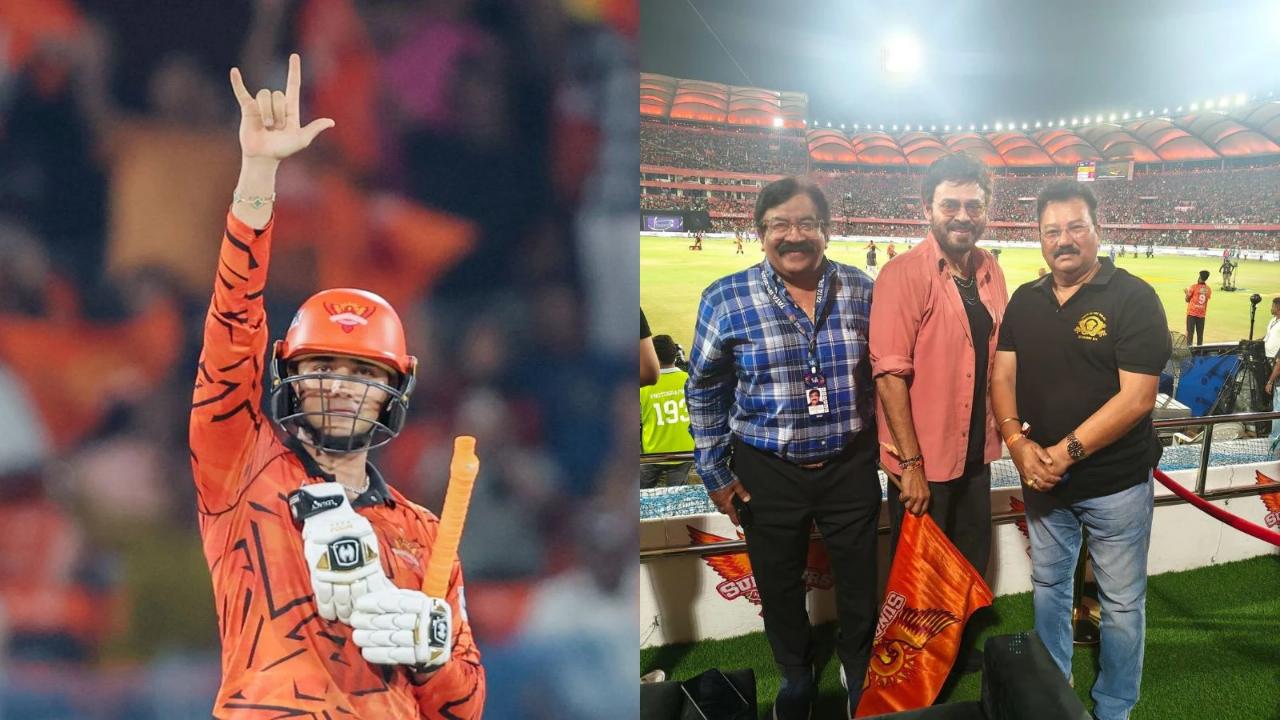
On Tuesday night, Abhishek Sharma had just hit 135 off 68 balls. The stadium in Hyderabad was still making the noise it makes after something like that. The presentation microphone was in his hand. And in that moment, with all of it around him, Abhishek Sharma thought about his father.
“I don’t know how, but since my Under-12 days, my dad has been sitting next to the screen all the time. Whenever I am at the non-striker’s end, he always tells me how to play a certain shot. It’s still going on. I want one of the cameras to go to him next time and just see his reactions.”
Raj Kumar Sharma was near the sightscreen. He is always near the sightscreen.
It started when Abhishek was playing junior cricket in Punjab. Sharma Sr would travel across the state, find the stand nearest the sightscreen, and sit. Not cheer. Sit and watch. From there he could read a bowler’s wrist. He could see the seam position shift, the change-up being loaded, the field setting into a trap. Over years, across hundreds of matches, the two of them built a language across the ground—a sign for he’s tiring, a sign for don’t play that shot now, a sign for wait.
“I would not let him play a bad shot,” he tells The Indian Express. “I would sign to him—a bowler is tiring, or trying variations, and you don’t have to play a wrong shot.”
The conversation has never stopped. Abhishek is 25, has a T20 World Cup medal, holds the highest individual T20I score for India, sits at the top of the ICC T20 rankings. They still talk across the ground in the language they made.
“Abhishek was delighted to see me at the same spot like junior days, ” Sharma Sr says of Tuesday. “And perhaps that was the reason he remained unbeaten till the last over. He wanted to show me.”
Of all the shots this IPL, one in particular stays with him. A six off Matthew Short—Abhishek creaming it so clean the ball landed outside the stadium in the match against Chennai Super Kings last week. “I liked that one,” he says.
***
Almost every IPL match, his father has been there. In early years, Sharma Sr watched his son bat down the order—at six or seven, a position that made no sense for a player of his ability.
“Abhishek nu down the order ghalde sige.” They would send Abhishek down the order. “While I did not say this to anybody, but I would tell myself—they are wasting his talent by sending him at 6-7.”
He did not say it to Abhishek. “I would only tell him: we have to work hard.” He kept travelling. He kept finding the seat by the sightscreen. He kept signalling.