

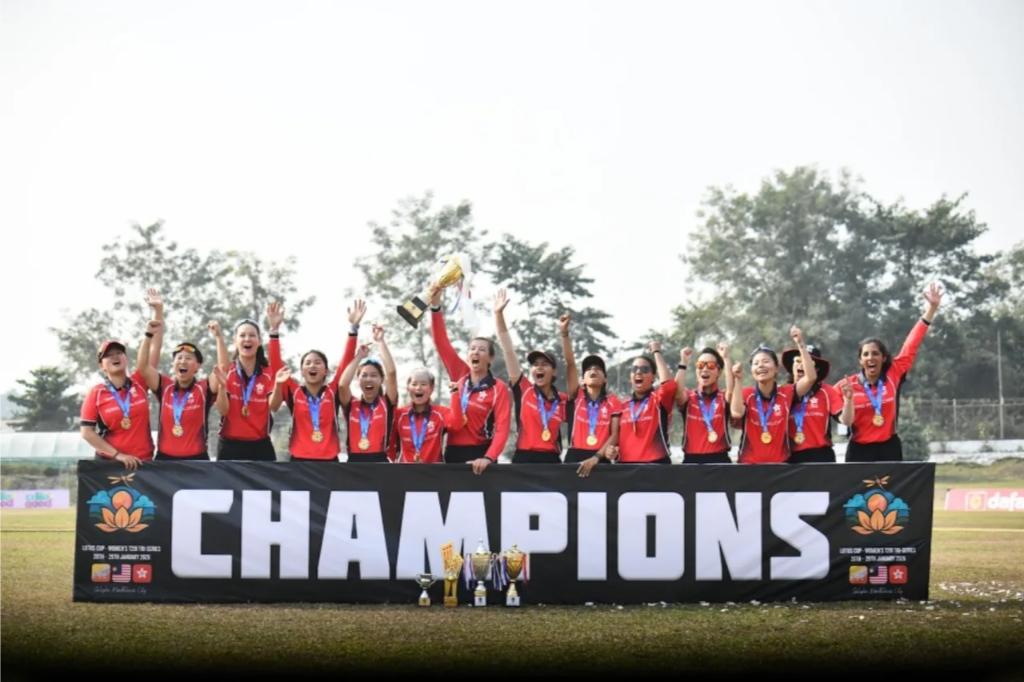
Natasha Miles vividly remembers what got her interested in cricket. Her father, Rodney, “a huge fan of cricket”, would play and organise overseas tours for clubs based in Hong Kong. Twelve-year-old Miles and her mother accompanied him on one such tour. The sight of players in whites, playing on a lush green outfield, and the distinct sound of bat hitting ball fascinated her.
When back home, she wanted to play cricket just like her father, who later became the president of Cricket Hong Kong (CHK, then known as the Hong Kong Cricket Association). At the time there were no avenues for women’s cricket in the country, but she found a way. The Hong Kong Cricket Club (HKCC), where Rodney was a member, had a youth programme called Gappers – for where the club was located, on the Wong Nai Chung Gap Road – for boys under the age of 13; Natasha enrolled there.
Her mother, Anita, fuelled by her daughter’s eagerness, developed a desire to learn to play. She gathered like-minded women who loved sport, and wives of players in the HKCC, to form a team. She also reached out to CHK to see if she could get some of their female staff to play. During the 150th anniversary celebrations of HKCC in 2001, the club played a women’s exhibition match, which was later recognised as being the start of the journey of women’s cricket in Hong Kong.
“My mum had always wanted to learn cricket because my dad played, but never took the time to start until then,” Miles, 37, says. “We both sort of went on that early journey together. From where it started, where it was me, and I think one other girl that played a little bit of the Gapper stuff at the time, to where we are now, with three thriving divisions and a good premier league, which is our top of the pile, and lots of junior cricket going around – I think it is quite an impressive achievement that Hong Kong have maintained.”
In 2004, CHK launched its first women’s league. In 2006 the first-ever Hong Kong Women’s team was named, with 18-year-old Miles in it. They toured Pakistan for three matches in September that year. Now, the side, captained by Miles, will play in the Women’s T20 Asia Cup 2026, 14 years after that first appearance.
Hong Kong is a tiny country, about 75% of the size of Delhi, and cricket is not a popular sport yet. Infrastructure for the game is limited. The Mission Road Ground, which regularly hosts internationals and the Hong Kong Super Sixes, has outdoor nets, and is the main facility. There are indoor facilities at the Craigengower Cricket Club and the HKCC, both private clubs. Those clubs also each have their own ground but those are smaller than traditional cricket grounds. And then there is the Hong Kong Sports Institute (HKSI), where mainly athletes playing Olympic sports train, but cricketers can access it for gym and fitness sessions. Players’ sessions are divided across these venues. Going from one to one of the others takes about 30 minutes to an hour, depending on the mode of transport.
Work days are pretty stretched for former India captain Mamatha Maben, Hong Kong’s new head coach and easily their most high-profile women’s coach to date. She was Karnataka’s head coach when they made their first-ever final of India’s Senior Women’s One Day Trophy in 2021-22, and then again the following season. She has been part of the coaching staff at Velocity and Supernovas in the now defunct Women’s T20 Challenge, the tournament that was the precursor to the WPL. She also has coached Bangladesh women in the past, and held consultancy roles with China in the last decade, and Namibia more recently, from August 2023 to November 2024.
Maben was given a three-year contract last December. The role itself wasn’t the hardest part. “The main thing for me about this relocation to Hong Kong was my pets – I have six pets at home! I don’t mind leaving human beings behind, but I travel back home twice or thrice a year for my pets,” she says with a laugh.
“I saw this role as a challenge, one that will help me grow and evolve but also something that will raise the standard of cricket in Hong Kong. Coming from a Test-playing nation, infrastructure is a given for us, but here it is slightly different. I have to travel a lot, sometimes to two-three places in a day for training sessions. But I was prepared for all this, thanks to my stint in Namibia.”
Unlike during her tenure with China, language was not a barrier for Maben with the Hong Kong side. Most of the players speak and understand English, and help translate for the newer ones who don’t. That made it easier for Maben to make her goals clear to the players.
“The players have pulled up their socks by about 40-50% since I have joined,” she says. “We have made strides in a few departments but they still aren’t where I want them to be. I want to get all of them to think like international cricketers, which will come with more games against higher-ranked sides.
“Because I was so used to training elite athletes, I used to crack the whip early. But we have had open dialogues and those have helped.
“I have told them that I cannot come down to [their] level to coach. Then we won’t make any progress. I’ll try and come down a little, you bump up, and then we’ll go up from there. I have told them that I will crack the whip from time to time, because I won’t be okay with mediocrity. I think they have taken it in the right way and I see that in the progress we have made.”
Hong Kong beat higher-ranked Nepal in the ACC Women’s Premier Cup, the qualifying competition for the Asia Cup, in June this year. They won every game in the league stage before losing to UAE in the semi-final. In May they won a tri-series, beating China and Malaysia, teams who pipped them at the Asian Games Qualifier later that month.