

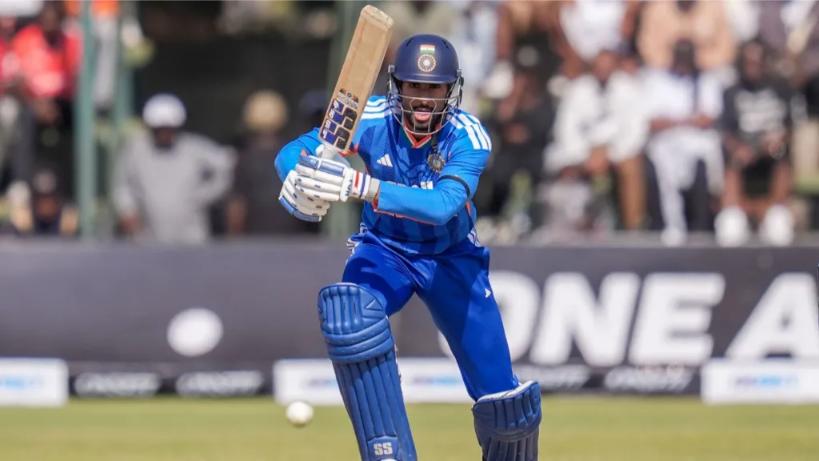
Before India’s three-T20I series against Zimbabwe, Tilak Varma had ventured his views on the strike rate discourse: only if the team does not lose early wickets, he can hit boundaries from ball one. On Saturday, he let his willow back his words, hitting five fours and three sixes in his unbeaten 29-ball 60, the first of those boundaries coming off the second delivery. India, banking on the vice-captain and Ishan Kishan’s exploits, scored 219/5, securing a 90-run victory, and subsequently, the series, as Zimbabwe could only muster 129.
The final scorecard, India’s sixth-highest T20I total away from home, suggests a comfortable evening. For a brief while, it looked anything but.
Abhishek Sharma‘s lean run continued as he fell in the second over, meekly pushing a Blessing Muzarabani delivery straight to Ryan Burl at backward point. Vaibhav Sooryavanshi briefly restored the momentum with three fours and a six off Richard Ngarava, only for the left-arm quick to exact revenge. Just as it had in England, the short ball exposed the teenage prodigy.
The next phase of play highlighted a quality that has been found wanting in Indian cricket in recent times, role clarity. Kishan, riding a rich vein of form, assumed the responsibility of boundary-hitting. Captain Shreyas Iyer, meanwhile, played the stabiliser, ensuring India did not once again succumb to a familiar collapse.
By the halfway mark, Kishan was scoring at over 150, allowing Iyer’s run-a-ball approach to coexist without dragging India’s scoring rate. Their 66-run stand for the third wicket ended off the final ball of the 10th over when Iyer holed out to backward point.
At 95 for 3, with Kishan well set at the other end, caution from Varma would have served neither India’s cause nor his own. Instead, he scored the second fastest fifty of his international career, ending with a strike rate of 206.89.
The onslaught began in the 14th over. Muzarabani was re-introduced to find wickets, but all he found was shots with spite and conviction from Varma; three consecutive boundaries came off that over. In the next over, Kishan bettered his partner, with two fours and a six.
On the occasions where they could not find boundaries, the pair of southpaws did well to rotate strike. Between the second delivery of the 13th over to the first of the 18th, where Kishan lost his wicket after scoring a 44-ball 81, India negotiated 28 deliveries without playing a dot. The last seven overs of India’s innings yielded 98 runs, at 14 per over.
Comfortable with the ball
India’s start with the ball mirrored their batting, underwhelming. The first three overs yielded 23 runs, as Mayank Yadav, after what was an exemplary comeback, could not replicate either the consistency or the sharpness from barely 48 hours ago. Yash Thakur, however, needed only 11 deliveries to claim his maiden international wicket, Brian Bennett’s half-hearted scoop looping comfortably into Ishan Kishan’s gloves.
Prince Yadav struck with the very first over of his spell, a sharply directed short ball accounting for Ben Curran and ensuring Sooryavanshi was no longer alone in the catching column.