

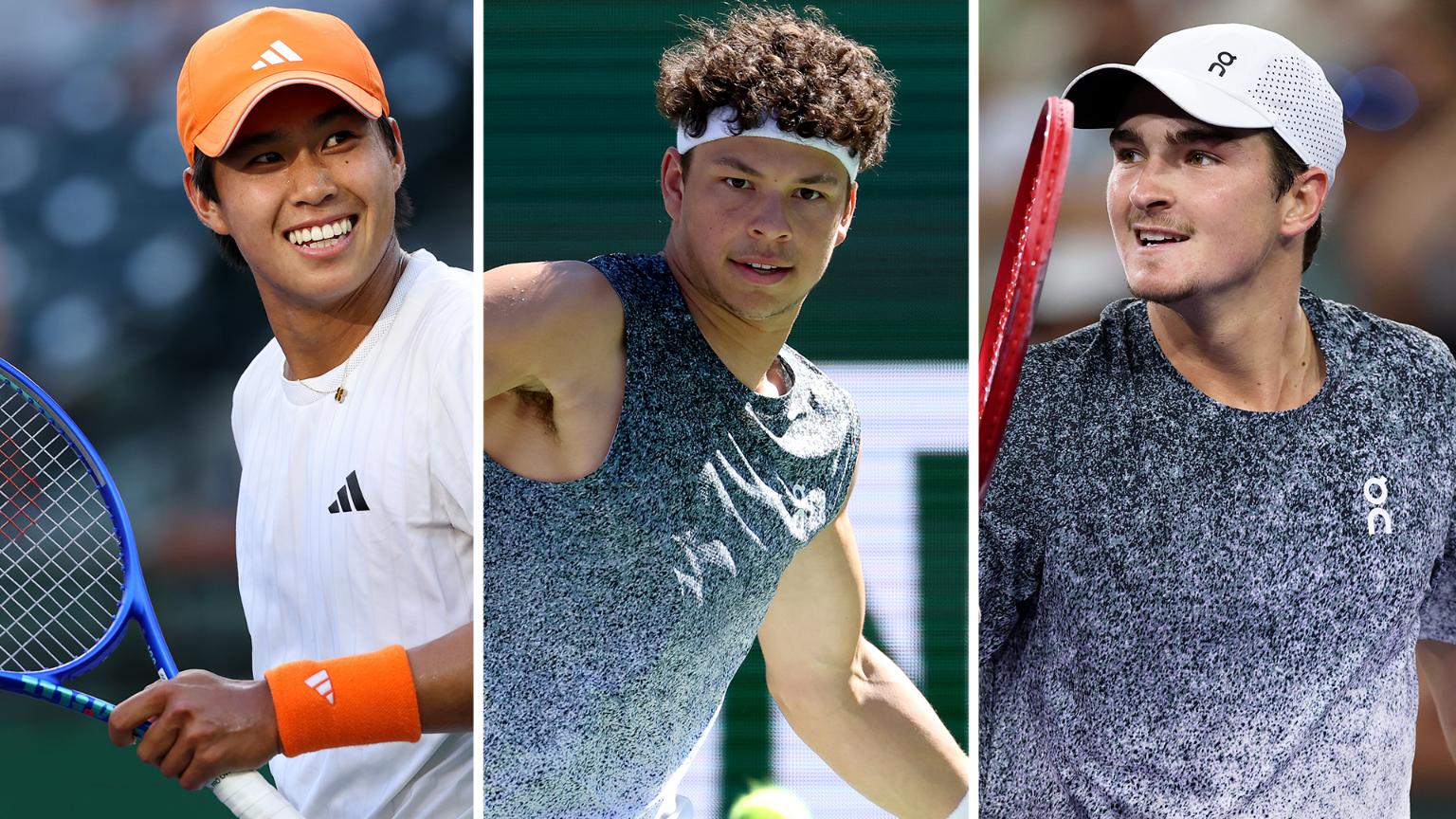
The “Third Man” has been a staple in books and film ever since the classic movie of the same name was released in the 1950s. He—or she—is usually a mysterious figure who drives or resolves the plot without having an outsized, visible role in it.
Many think that ATP tennis is currently in need of a third man, to prevent the “Sincaraz” Grand Slam duopoly—glorious as it is at the moment—from growing stale.
“[Jannik] Sinner and [Carlos] Alcaraz have pulled away from everybody for almost the last two and a half years,” supercoach and broadcast analyst Brad Gilbert told me recently. “It’s kind of like we’ve been waiting because—great as they are—it’s just the two of them.”
We were relieved to get Sincaraz to compensate for the loss of the Big Three. But our infatuation with them makes it easy to forget that a “trivalry” is in many ways even richer: Borg-McEnroe-Connors, anyone? Novak Djokovic has waged the good fight to remain the third man, but he’s 38 and there’s daylight between him and the Top 2, even if it isn’t as great as the distance between Djokovic and everyone else.
“It makes it more exciting when someone else is in the mix,” Gilbert said. “Even during the Big Three, we had Stan Wawrinka (three Grand Slam singles titles) and Andy Murray (also three majors, but 11 other times a finalist) to make things more interesting. We do need at least somebody else.”
The candidates for the third-man job must be under 25, which leaves out Grand Slam champion and last week’s BNP Paribas Open finalist Daniil Medvedev—who beat Alcaraz but lost to Sinner in the final (he’s 30)—and many of the solid veterans still vying to win a major: a cohort led by perpetual ATP No. 3 Alexander Zverev, diligent Taylor Fritz, Casper Ruud and slumping Stefanos Tsitsipas. You get the sense that if any of those bankable players punched through, it would crown his career, not launch it. So, let’s make a list of prime contenders, in order of current ranking:
No. 5 Lorenzo Musetti does not appear to be a great candidate for the role of third man at first glance, partly because he plays against type in today’s game. He’s a slender, 6-foot-1 Italian with an artistic sensibility and the ivory-billed woodpecker of tennis, a one-handed backhand. But truth: he’s ranked No. 5 for a reason.
Unfortunately, current data on Musetti is skimpy. He suffered a psoas (leg) muscle injury during his quarterfinal match with Novak Djokovic at the Australian Open. He missed the “golden swing” on clay and lost his first match back, at Indian Wells. His 1-10 record against Sincaraz isn’t encouraging, but the 23-year old still seems to be arcing upward.
No. 9 Ben Shelton was off to a good start this year, 10-1 going into Indian Wells, where the faster courts (this year) would have increased the 6-foot-4 southpaw’s chances. But he caught a viral bug and, visibly compromised, lost to Learner Tien.
Shelton, 23, has the big game coaches and pundits salivate over, coupled with a healthy appetite for performing on the game’s biggest stages. He’s just 1-12 against the Top 2, but he shows up and leads with the jaw. Eight of his nine meetings with Sinner were at Grand Slam or Masters level, with a semifinal and two quarterfinals at majors.
“He doesn’t beat the top guys right now, but his game still feels like there’s plenty of room to improve,” broadcast analyst Jimmy Arias told me. “Some of the strokes are funky, but he’s got that attitude—that belief and swagger.” As Shelton himself said at Indian Wells, “I think delusional belief or confidence isn’t always a bad thing, and I think a lot of the greats and successful people, you know, turn what seems to be delusional belief into success.”
No. 13 Jakub Mensik sent shock waves through global tennis this time last year. Just 19 at the time, he was a semifinal loser at a lowly Challenger a week before the Miami Open. But the raw-boned Czech then claimed the prestigious Masters title defeating, in succession, fellow rising star Arthur Fils, No. 3 seed Taylor Fritz, and No. 4 Novak Djokovic. It was a big statement by a big (6-foot-5) talent.
Mensik is 12-4 in tournament play this year, with a title in Auckland. He moves and slides (even on a hard court) like a nimble 6-footer. He also continues the Czech tradition of (two-handed) backhand quality, and serves thunderbolts.
Djokovic hosted Mensik for training blocs in Belgrade about three years ago and took note. After losing to him in two tiebreakers in Miami, Djokovic said: “I could see back then that he’s going to be, you know, one of the top players of the world. I’m super glad that he’s using the potential that he has, because he’s got the complete game.”
No. 21 Learner Tien is one of those cherished outliers who reminds us that there are alternate means of succeeding in these days of Buyanesque players wielding not axes but racquets strung with polyester. Tien exploded from a ranking of No. 121 at the start of 2025 to his current No. 21. Along the way he became the youngest man to beat a Top Five (Daniil Medvedev, in the AO) player in ATP rankings history.
Tien is only 20 and 5-foot-11, but upon observing his ultra-smooth game, his mastery of tactics, and his preternatural composure at the China Open, Andre Agassi told a local media outlet: “He has to overcome certain physical limitations versus other guys [but] . . . From a tennis player execution standpoint, he’s one of the few guys I say to myself, ‘(I don’t know) how would I help him get better—he does everything.’”
Tien is already 6-6 against Top 10 opponents, but has yet to meet Alcaraz and has lost twice to Sinner.
No. 26 Jack Draper, the champ at Indian Wells in 2025, showed up in the desert this year looking less like the pleasant, clean-cut British lad of yore than an action-movie hero, complete with sleeveless T (gun show!), a buzz-cut, and a lightning bolt tattoo on his left upper arm. Fair warning to his rivals.
Although he’s another towering (6-foot-4) lefthander, the secret sauce in Draper’s game is his speed. Arias told me that in a study done at Indian Wells last year, Draper clocked the fastest line speed—faster than de Minaur, faster than Alcaraz and all the rest. “I knew you wouldn’t believe me,” Arias said. “But it’s true.”
Injury, though, has been a constant torment. The latest was a deep bone bruise in his left (serving) arm that caused him to pull the plug on his 2025 season in August. But Draper shook off the rust quickly. He outlasted Djokovic in a sensational fourth-round battle at Indian Wells before fatigue caught up with him a quarterfinal loss to Daniil Medvedev.
“The health issue is big with him,” Arias said. “But he’s a big lefty who started life as a defender but now has weapons while still playing great defense.”
No. 39 Joao Fonseca arrived among us on a towering wave of hype, attaining celebrity status before doing very much in the game. But the 19-year old Brazilian quickly justified all the chatter by winning two titles in 2025, including the Basel 500 on hard court. Not bad for a kid raised on clay.
Fonseca struggled with a back injury early this year. He didn’t log a win until the Rio 500 in mid-February, but lost in the second round. Folks were getting nervous but at Indian Wells he rode some tough wins into the fourth round where he was outplayed—but just barely—in two tiebreakers by Jannik Sinner.
“I think he is fearless,” Sinner said after the win. “He likes to go for shots. He is very aggressive. Has a great mentality…For sure he’s gonna be very, very tough to beat. He’s already very tough to beat.”
Sinner went on to single out Tien as another youth to fear, but there are other up-and-comers in the pipeline including Arthur Fils and a still-recovering Holger Rune. But for now, the Top 2 create a formidable obstacle for all.
“Yeah, there are some guys out there,” Gilbert said. “But I also feel that if something doesn’t change, we might be having this same conversation for five years. It’s true. You’re going to have to think of a lot of new things to say, right?”
Perhaps. But there’s always that possibility of a third man stepping out to reshape the narrative.