

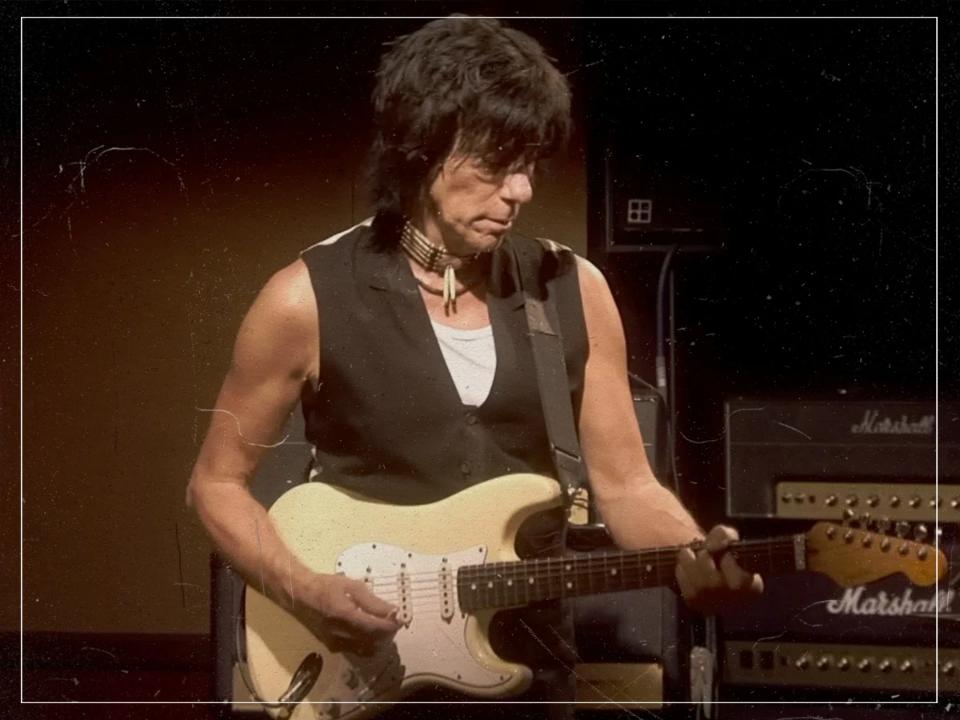
Greatness can sometimes lie in the eye of the beholder, but true excellence exceeds that and is clear to everyone. Jeff Beck could steal your carpark space, partner, and the fiver you dropped, and it would still be undeniable that his art was a work of irrefutable excellence.
Alice Cooper saw this firsthand on plenty of occasions, but one moment stands out as a showcase of unequivocal brilliance. “Everybody asks, ‘who is the best guitar player?’ This is what cinched it for me. Jeff Beck, they’re playing the song, he holds his guitar like this [outstretched and vertical] and it’s feeding back and he’s talking to somebody.”
So far, it sounds like he was simply good enough to be nonchalant, but Cooper continues, “He’s like, nineteen years old, and while he’s talking, he’s dropping the guitar and doing triplets, perfect triplets, and catches it right on the last note where it’s feeding back. And we went, ‘what? That’s impossible.’ That was 1966.”
That’s an interesting indictment to point to, because by and large, Beck wasn’t bothered about ‘showing off’. His passion lay in finding fresh ways to happen upon new ways to unlock deeply emotive expression on the six-string.
With ‘Where Were You’ from his 1989 album Jeff Beck’s Guitar Shop, he figured that he has found it. “This is probably the best thing I ever wrote,” the late rocker said, “And it’s a milestone in my playing. It’s where I began to forge a unique new style. The key thing was discovering how I could use bent harmonics.”
While it’s not up there with his most famous tracks or any of the hits that he worked on with others, it does embody exactly what he was searching for in music. His old pal Ronnie Wood said that what always astounded him about Beck was that even when they’d meet each other in old age, the long-haired former Yardbird would always be buzzing with excitement over a new trick he had uncovered, keen to display it like a fellow with a new watch constantly checking the time.
‘Where Were You’ embodied the perfect overlap where innovation not only unearthed a new sound, fitting for Beck’s style, but also plunged into emotive depths hitherto unknown. He was even happy to explain how: “That’s basically taking false harmonics and, by bending the whammy bar, constructing melodies and tunes with it,” he told Guitar World.
He had journeyed far and wide for this musical technique, highlighting his musical eclecticism. “The inspiration for ‘Where Were You’ was the Bulgarian female choir record Mystere des Voix Bulgares. It’s so astonishing when you hear it,” he continued, “It’s like a religious experience.”
He looked to mimic that on his guitar – something that nobody had done before – explaining, “When these women all hit a note together, it’s the most amazing sound you’ve ever heard. They sing these kind of broken scales with quarter-tone intervals. It’s extremely emotional music. I realised this was another tonal palette I could experiment with, because the guitar is capable of doing that, particularly with bent harmonics and the whammy bar.”
You can tell from his words alone just how seamlessly it embodied his life’s work. Who else is going to ponder what they want to be remembered for and end up invoking a Bulgarian female choir, use the ‘whammy bar’ about three times, and reveal all the tricks to how they got that sound in the first place? Maybe that, more so than the feedback incident in ‘66, is what made Beck the greatest.