

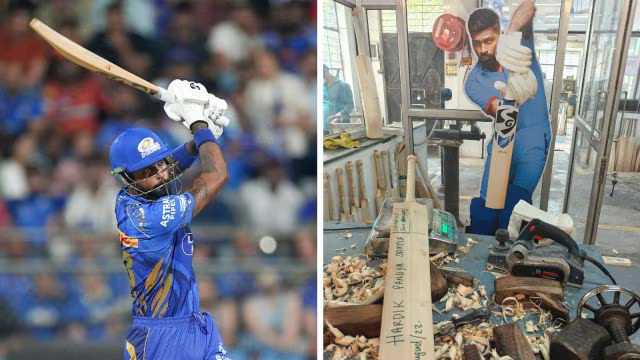
There’s a nonchalance about Hardik Pandya when he hits his trademark no-look sixes; his timing, skill and power make it look easy. Aiding the star in clearing the rope is his bat with a curve in the front – a radical innovation that has been around for a while now but has largely gone unnoticed.
The revolutionary ‘bat tweak’ originated in the 1990s when Sachin Tendulkar came up with a query for his bat manufacturer. He had noticed that his bats would develop a nice sweet spot – the wood would get compressed, giving the willow a ‘good dent’ – when used over a period of time. ‘Was it possible to have a readymade sweet spot?’ was Tendulkar’s question. And the answer was ‘yes’ and the bats were no longer flat as a chopping board. They were also convex.
With time, the dent got deeper and broader and the process more scientific. Researchers would bank on the laws of physics, carve the bat keeping in mind the principles of the angle of incidence and reflection. The result is constantly evolving game-changing cricket equipment that is silently and methodically putting cricket on steroids, making six-hitting a frequent event. The ‘bats with arc’ are T20’s unsung heroes, the anonymous crowd-pullers.
Hardik’s skills, his training, aided by his bat, make him a front-runner in the arms race among six-hitters. His bat has nearly 200 percent more curve than the competition, claims Meerut-based manufacturer Sanspareils Greenlands (SG).
Behind the scenes, in this drive to stay ahead, is a collaboration between researchers at the Indian Institute of Technology, Delhi, mechanical engineers at SG, and Hardik himself. It isn’t unusual for the India star to travel to Meerut and ask questions, and give suggestions, to the engineers poring through bat dimensions.
Hardik has a couple of demands: the ball hitting the curve’s sweet spot, and its take-off being at the precise angle that would make it travel the farthest. As an SG engineer points out, it is all physics. For the trajectory of the ball to make a perfect parabola in the air, and thus cover the longest distance, the take-off from the bat needs to be at 45 degrees. With a curved willow, the batsman’s chance of getting the ideal angle increases.
SG CEO Paras Anand gives a golf analogy to explain his bat with an arc.
“If you look at golf clubs, the pitching wedge has an angle and gives you elevation. What we have done with the help of the curve is give a very good angle. A 45-degree hit with the right force takes it almost 90 metres. That is the science here. The curve helps loft the ball. Hardik figured that out,” Anand said.
The SG engineers scribble diagrams on their notebooks and take help of 3D animation on their laptops to explain the mechanics behind their Arc series bat. Few are old-timers having spent over a decade at the company and aren’t keen to be named. In a highly-competitive market, they are assets that the company can’t afford to identify or lose.
Listening to them makes one understand why T20 cricket has become a batsman’s game. They talk about how by increasing the degree of the curve, the surface of the bat gets longer and the sweet spot bigger.
“A bat with a longitudinal curve has a longer surface if you measure along the curve, like with a string, compared to a flat bat. Because of this extra surface area, the sweet spot or the high-performing zone becomes bigger. This means the bat has more ‘forgiving space’ to hit the ball well, even if the timing isn’t perfect. So, curving the bat helps increase the area where you get powerful, clean shots,” a mechanical engineer, who is Hardik’s sounding board, says.
The curve, as compared to a flat surface, makes the bat a better tool for a batsman, but execution of big hits requires exemplary skill. Digging out yorkers, in a batsman-friendly game, has also become easier.