

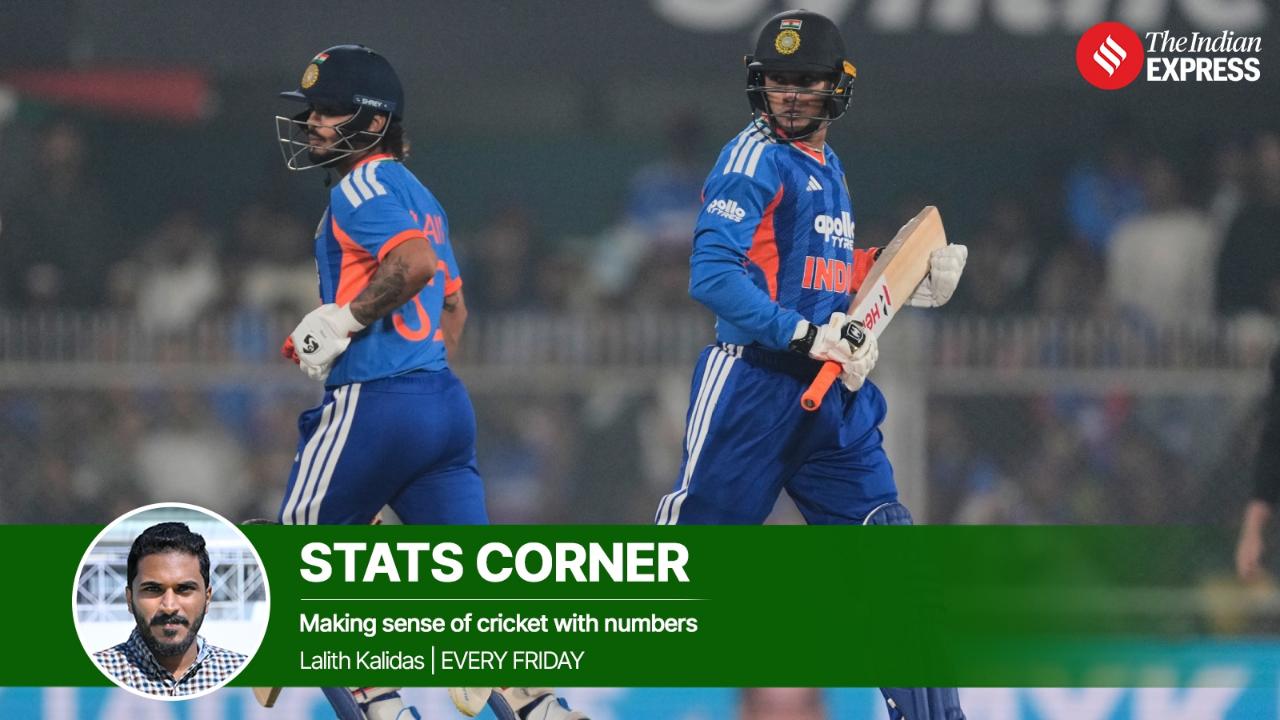
India’s supersonic batting smarts had briefly disappeared on the road to the 2026 T20 World Cup, but Suryakumar Yadav’s men have course-corrected in recent weeks, emerging as the most ruthless group entering the tournament.
Positivity has been gushing across departments in the 20 months since the last title triumph in the Caribbean. As they bid for home title defence, India will also attempt to storm past a few historical inhibitions.
In sending two left-handers, Abhishek Sharma and Ishan Kishan, to open against the USA in Mumbai on Saturday, India will challenge the perennial cricketing bias, overriding the excessive chatter around the supposed batting combination.
Abhishek and the resurgent Kishan are set to officially open for the first time together for India at the Wankhede Stadium, as India back individual form over rigid conventions. There is also a rare proclivity for domination — six of India’s top eight in a first-choice XI could be Left-Handed Batters (LHB).
A southpawed opening pair has been rare, almost purposefully avoided across India’s two-decade-long journey: only five out of 264 T20I innings have seen an LHB-LHB opening association. No champion side has particularly inclined towards this specific pairing in history in the past over a more common pairing of right-handers or the theoretically favoured LHB-RHB order.
| Full-Member T20I teams | Total opening pairs |
Left-handed opening pairs used
|
| Afghanistan | 28 | 0 |
| Australia | 52 | 7 |
| Bangladesh | 50 | 17 |
| England | 46 | 1 |
| India | 48 | 3 |
| Ireland | 20 | 3 |
| New Zealand | 49 | 2 |
| Pakistan | 59 | 4 |
| South Africa | 47 | 3 |
| Sri Lanka | 42 | 7 |
| West Indies | 60 | 9 |
| Zimbabwe | 43 | 1 |
It remains an integral decision-making factor as openers have accounted for more than 35 per cent of all T20I runs ever made and are tasked to maximise the six-over Powerplay, which covers 33 per cent of a batting innings.
Curiously, a left-handed pair is still almost the last resort. If not for Kishan’s fairy tale comeback from the wilderness, India would have been looking at two contrasting LHB-RHB opening pairs in the build-up. With Abhishek quick to cement his position, there wasn’t one specific reason why Yashasvi Jaiswal could not have added more T20I games in this cycle, except that he, too, was a left-hander.
It should not be surprising then that T20I cricket (Full-Member sides) has held the same left-handed pair at the top for 20 years, starting with the second-ever game in the format in 2005. After bludgeoning the ball with no remorse in their storied ODI and Test careers, T20 cricket arrived late at the doorsteps of Matthew Hayden and Adam Gilchrist. The devastating Aussie duo aggregated 398 runs together in nine innings. 330 of those came in the inaugural World Cup in 2007, still the best for a left-handed opening pair after nine editions of the tournament.
| Most successful left-handed T20I opening pairs (Full-Member teams) | |||||||
| Partners | Span | Inns | Runs | High | Ave | 100 | 50 |
| Parvez Hossain Emon, Tanzid Hasan (BAN) | 2024-2025 | 20 | 520 | 110 | 26 | 2 | 0 |
| Adam Gilchrist, Matthew Hayden (AUS) | 2005-2007 | 9 | 398 | 104 | 49.75 | 2 | 1 |
| Soumya Sarkar, Tamim Iqbal (BAN) | 2015-2018 | 17 | 389 | 61 | 22.88 | 0 | 1 |
| Niall O’Brien, William Porterfield (IRE) | 2008-2010 | 9 | 288 | 59 | 32 | 0 | 3 |
| Chris Gayle, Evin Lewis (WI) | 2017-2021 | 7 | 277 | 82 | 39.57 | 0 | 3 |
The one pair that surpassed them on the overall charts last year – Parvez Hossain Emon and Tanzid Hasan (520 runs) – will not be seen at the World Cup following Bangladesh’s exit this time.
Across the 12 Full-Member nations, 544 different opening pairs have been used over two decades of T20I cricket, only 57 of which are all-left associations. Only two left-handed pairs have ever played at least 10 innings together, both for Bangladesh.
Bangladesh have posed 17 such pairs in the last 19 years, the most among all teams, while none of Afghanistan’s 28 opening pairs have registered two lefties together. Across 217 T20Is, England have only sent one left-handed pair to open in a solitary game in 2006. They have held 46 different opening combinations in all.
India’s previous three pairings – Gautam Gambhir/Irfan Pathan, Shikhar Dhawan/Parthiv Patel and Kishan/Rishabh Pant – were all born in trivial one-off or bilateral contexts.
Kishan and Abhishek’s entrance would stoke life into the dormant pack, hoping that they would not bear the misfortune of those before them during a special home initiation. Some will hope for a modernised encore of Haydos and Gilly from the Indian stars, anticipating that the taboo around cricket’s left-handed opening pair is finally banished for good.