

Prince William is marking a special anniversary.
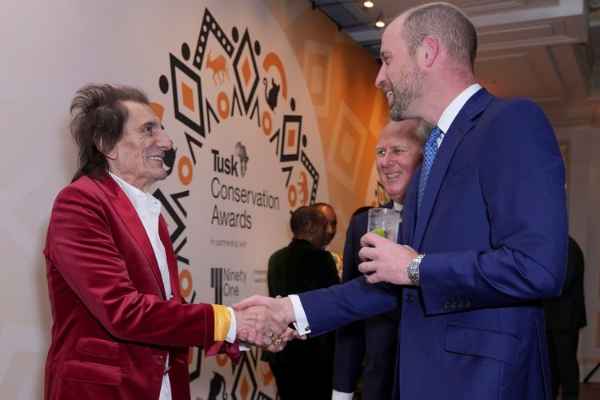
The Prince of Wales, 43, stepped out in London on Nov. 26 to celebrate 20 years of his support for the wildlife charity Tusk. Looking dapper in a suit and tie, he joined the charity’s annual awards evening and made a speech at the event, also attended by Monty Python star John Cleese and the Rolling Stones’ Ronnie Wood.
The event continues Prince William’s busy month, after traveling to Brazil for the Earthshot Prize awards ceremony and attending the Royal Variety Performance in London alongside Kate Middleton, marking their first joint red carpet moment in two years.
Tusk is one of William’s longest-running patronages, as the prince has been involved with it since he began his public life in 2005 following his university studies.
Prince William met some of the charity’s top supporters and the leading African conservationists who are the big winners this year.
After a performance from the London Assembly Gospel Choir, which opened the ceremony, the royal heir presented the three awards: the Prince William Award for Conservation in Africa, the Tusk Award for Conservation in Africa and the Tusk Wildlife Ranger Award.
During his speech, Prince William said solutions to help the environment must be “accelerated.”
“My visit to Brazil earlier this month for the Earthshot Prize and for COP30 reinforced my sense of urgency,” he said. “It reminded me that when we unite behind a shared purpose, we can accelerate solutions that make both people and planet healthier.”
Like Prince William’s Earthshot Prize, which he celebrated in Rio de Janeiro, Brazil, in early November, the awards help to amplify the work of those who are on the frontline. They also provide much-needed backing and funding for the ongoing work. Since the awards began more than a decade ago, 61 winners have received more than $3 million in grants for their organization, helping them to scale their work and collectively improve protection for over 60 species.
The winners highlight the importance of collaboration in effective conservation and have shared their expertise and knowledge to drive vital change in tackling issues such as the illegal wildlife trade and climate change.
A key theme of the awards, and William’s year, has been supporting those who are on the frontline of caring for and protecting both animals and the natural environment. In Brazil, he spoke out in support of indigenous people and the work they do to both protect the globe’s resources and the way their lifestyles preserve the land and nature they, and others, rely on.
Laban Mwangi, Head Ranger at the Bongo Surveillance Project (BSP) in Kenya, was the winner of the Tusk Wildlife Ranger Award. He told PEOPLE the award was an “honor.” It is “a chance to raise global awareness about the importance of our work and the challenges we face, and I hope it will inspire more people to support conservation efforts for future generations.”
“The award means we can continue to expand our efforts to protect the bongo and other endangered species in the Maasai Mau and Aberdare forests. The award will help equip our rangers with better training and new tools, like camera traps, to monitor the forest more effectively.”