

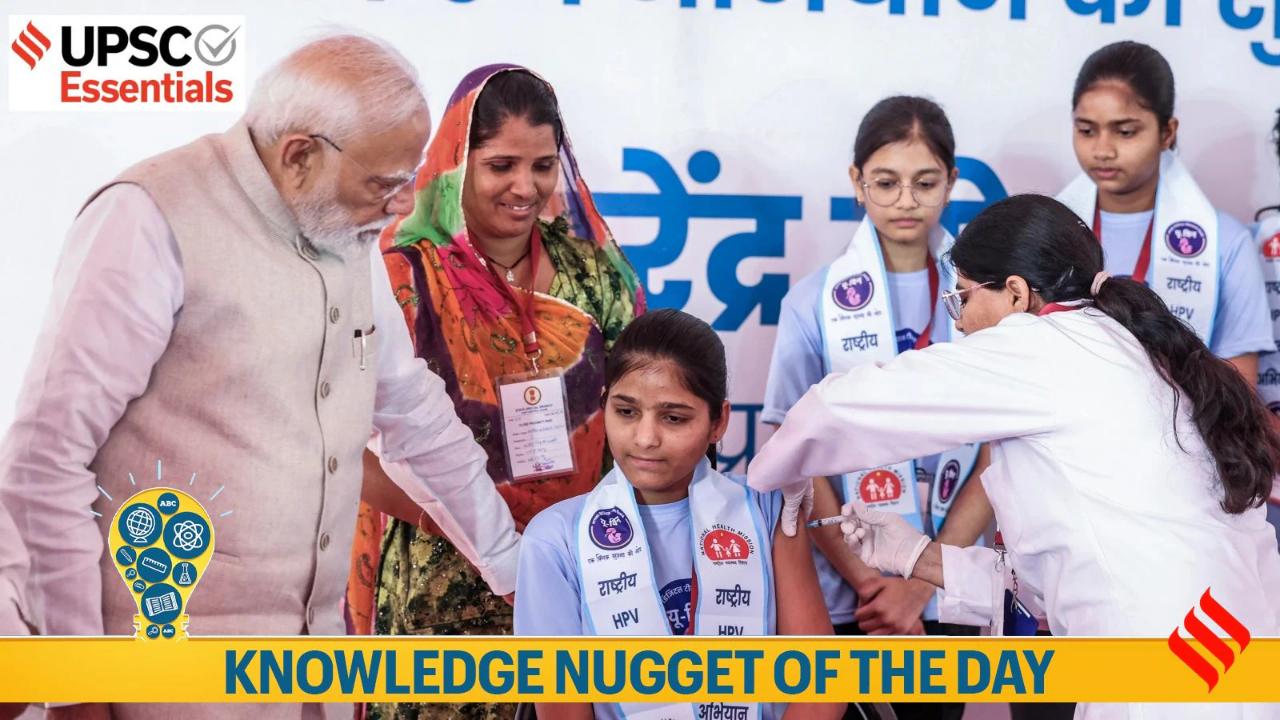
Take a look at the essential concepts, terms, quotes, or phenomena every day and brush up your knowledge. Here’s your knowledge nugget on HPV Vaccination drive that is launched nationwide.
Knowledge Nugget: HPV vaccination programme
Subject: Health
(Relevance: Since the HPV virus causes 99 per cent of cervical cancers, the government’s step towards HPV vaccination aims to address it through prevention. Questions have been asked in Prelims on the government immunization programme, making it an important topic for your upcoming UPSC Prelims 2026.)
Why in the news?
Prime Minister Narendra Modi launched a nationwide Human Papillomavirus (HPV) vaccination campaign on 28th February for girls aged 14, aimed at preventing cervical cancer, during his visit to Ajmer, Rajasthan. Cervical cancers are the second most common type of cancer among women in India.
Key takeaways:
1. HPV is a common, sexually-transmitted infection. Only certain forms of the virus progress to cancer. HPV immunisation in the teenage years — when girls are going through puberty but are not sexually active — results in better and longer immunity.
2. While the body’s immune system usually gets rid of the HPV infection naturally within two years, in a small percentage of people the virus can linger over time and turn some normal cells into abnormal cells and then cancer, according to the Centers for Disease Control and Prevention (CDC).
3. Eligible girls will need to book a slot at government health centres using the vaccine management platform U-win — just like people used Co-Win during the Covid-19 pandemic. Vaccinations will not end after the 90-day period. The programme will continue at health and wellness centres alongside the country’s routine immunisation framework. Girls who keep turning 14 each year will be able to access the shot this way. An estimated 1.15 crore girls turn 14 every year in India.
4. There are at least 14 types of HPV that can potentially cause cancer. Among these, HPV types 16 and 18 are considered to be the most likely to lead to tumour development, causing about 70% of all cervical cancer cases globally. The vaccines work by preventing the entry of two, four or nine of the most common types of HPV.
5. The government is giving quadrivalent Gardasil vaccine free to 14-year-old girls at government facilities nationwide — a step made possible through partnership with Gavi, the vaccine alliance. This is also aligned with the World Health Organization (WHO) global strategy to eliminate cervical cancer by 2030 by vaccinating 90% of girls before age 15.
6. Officials say that the government may switch to Serum Institute of India’s Cerevac which is India’s first indigenously developed quadrivalent human papillomavirus (qHPV). It is yet to receive WHO approval and the ICMR is still studying its single-dose effectiveness. It provides protection against HPV types 16, 18, 6 and 11.
7. HPV virus causes 99 per cent of cervical cancers, however, it is also responsible for a significant percentage of genital warts, penile, anal and oropharyngeal (throat and mouth) cancers. Therefore, many oncologists are calling for gender-neutral vaccination against HPV.
8. As of early 2026, over 50 countries have implemented national HPV vaccination programmes that include both boys and girls to promote herd immunity and prevent various cancers. These include Australia, the US, UK, Canada and Germany.
9. According to Dr Rohit Raghunath Ranade, clinical lead, Gynaecologic Oncology, Narayana Health City, Bengaluru, “the most common misconception about HPV is that if you do not have a cervix, you are safe. Scientifically, this is far from the truth. A landmark study published in The Lancet Global Health (September 2023) found that at least one in three men over the age of 15 are infected with at least one genital HPV type.”
10. In the UK, the National Health Service (NHS) expanded the HPV programme to include boys aged 12–13 in 2019. The logic was clear: if we want to eradicate HPV-related diseases, we cannot leave the male population out of the solution. Australia, an early adopter of this strategy, is now on track to becoming the first country in the world to effectively eliminate cervical cancer as a public health problem by 2035. Dr Rohit opines that this feat would be impossible without vaccinating their boys.
Significance of HPV Vaccination
1. For decades, cervical cancer has remained one of the most tragic and preventable killers of women in the country, yet the HPV vaccine uptake was limited by cost, access barriers and persistent
myths fuelled by misinformation.
2. India accounts for a fifth of global cervical cancer cases. Within the country, it continues to be the second most common cancer among women, affecting 1.25 lakh and killing 75,000 each year.
3. While earlier evidence has shown that the vaccine is effective at reducing HPV infection and pre-cancerous lesions, studies have since demonstrated that it also reduces the incidence of cancer.
4. A major study evaluating the real-world consequences of the vaccine in Sweden, published in 2020, found that the risk of cervical cancer was 88% lower in women who received their vaccine before the age of 17.
5. Importantly, universal immunisation of girls also reduces the transmission of the infection to boys and protects them from other cancers.
BEYOND THE NUGGET: Universal Immunization Programme (UIP)
1. Immunization has been a central focus in India’s public health strategy for decades. India’s Immunization programme is one of the largest public health programmes in the world. In 1978, the Expanded Programme on Immunization was launched, which was later renamed as the Universal Immunization Programme in 1985 after it expanded beyond urban areas.
2. In a written response by the Ministry of Health and Family Welfare (MoHFW) to an unstarred question in Lok Sabha on 12th December, 2025, that in the Universal Immunization Programme (UIP), 11 vaccines are provided against 12 vaccine-preventable diseases (VPDs). However, the Human Papillomavirus (HPV) vaccine is not a part of the Universal Immunization Programme (UIP).
3. According to MoHFW, under UIP, immunization is being provided free of cost against 12 vaccine-preventable diseases:
* Nationally against 11 diseases that include Diphtheria, Pertussis, Tetanus, Polio, Measles, Rubella, severe form of Childhood Tuberculosis, Rotavirus diarrhea, Hepatitis B, Meningitis & Pneumonia caused by Hemophilus Influenza type B and Pneumococcal Pneumonia; and
* Sub-nationally against 1 disease – Japanese Encephalitis (JE vaccine is provided only in endemic districts).
4. Mission Indradhanush: According to the ministry, it is a special catch-up vaccination campaign, launched in 2014, under the UIP. It is conducted in areas of low immunization coverage to vaccinate left-out and dropped-out children and pregnant women. 11 types of vaccines, which are used in the UIP, are provided in this programme.
Post Read Question
‘Mission Indradhanush’ launched by the Government of India pertains to (UPSC CSE 2016)
(a) immunization of children and pregnant women
(b) construction of smart cities across the country
(c) India’s own search for the Earth-like planets in outer space
(d) New Educational Policy