

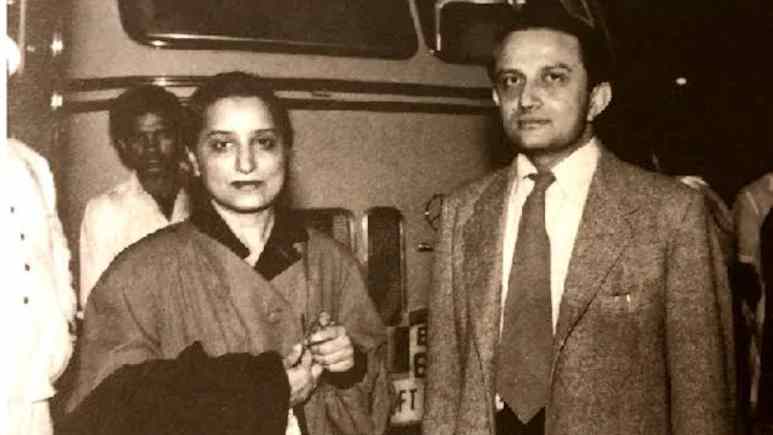
He was the man who took India to space, believed that science was meant for social transformation, and built institutions that shaped the country’s intellectual landscape.
But behind the visionary physicist and institution builder, Dr Vikram Sarabhai, lies a story that reads almost like a classic Indian love drama, where intellect meets affection, and passion quietly alters the course of history.
According to psychoanalyst and author Sudhir Kakar’s book, A Book of Memory: Confessions and Reflections (Penguin Random House 2011), the birth of India’s second Indian Institute of Management (IIM Ahmedabad) wasn’t just a tale of academic ambition or government vision, it was also the outcome of a love affair. Sudhir Kakar is the nephew of Kamla Chowdhry, a key figure in this saga of love and legacy.
A Man Of Vision
Born in 1919 into one of Ahmedabad’s most influential industrialist families, Vikram Sarabhai had a privileged start. His father, Ambalal Sarabhai, owned one of the largest textile mills in India, and the Sarabhai family home was a meeting ground for thinkers, freedom fighters and intellectuals of the time. Growing up in this atmosphere, Vikram developed a deep curiosity for both science and human progress.
After school in Gujarat, he went on to study natural sciences at St John’s College, Cambridge, UK. His academic brilliance was evident early on, and he later earned a PhD in cosmic ray research from the University of Cambridge. His doctoral work laid the foundation for India’s cosmic ray and space research programmes, which he would pioneer in the years to come.
When he returned to India in the early 1940s due to the World War, Sarabhai joined the Indian Institute of Science in Bengaluru to work with Nobel laureate Dr CV Raman.
But what set him apart was not just his scientific mind, it was his remarkable ability to translate vision into institutions. He went on to found the Physical Research Laboratory (PRL) in 1947, which became the cradle of India’s space journey.