

The art of batting time has lost its greatest modern devotee. Cheteshwar Pujara, whose best friend on the cricket field was time, and who in his peak batted as long as he wanted to, has bade farewell to the game he loved, and a game that loved him back. The end was as simple as his entire career was, without the obsession for limelight, with a quiet dignity and worldly-wisdom to not expect a perfectly-choreographed farewell. The face when he penned the farewell note would have been as stern as his bat, when he blocked a 90mph thunderbolt rearing to his rib-cage.
The numbers he etched are admirable. He retires as his country’s eighth highest run-getter in the longest format (7,195 runs and 19 hundreds at 43.60). A lean spell towards the end of his 103-Test career diminished his average. But the skinny child with gleaming eyes who faced thousand balls a day under a neem tree in Rajkot’s 3, Kothi Ground from his father Arvind, a first-class cricketer and Railway employee, would gleefully and humbly accept the numbers.
The legacy he leaves behind would overwhelm him. There have been more talented Indian batsmen, more technically-refined and dominant ones, more artful purveyors. But none could lay claim to the Pujara feat—shape and define India’s maiden series triumph in Australia. A hundred men had toiled for 71 years to conquer the elusive, golden peak.
For this, he would be immortalised in the country’s cricketing consciousness, even if his numbers are forgotten. His 521 runs, 1,258 balls he faced, three fourth of which he blunted, and three hundreds in the series would be as precious in India’s cricket history as Sunil Gavaskar’s 774 in West Indies in 1970-71, or the spin trifecta’s 37 wickets in the epochal triumph in England the same season.
In Australia in 2018-19, he was the citadel Australia’s formidable bowling virtuosos couldn’t breach. He existed simply as a point of resistance, constructing slow-burn notes of staccato defence. A tired Nathan Lyon, the second-most prolific off-spinner ever, asked him, utterly exhausted: “Don’t you get bored of batting.” He smiled fleetingly, the closest to an emotion he shed on the field. He marked his hundreds with a monkish abstinence from excess celebrations. He often raised both his arms and waved his bat at the crowd with a shy smile.
From the land of Mahatma was another practitioner of abstinence and non-violence.
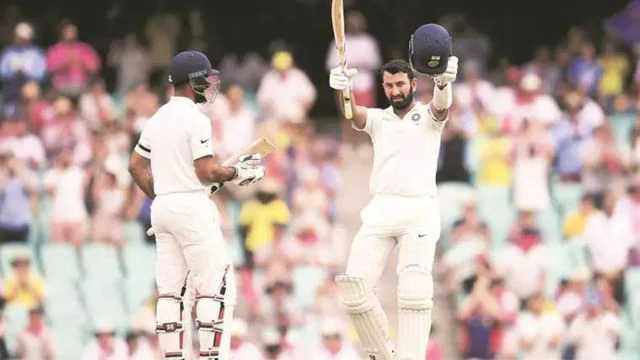
In Sydney, after completing a century that stubbed out the home side’s last lingering hopes of a drawn series, he pulled a rare air-punch to celebrate. But he carried the sheepish demeanour of an uncle shaking his leg awkwardly to the latest K-pop in a pub. Century celebrations were withdrawn because his mind would have already begun plotting the next hundred runs. Or two hundreds. For he knew only a mountain of runs could move him closer to achieving his dream of playing Test cricket. Nothing else mattered to him. It was a dream he dreamt with his father, who was stern as well as doting, who raised him by himself after his wife died when Pujara was still a teenager.
By then, his mother Reena has instilled the virtues of humility and single-mindedness in him. “His personality is because of his mother,” Arvind had once told The Indian Express. She insisted on performing pujas every day. When his father wondered about her insistence, she would tell him. “He will be facing a lot of struggles in life. There will be tough times. Believe me, puja is a kind of meditation and will help him cope with life.”