

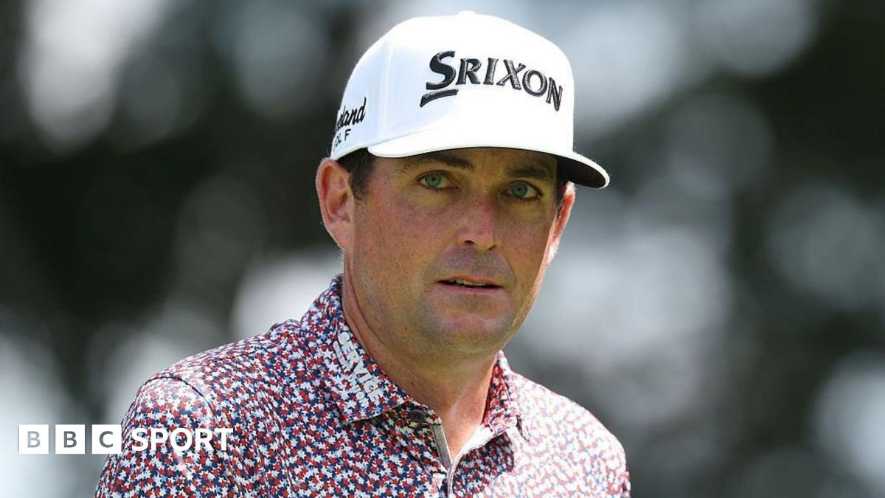
So it will be golf buggy rather than bag for captain Keegan Bradley at next month’s Ryder Cup in New York.
To most informed observers, common sense has prevailed. From the moment he took the captaincy of the American side, the 39-year-old was told it would be too much to play as well as lead his side.
And yet it was a close-run thing. There is a sense of self-sacrifice from the skipper for overlooking his own playing ambitions.
Bradley admits “it hurts” not to be teeing it up at Bethpage for the match on 26-28 September, but that can surely inspire those players he has selected.
They know their captain has put them ahead of himself. At a stroke he has extinguished any notion of self-interest. “It hurts, for sure. I mean, I grew up wanting to play Ryder Cups,” Bradley told BBC Sport.
“But then you’ve got to quickly remind yourself what an honour it is to be the Ryder Cup captain. So many players that are much more deserving of me never got the opportunity to do this.
“This is the ultimate job in golf.”
So the former US PGA champion has gone with his initial gut instinct of taking the job to be a captain rather than a player.
But Bradley’s win in June at the Travelers Championship did alter his thinking for a while. His form thereafter was not quite compelling enough to force a historic decision.
He claims he has known for some time that he would not play, but why not make that public to end the fevered speculation that built ahead of his announcement? “It crossed my mind,” he said.
“But I also wanted to make sure of this decision. I just wanted to be treated like another player on the team and we wouldn’t announce a player wasn’t going to make the team.
“I wanted to play it out and see how the season ended, but you know, this decision was difficult for sure.”
There are good reasons why no-one since Arnold Palmer has been a player-captain. The Ryder Cup has grown into one of the world’s biggest sporting events and captains face a myriad of demands.
They have to shape pairings, the order in which to send out their partnerships and get a reliable handle on how each member of their team is playing.
Are team members faking it when they say they are playing well? Do they need cajoling or taking down a peg or two?
There are speeches to make at ceremonies that can shape the tone of the entire week and decisions have to be made on the run.
Where would be the headspace to consider your own golf swing and putting stroke?
Especially with every single shot and decision coming under unprecedented scrutiny. It would have been sporting masochism to pick himself.