

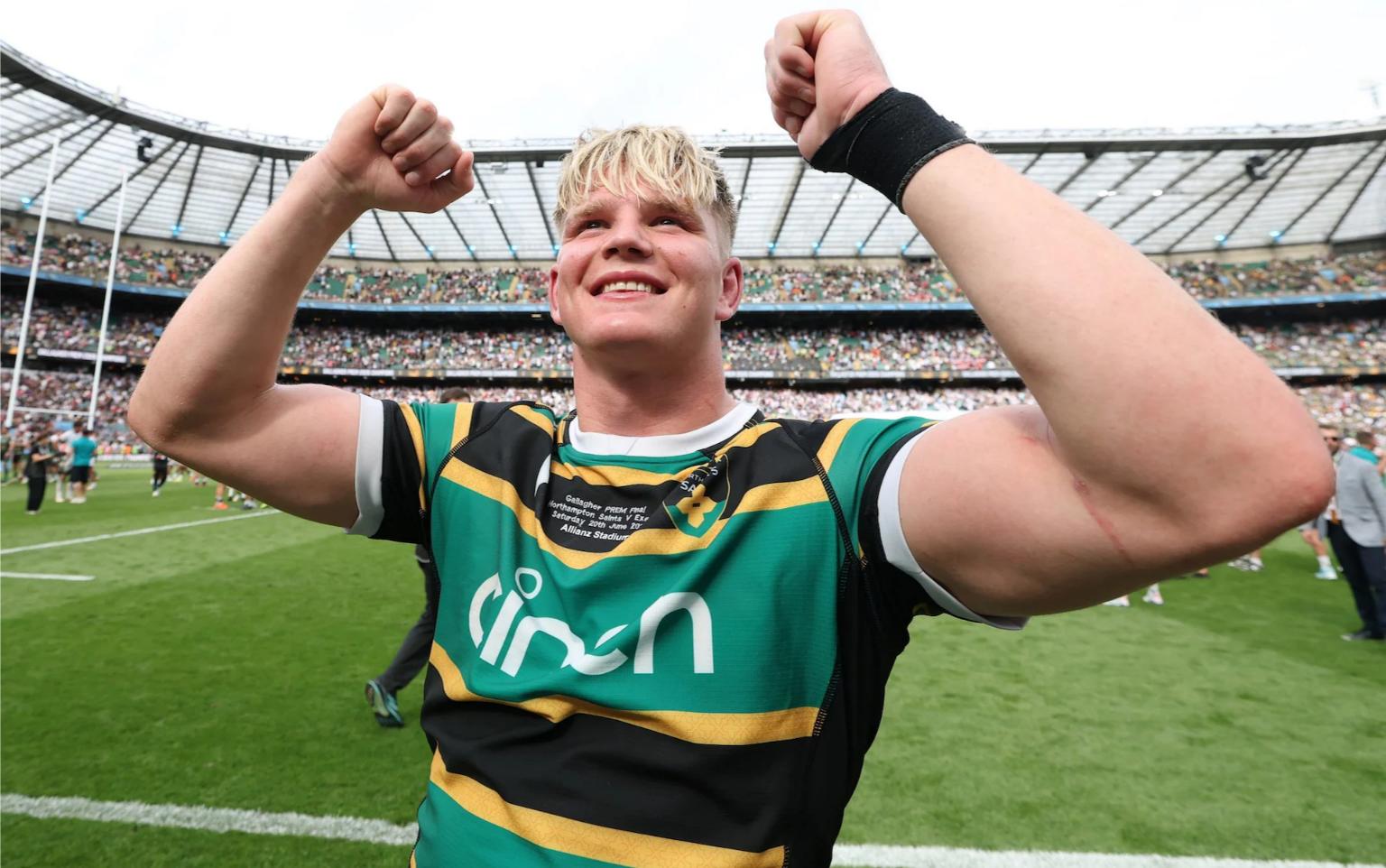
Eddie Hearn’s desire to make Henry Pollock a £1m player is laudable. Every agent should look to maximise their client’s value and Pollock’s stock is soaring as he enters contract negotiations with Northampton Saints.
Yet in the context of English rugby’s ecosystem, it comes across as laughable that Pollock – who has made just one Test start – could become Prem Rugby’s highest-paid player.
The marquee question
The single biggest barrier to Hearn’s wish to make Pollock a seven-figure player is the presence of England fly-half Fin Smith at Franklin’s Gardens. Every Prem Rugby club can nominate one “marquee” player to sit outside the £6.4m salary cap. These tend to be a club’s highest-paid player. Bristol Bears, for example, used this designation to pay Charles Piutau £1m in 2017. However, Smith is Northampton’s current marquee player and is not going anywhere soon having signed lucrative terms last season.
The problem for Pollock is that he cannot become a marquee player at another Prem Rugby club under rules set to prevent poaching. Therefore any club wanting to sign him must do so within the £6.4m cap, which is problematic given the sums Hearn was quoting. Even accounting for ambitious clubs such as Newcastle Red Bulls and Bristol Bears, whose marketing teams would desperately want to get their hands on Pollock, no director of rugby is going to consent to losing a sixth of their cap space to a single back-rower who may only be available for 20 games a season.
Positional value
Two agents contacted by Telegraph Sport about the feasibility of Pollock earning £1m a year both suggested he start playing at fly-half instead. A recent Prem Rugby salary cap report revealed stand-offs are the best-paid positional group in the league. Indeed, Telegraph Sport understands that Bath fly-half Finn Russell is the best-paid player in England followed by a triumvirate of English stand-offs in George Ford, Marcus Smith and Fin Smith. Most directors of rugby view a quality fly-half as a non-negotiable ingredient in a title-winning team and so they occupy a special position in club’s spending plans, similar to how quarterbacks invariably dominate the NFL’s salary-cap spend.
Loose forwards, even quality ones like Pollock, are more ubiquitous and therefore more replaceable and less valuable in contract negotiations. Even England captain Maro Itoje, who arguably still boasts greater recognition than Pollock, is paid significantly less as a second row for Saracens than the league’s front-line fly halves.
Other avenues
If the Prem cannot afford Pollock then a bidding war could easily start abroad. Japan is known to offer the world’s highest salaries. However divisive Pollock might be among the French, there would definitely be a Top 14 president somewhere willing to chuck a chequebook at him. The problem, as Hearn himself admitted, is that Pollock is desperate to keep playing for England and, as the rules stand, the Rugby Football Union will not select players based overseas. In fact, Prem Rugby would probably argue this is precisely why the rule exists to keep the most marketable assets in the league.