

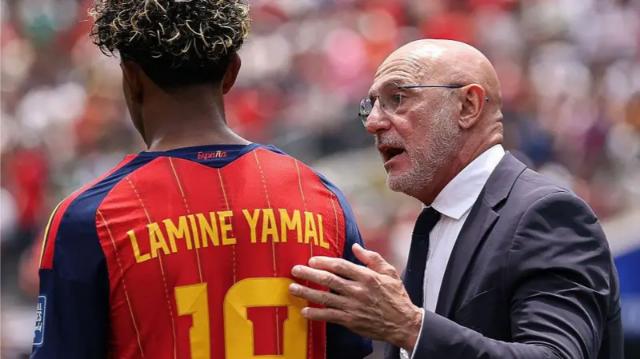
Luis de la Fuente’s Spain are closing in on greatness.
They are bidding to become just the fourth team to hold both the World Cup and European Championship crowns at the same time; following their compatriots in 2010, France in 2000 and West Germany back in 1974.
De la Fuente is now into his fourth year as Spain boss; winning the Euros two years ago and now guiding his country to a quarter-final against Belgium on Friday. France lie in wait for the winners.
He has lost just three times since he took over in January 2023, and is on a run of 35 games without a defeat.
There are coaches who build teams through tactics, and there are coaches who build teams through people. De la Fuente somehow manages to do both.
What sets him apart though is more than a football philosophy, but rather a way of understanding people.
His style can be defined as controlling possession but with alternatives. But alongside it he has created a culture.
De la Fuente’s success with Spain is the product of decades of work within the Spanish federation, and of his own role as a coach in that system since 2013, shaping players and instilling values.
He has played a crucial part in building a collective identity that is now unmistakable, and that is no small feat with a national side.
‘Football is a team sport, built by good people’
At the heart of De la Fuente’s world view lies a simple conviction: football is a team sport built by good people.
Not ‘good’ in the abstract moral sense – though Christian values and common sense ethics clearly guide him – but in the footballing sense; generous, supportive, selfless, disciplined, and willing to sacrifice for the collective.
He repeats this idea constantly, almost with surprise that anyone finds it unusual. “Those of us who have been in a locker room know what it means to be a good person,” he said in an exclusive chat before the game against Belgium.
“Almost every squad has had the opposite, the player who disrupts harmony, who puts himself first.”
De la Fuente, 65, has lived through enough dressing rooms to know that talent without generosity does not go far. His Spain is built on players who give before they take.
Spain’s style has always relied on players who understand the game collectively. The passing, the possession, the positional intelligence: these are technical qualities but social ones too.
The ‘easiest team to analyse’ but ‘hardest to beat’
Every team left in this World Cup has one thing in common: a clear idea.
National teams don’t have the time to build the complexity of club sides, so the message has to be simple and repeated.
That is where Spain have an advantage. Their footballing identity has been developed over decades.
Players and coaches are selected because they fit the idea, not the other way round. And they have been able to evolve their style because the foundations were already there.
Some would argue they have a certain advantage on the national teams that are trying a ‘new project’ with a new manager.
De la Fuente has inherited that identity, and to paraphrase what Pep Guardiola once said when talking about Johan Cruyff, De la Fuente “has not built the cathedral, he merely re-paints it from time to time”.
The Spain manager has added layers: more versatility, more depth, more comfort in transitions, more unpredictability in the final third, more solidity.
Spain are still recognisable, still “the easiest team to analyse”, as a member of Portugal’s staff told me after their defeat in the last 16, but “the hardest to beat.”
He knows these players because he has worked with them at youth level for a decade.
His coaching decisions reflect this familiarity. His staff logically analyse every match in detail and learn what the adjustments are.
Against Cape Verde, Spain lacked finesse in their passing. Against Saudi Arabia, the machine ran smoothly again.
Against Uruguay, he knew that Spain had historically lost matches when dragged into provocation and chaos, so he insisted on calmness, discipline, and emotional control.
De la Fuente admits that in earlier years he would have reacted more emotionally.
He said: “Experience has taught me to face these situations many times. I’ve been through these games – I’ve already lived through them and usually lost. Why? Because we didn’t know how to play certain types of games.”
“So, when someone rattles you, knocks you off your game, breaks your focus, you find yourself interrupted, paused, with changing disrupting rhythms.”
It has taught him that Spain lose when they abandon their identity.
His news conferences reflect the same values. He prepares them, with the help of Aitor Karanka, director of football at the federation, the media team and also the FA psychologist, former player Javier Lopez Vallejo, but he improvises when the situation demands it.
He speaks from the heart. He calls journalists by name because he was taught that at home that “respect begins with recognising the person in front of you”.
He looks people in the eye and treats them as equals. He insists these are not media tricks.