

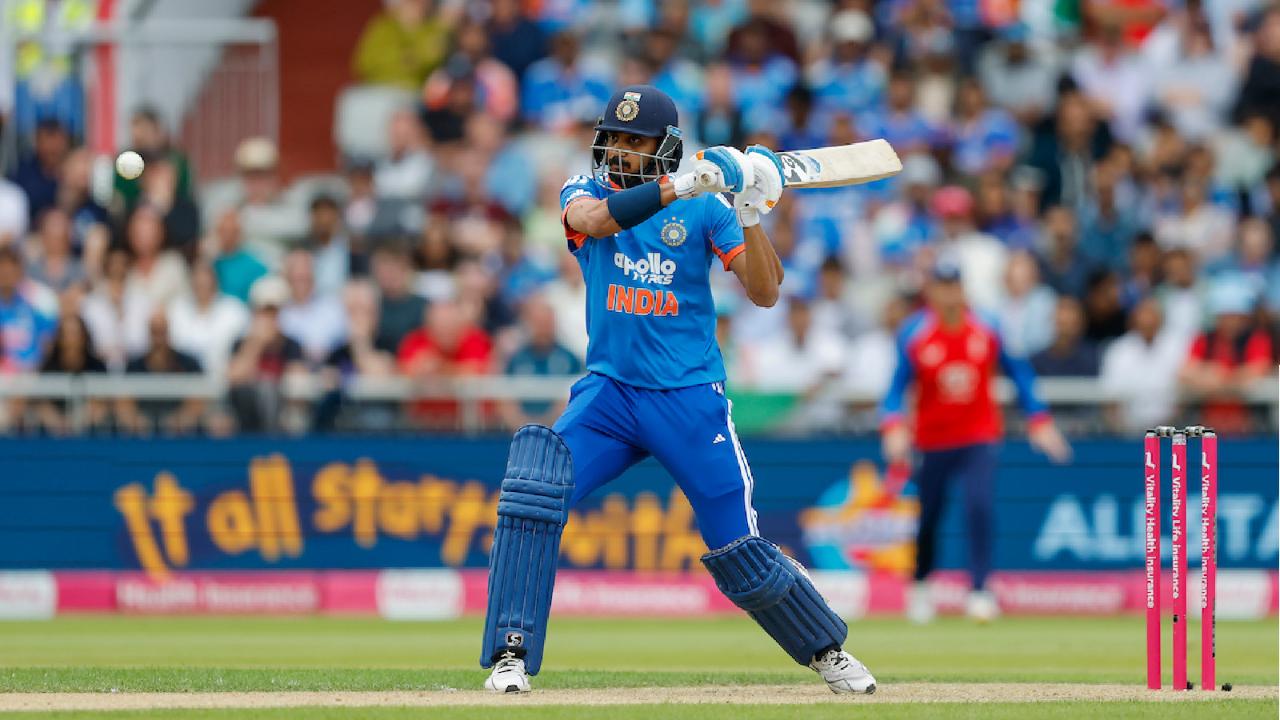
When India were reduced to 34/3 in the 2024 T20 World Cup final at Barbados, staring at the prospect of a below-par total, an unlikely firefighter walked into the blaze. Axar Patel, promoted to No. 5, produced one of the defining knocks of the final. His 47 off 31 balls helped wrest back control with a priceless partnership with Virat Kohli and laid the platform for India’s eventual triumph.
The innings was no accident. Speaking to The Indian Express after the win, Axar recalled the clarity of Rahul Dravid’s message before he walked out.
“Whenever I went out to bat at 4 or 5 in the final, Rahul bhai has given me clear instructions that I don’t need to slog. I must play my game and stick around. I had the belief that if the ball was in my area, I would go for my shots,” he said.
With batting stretching till No. 8, India’s think tank wanted him to absorb the pressure and take calculated risks rather than chase quick runs or force the pace. It perfectly summed up the role Axar played under Rohit Sharma and Dravid – a floater trusted to bat anywhere in the middle order and adapt his game to the match situation.
Little did anyone know, though, that the knock would remain his finest T20I innings for the next two years. In a side that increasingly values explosive finishing over rescue acts, the all-rounder’s batting has struggled to evolve with the demands of the team and the format, leaving India searching for greater firepower from a player once nicknamed the ‘Nadiad ka Jayasuriya’.
Since July 1, 2024, the left-hander has amassed a mere 283 runs in 25 innings at a strike rate of 113.65. Just 19 boundaries and six sixes in this period suggest that the power-hitting game has not evolved at the rate he and India would have wanted.
New template
The modest returns largely escaped scrutiny because Hardik Pandya and Shivam Dube consistently delivered the goods. In the same period, Pandya scored 796 runs in 32 innings at a strike rate of 156.38 with 48 sixes, while Dube struck at 170.63 in 30 innings and hit only two fewer maximums. Between them, they masked Axar’s diminishing returns.
Axar’s route back into the top order was also blocked by India’s evolving batting line-up. Following the 2024 World Cup, India backed Tilak Varma as their left-hander at No. 3, with Suryakumar Yadav at No. 4 and Pandya providing the late surge lower down. It left India with a settled batting core and little need for Axar to be the floater.
With Pandya absent on the ongoing tour and Tilak batting in the middle order, Dube has become India’s only established finisher.
Saturday’s second T20I at Old Trafford presented the ideal opportunity. When Iyer’s dismissal in the 13th over stalled India’s momentum, and Dube fell cheaply shortly after, the stage was set for Axar at No. 7. With just over two overs left, India needed one final surge alongside Tilak. Instead, he managed only two runs from three balls.
Declining IPL numbers
At Delhi Capitals (DC) in IPL 2026, Axar, despite being captain, never settled into a defined batting number for himself. Shuffling between Nos. 4 and 8, he finished with 173 runs in 14 matches at a strike rate of 131.06
His best performance came against Punjab Kings in Dharamsala, where, batting at number five, his 56 off 30 balls helped DC recover from 33/3 and chase down 211 runs to keep their tournament alive.
The innings reflected the batsman Axar remains – a rescuer rather than an outright whacker, capable of rebuilding an innings before expanding his strokeplay.
In IPL 2025, he smashed 15 sixes in 12 games and had a strike rate of 157.49. In 2026, the sixes tally came down to six in 14 matches. There was also a five-month stretch where he failed to hit a six in 10 T20 innings.
India currently doesn’t require that version, which rescues them from a spot of bother. Others can absorb pressure and accelerate once set. Instead, they now need Axar to walk in late, clear the ropes and turn competitive totals into daunting ones.