

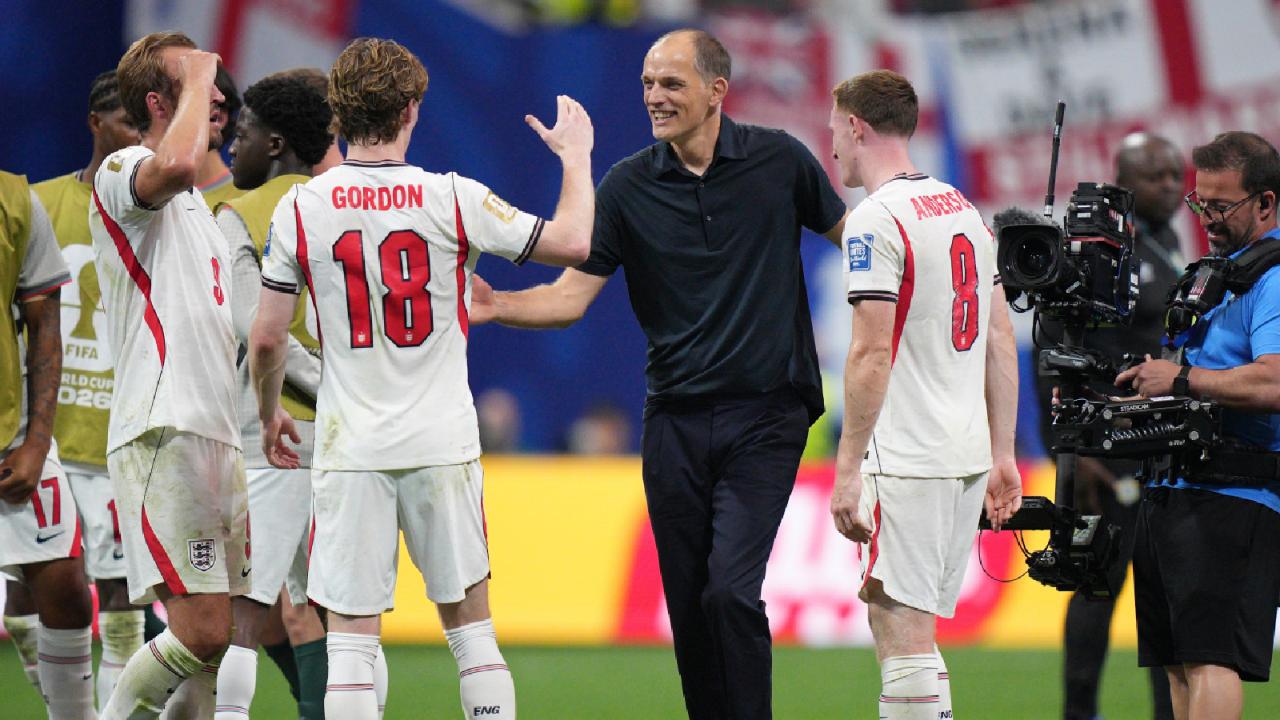
It is always about him. Not his tactics, but his antics. His passport. His nationality. His perceived symbolism.
Inquisitive lenses, with apertures and ISOs tuned to perfection, could have chosen to capture the generational Harry Kane when the Dallas Stadium’s speakers blasted ‘God Save the King,’ ahead of England’s 2026 FIFA World Cup opener against Croatia. Or Jude Bellingham. Maybe, even a Declan Rice. Yet, almost every camera swivelled in one direction — towards him. Thomas Tuchel. The outcome of the match mattered. Whether England’s German manager would sing the national anthem mattered more.
And yet, it is never about him. He could have made it so, with a performative speech after England’s 2-1 win over DR Congo in the round of 32. He could have joined England’s players in their customary rendition of Oasis’ Wonderwall. Echoing the Gallaghers would not elicit the same questions as humming a pro-Empire tune. He didn’t. Tuchel is a master of deflection.
At the post-match press conference, he was informed that the occasion marked England’s first World Cup victory by overturning a half time deficit in six decades. Poetic as it may be, the previous instance was the 1966 final, against West Germany — the place Tuchel calls home. Tuchel attributed the triumph to everything under the sun, but him. His team’s determination, the players’ commitment, Harry Kane’s finishing, and even his assistant Anthony Barry’s tactical acumen. He is a self-proclaimed introvert, and it was reflected in the room.
But not on the touchline. When referee Adham Makhadmeh blew his whistle for the second hydration break, Tuchel’s arms flailed and instructions flew as players gathered round him. England had barely 25 minutes to rescue their World Cup. And rescue, they did.
The turnaround began with tactics. Congo had severed all central passing lines for England by gaining numerical supremacy in midfield. Ngal’ayel Mukau was handed a start with a specific purpose — to suffocate channels. After the match, coach Sebastien Desabre revealed the plan was designed to neutralise the conductor of Tuchel’s orchestra. Not Kane. Not Bellingham. Elliot Anderson.
No England player had attempted more line breaks in this World Cup than Anderson. He was the origin of the attacks. With Anderson crowded out, England were funnelled wide, repeatedly relying on crosses. Especially from the right, with Congo’s left-back being a 32-year-old Arthur Masuaku, who had seen better days in this sport.
The change in plans necessitated a change in personnel. Djed Spence, who started in the right-back role in Reece James’ absence, had only attempted two crosses in his 122 World Cup minutes. Declan Rice, meanwhile, had already delivered 20 — almost twice as many as any other England player. Rice shifted to right-back, and Spence departed for Eberechi Eze.
One swift move created two advantages. Being Arsenal’s corner specialist, Rice’s deliveries immediately offered greater quality, while Tuchel also assembled a triangle built on familiarity. Eze, Rice and Bukayo Saka all play for the same club. The familiarity earned England a prized equalizer: Saka to Eze, Eze to Rice, Rice’s cross finding Anthony Gordon before the ball eventually reached Kane.
When asked about why Rice was shifted to the right, Tuchel said: “To have his quality from the side, and get more difficult crosses in there. That makes it more difficult to defend. We had more connection on the right. That opened up (the game).”
That aside, his timely alteration of wingers also paid dividends. Gordon and Saka injected life after replacing Marcus Rashford and Noni Madueke. The obvious question followed: why not start them?
Tuchel explained: “We were always clear that we wanted to finish off with fresh legs on the wings — with Anthony and Bukayo. After 60-70 minutes, we come up with fresh legs.”
Despite staring at what would have been an embarrassment for the ages, Tuchel claimed he was calm at the half-time break. He did not try to teach tactics.
Instead, he had a simple task for his players. “Keep pounding the rock. You have to keep on knocking, knocking, knocking.” Kane, and his team, did accordingly. They knocked, until Congo’s resilience broke.