

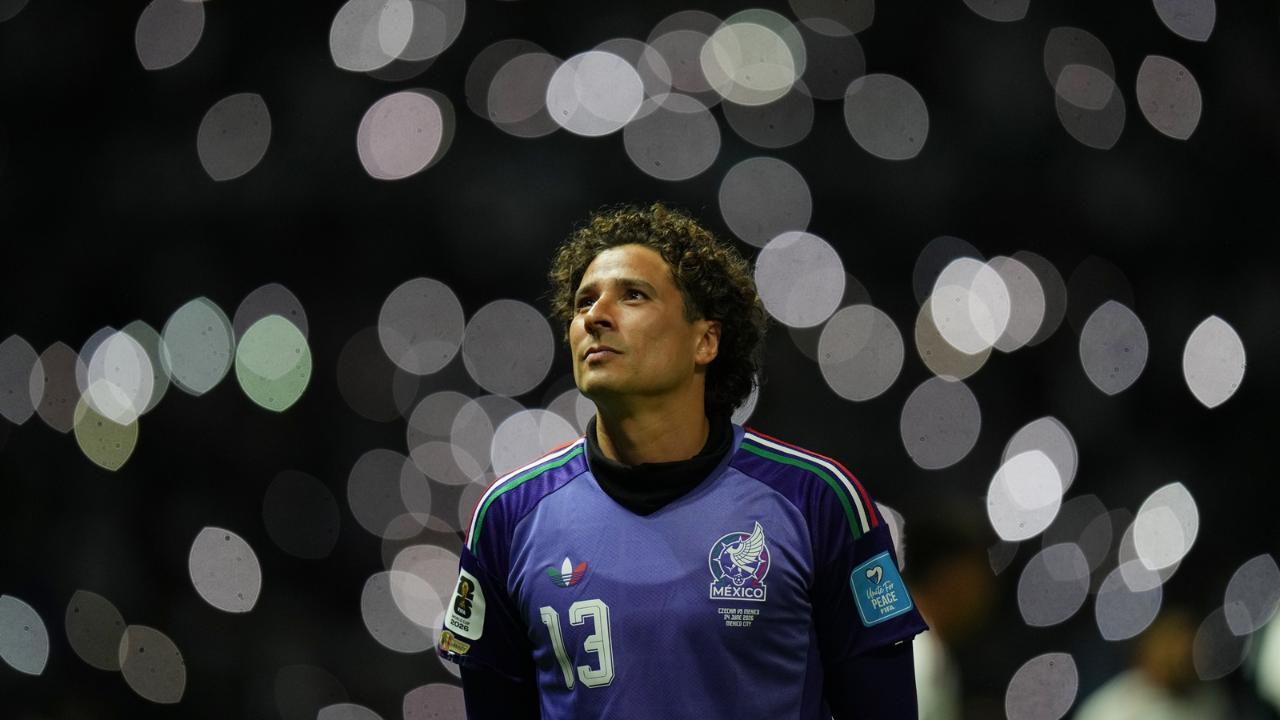
Before Guillermo Ochoa walked on, Mexico City’s Estadio Azteca stadium asked for him.
Mexico were 2-0 up against Czechia, the group already won, 12 minutes left. The chant started somewhere in the upper tier and spread. “Ochoa, Ochoa, Ochoa.” Over 80,000 voices, singing as one, pleading for one last look at the man with the curls and the headband — known across Mexico simply as Memo and after that one afternoon in Fortaleza in 2014, as San Memo. Coach Javier Aguirre had left him on the bench for the first 78 minutes. The crowd had been patient. Now they were not.
Then the board went up. Number 13.
What followed was louder than any of the three goals Mexico had scored that evening — louder than anything the Azteca had produced all night, a volcanic eruption that drowned out everything else in the stadium. Ochoa, already on the verge of tears, walked onto the pitch he had played on for Club America as a teenager. He could barely keep it together. Every time the ball came to him the crowd exploded. In the final minutes they sang “Ole, Ole, Ole, Memo, Memo” over and over, not because of anything he did with the ball but because of everything he had done to get there.
He has been going to World Cups since 2006. He was a substitute in Germany, watching Oswaldo Sanchez play every minute. He watched all of South Africa 2010 from the bench after a poor friendly against North Korea cost him his place. “I had pictured myself on the pitch,” he said years later. In 2011 a false doping allegation cut short his Gold Cup — the charges were later dropped, but his tournament was already over.
At his first actual start, in 2014 against Brazil in Fortaleza, he made four saves — a Neymar header pushed round the post, a Paulinho shot, a second Neymar effort, a Thiago Silva header in the 86th minute that the whole stadium assumed was a goal. Pele, watching, said the Neymar save was “almost the same” as Gordon Banks’ save against him at the 1970 World Cup — widely considered the greatest save ever made. Ochoa’s Wikipedia page was updated that night to describe him as the Mexican Jesus. “It was the match of my life,” he said, visibly moved. He was 28.
He is 40 now. He got here this time by going to Cyprus. His coach told him last year that if he wanted to be in the World Cup squad he needed a club — any club. He had been a free agent for months after leaving Portugal. He found AEL Limassol. He played 24 games. He earned his place.
At Qatar 2022, in the dying seconds of a group stage match against Saudi Arabia, he hesitated on a cross. Salem Al-Dawsari scored. Mexico went out at the group stage for the first time since 1978. “There are good things here,” he said immediately after. “We should not tear everything down.” He was 36. Everyone wrote the last chapter for him. He refused to read it.
“These are my final few hours as a national team player,” he said before this tournament. “So I wake up, I give thanks, I smile and I enjoy myself.”
Outside the Azteca before the match, a fan named Rogelio, 41, stood in a tricolor curly-haired wig. “Today he’s going to play,” he told Sports Illustrated. “Maybe just 10 minutes, but he’s going to play. We want one final memory of his final game.” Another fan, Enrique, also 41, was almost insulted by the question of whether Ochoa would get minutes. “He’s a legend, a legend of Mexico,” he told Sports Illustrated. “He has to have a good farewell, at the Azteca, at his home.”
At the final whistle Ochoa kissed the goalposts. He embraced his fellow goalkeepers Rangel and Acevedo, who encouraged the crowd to keep chanting his name. He took a knee on the pitch, tears running down his face. Then his teammates hoisted him and threw him into the air.
“I am simply grateful,” he said afterwards. “To the fans, my teammates, and the coach for letting me experience this moment.”
The Azteca had asked for him before the match. It gave him what he came for after it. He played twelve minutes. It took him twenty years to get there.